$80 Million Kandinsky Once Owned by Guggenheim Headed to Christie's
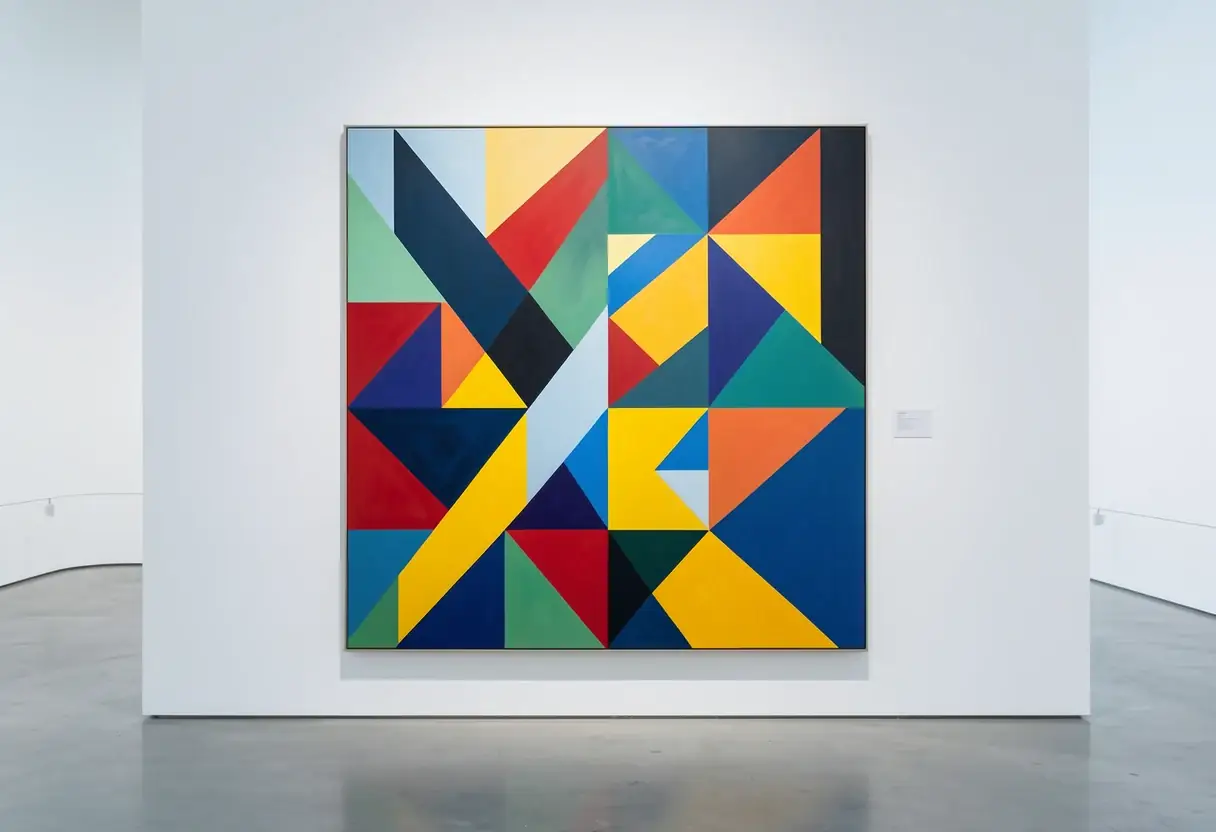
Christie's New York will offer Kandinsky's 'Betonte Ecken' (1922–23) on November 17 with a $60–80 million estimate, guaranteed to set a new artist record.
Programme
- Christie's New York offers Kandinsky's 'Betonte Ecken' (1922–23) on November 17, estimate $60–80 million.
- The painting is guaranteed to sell above the artist's current $44.8 million auction record set at Sotheby's London in 2023.
- The work was held in the Guggenheim's collection until 1964; the seller bought it at Sotheby's in 1986.
- Kandinsky's top 14 auction results all exceed $20 million; 10 were set in the past decade.
- Paige Kestenman, co-head of Christie's 20th-century evening sale, called the Bauhaus canvas a 'masterwork'.
Christie's New York will offer Wassily Kandinsky's Betonte Ecken (1922–23) on November 17, carrying an estimate of $60 million to $80 million. The auction house told ARTnews the painting is guaranteed to sell at a record-setting level. The current anonymous seller bought it at Sotheby's New York in 1986.
The estimate towers over Kandinsky's existing auction record of $44.8 million. That mark was set in 2023 at Sotheby's London, for the 1910 painting Murnau mit Kirche II (Murnau with Church II). Even at the low end of the new estimate, Betonte Ecken would beat the record by roughly a third.
How hot is the Kandinsky market?
The market has been climbing fast. Christie's London sold the 1907 canvas Das bunte Leben (La vie mélangée) just last month for $41.5 million against a $30 million estimate — the third-highest price for the artist. That work had recently been restituted to the heirs of a Jewish Dutch collector family whose art was lost during the Nazi era.
The numbers show sustained demand:
- All of Kandinsky's top 14 auction results exceed $20 million.
- Ten of those prices were set in the past decade.
In plain terms: the top of the Kandinsky market has doubled its pace of record-setting in ten years.
What is the painting, and where has it been?
The canvas measures just over four feet square. Its title translates as Accentuated Corners, and Kandinsky painted it in Weimar, Germany, while teaching at the Bauhaus.
Christie's provenance traces nearly a century of ownership:
- First at auction in 1926 at the Jacob Hecht Auction House in Berlin, from the Schwarz collection.
- Sold to Berlin's Galerie Nierendorf, which passed it — probably in 1929 — to Hilla Rebay, adviser to Solomon R. Guggenheim and an early champion of abstract art in the US.
- Acquired by Guggenheim, and held in the museum's collection until 1964.
- Sold at Sotheby's London to New York dealer Stephen Hahn.
- Later owned by Boston collectors Sandra and David Bakalar, who consigned it to Sotheby's in 1986, when the present owner bought it.
Sotheby's did not immediately respond to ARTnews's inquiry about the prices the work fetched in its two earlier trips to the block.
Why music matters to this sale
Music drove Kandinsky's entire trajectory. He abandoned a career in law and economics for art after attending Richard Wagner's opera Lohengrin at Moscow's Bolshoi Theatre in 1896, at age 30.
"In spirit I saw all my colors—they stood in front of my mind's eye," he later said, per the New York Times. "Wild, almost mad lines appeared before me. It became quite clear to me that painting could develop the same powers that music possessed."
That experience anchors the current exhibition "Kandinsky: La musique des couleurs" at the Philharmonie de Paris.
Paige Kestenman, co-head of Christie's 20th-century art evening sale, framed the work in press materials. "In this masterwork, Kandinsky realizes Wagner's notion of the Gesamtkunstwerk, synthesizing his creativity into a singular, unifying artistic experience," Kestenman said. "This painting not only represents new heights in Kandinsky's own artistic progression, but also a key moment in the development of abstraction that would influence leading postwar artists and generations to come."
From Moscow to the Bauhaus and beyond
Born in Moscow in 1866, Kandinsky published On the Spiritual in Art in 1911 and joined the influential Blaue Reiter group. His first solo exhibition came at Der Sturm gallery in Berlin in 1912, and one of his works appeared in the groundbreaking 1913 Armory Show in New York.
He lived in Russia from 1914 to 1921, mainly in Moscow, holding a position at the People's Commissariat of Education, before moving to Weimar in 1922. The Société Anonyme — founded in 1920 by Marcel Duchamp, Katherine Dreier, and Man Ray — organized his first New York solo show in 1923.
Kandinsky became a German citizen in 1928. He relocated to France when the Nazi government closed the Bauhaus in 1933, and took French citizenship in 1939. The Nazis seized dozens of his works in the campaign against "degenerate art." He died in France in December 1944, three days short of his 78th birthday and six months before Germany's surrender.
On November 17, a painting the Guggenheim deaccessioned six decades ago will test whether the Kandinsky market can nearly double its all-time high.
Original: nytimes.com
More from Elena Vasquez
Show full bio
Senior reporter covering technology and product news in arts in the broadest sense at Arts & Voices.
709 articles