Alice Diop Turns Place d'Iéna Into a Path Toward Healing for Miu Miu
Alice Diop's Miu Miu commission 'Geste de Consolation' turns Paris's Place d'Iéna into a path from colonial archives to care, film to Simone Leigh sculpture.
Programme
- Alice Diop's 'Geste de Consolation' transforms the Place d'Iéna during Art Basel Paris for Miu Miu's annual public commission, running a few days this week.
- Nadia Beugré's 'Prophétique' is a 40-minute durational performance with two of six performers reading texts in call and response.
- The path ends at Simone Leigh's 2020–21 sculpture 'Sentinel (Mami Wata)' and opens with Zanele Muholi's 2015 photograph 'Bona, Charlottesville, Virginia'.
- Diop's next feature film adapts Michel Leiris's 'Phantom Africa'.
Filmmaker Alice Diop has transformed the Place d'Iéna into a large-scale installation, Geste de Consolation (Gesture of Consolation), for this year's Miu Miu commission during Art Basel Paris. It runs for a few days this week.
The visitor's path opens with Zanele Muholi's Bona, Charlottesville, Virginia (2015) from the "Somnyama Ngonyama (Hail the Dark Lioness)" series. The black-and-white photograph shows the artist looking at themself in a mirror, the face visible only through its reflection. Beyond it sits Diop's new film, [Sans titres], which begins with excerpts from ethnographic films of African women, depicted as the other, and ends with shots of empowered Black women.
What can visitors actually do there?
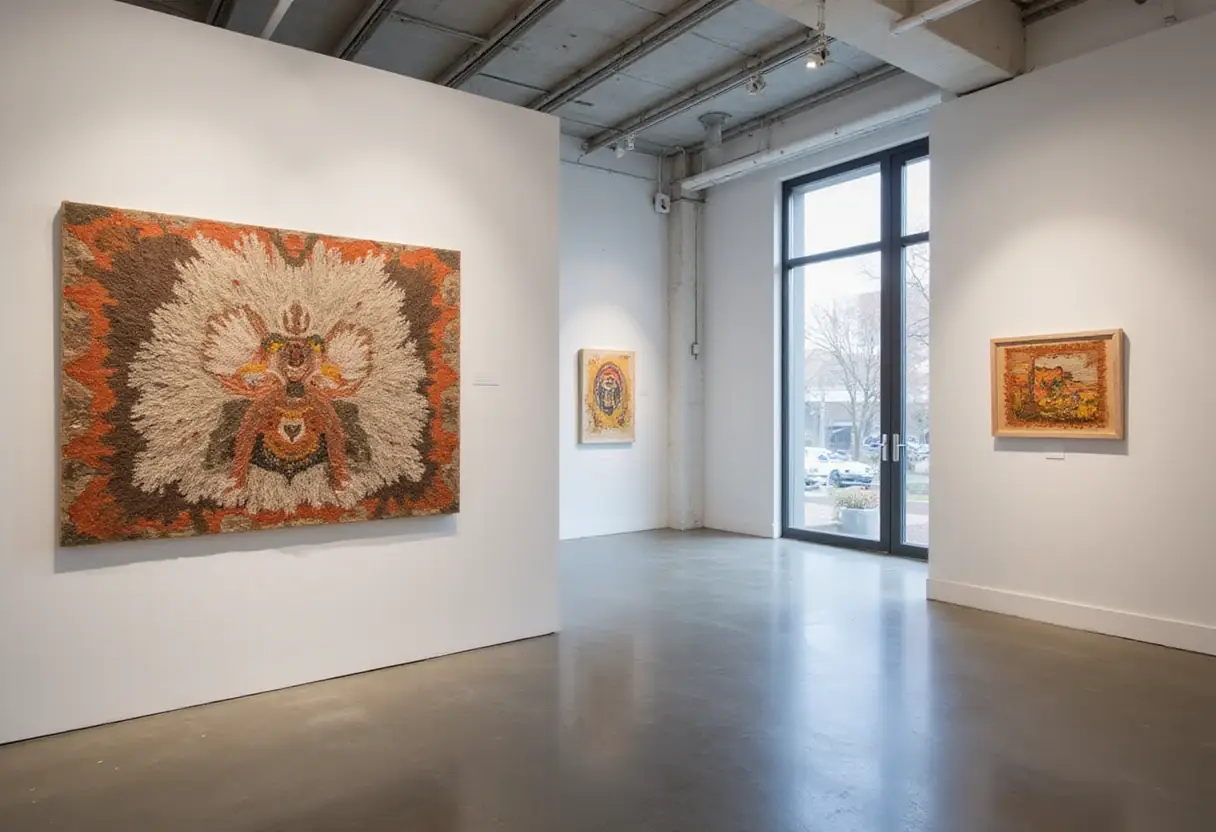
Next comes "Chambre à soi" (Living Room and Library), modeled on Diop's own office, with rugs inspired by the visual motifs of Gee's Bend quilter Mary Lee Bendolph. Diop calls it "a living room for a thinking Black woman—a space of pause, learning and encounter. Libraries have long been quietly radical spaces of Black political imagination." Visitors can read books by Christina Sharpe, Virginia Woolf and Jean Genet, and browse monographs on Otobong Nkanga, Deana Lawson, Henry Taylor, Chantal Akerman, Mona Hatoum, Jacqueline de Jong and Marcel Duchamp.
Between the library and Simone Leigh's towering 2020–21 sculpture Sentinel (Mami Wata), which concludes the journey, a performance space alternates between an embodied performance by Angel Bat Dawid and the Sistazz of the Nitty Gritty and Nadia Beugré's Prophétique, a 40-minute durational piece. Two performers from a group of six read excerpts from foundational texts for Diop and Beugré in call and response — words by Saidiya Hartman, Gayl Jones, Lucille Clifton, June Jordan and Toni Morrison.
How did the Miu Miu invitation come about?
Diop told ARTnews, speaking through a translator, that she had no relationship with Miuccia Prada before Verde Visconti invited her to propose a project for the "Women's Tales" series, which became Fragments for Venus. She met Prada when the film screened in Venice.
"A few months ago, she offered me—to my great surprise—to be the invited artist for the public commission that Miu Miu has done for the last years during Art Basel Paris," Diop said. "I was stunned, but I decided to trust the intuition of this woman whom I greatly admire."
She sees the project as "a prolongation, a culmination, and perhaps the end" of her research into the representation of Black women in art history.
Where do the archival images come from?
Diop studied anthropology and history at university before turning to cinema. A film archivist she hired found the opening images from French, German and Italian anthropological expeditions, in preparation for her next feature: an adaptation of Michel Leiris's Phantom Africa. The excerpts span Albert Kahn's Archives of the Planet, early Lumière films, private archives and 1930s films like Voyage au Congo.
"The way these images show and stage Black women tells me how I've been constructed and reveal how I became a filmmaker, to a large degree, to clean and heal myself," she said.
The closing "images of consolation" include Ousmane Sembène's La Noire de… (1966), Sarah Maldoror's Sambizanga (1972), Rosine Mbakam's Les prières de Delphine (2021), a Chris Marker film and Pedro Costa's Vitalina Varela (2019). All show Black women "with respect and dignity."
Why is there music throughout the film?
For the first time, Diop worked with a composer: Angel Bat Dawid and Naima Nefertari, whose album Journey to Nabta Playa haunted the writing of her next feature. The two musicians watched the archival images with Diop, cried, and composed live to them — "like a live film concert." Diop then edited the music to the image with minimal cuts.
"It made me realize that this was actually the only voiceover possible, and it was the only way to confront viewers with these images," she said.
Of the architecture, she described a deliberate trajectory: Muholi's photo as the desired point of view, the video as the space of violence, and the performance space where "these women just come out of the frame and are totally themselves." With a Leiris adaptation still ahead, Diop's research on the Black woman's image appears to close here — on her own terms.
Source: ARTnews
More from Daniel Okafor
Show full bio
News editor covering companies, deals and strategy in arts in the broadest sense at Arts & Voices.
678 articles