Art Basel Miami Beach Cuts to 272 Exhibitors and Redraws Its Floor Plan
The 2026 fair, running December 4–6, shrinks its Galleries section by 10 percent, drops Meridians and redistributes blue-chip dealers across a reworked convention-center floor.
Programme
- Art Basel Miami Beach 2026 runs December 4–6, with VIP preview days December 2–3, and names 272 exhibitors, down from 285 last year.
- The Galleries section shrinks from 227 to 204 exhibitors; the Meridians section is eliminated and the fair occupies roughly 12 percent less floor space.
- Hauser & Wirth, David Zwirner, Lisson Gallery, Sprüth Magers, David Kordansky and Mendes Wood DM will relocate from Plaza A to Plaza B; Zero 10 returns with 22 projects curated by Karen Archey.
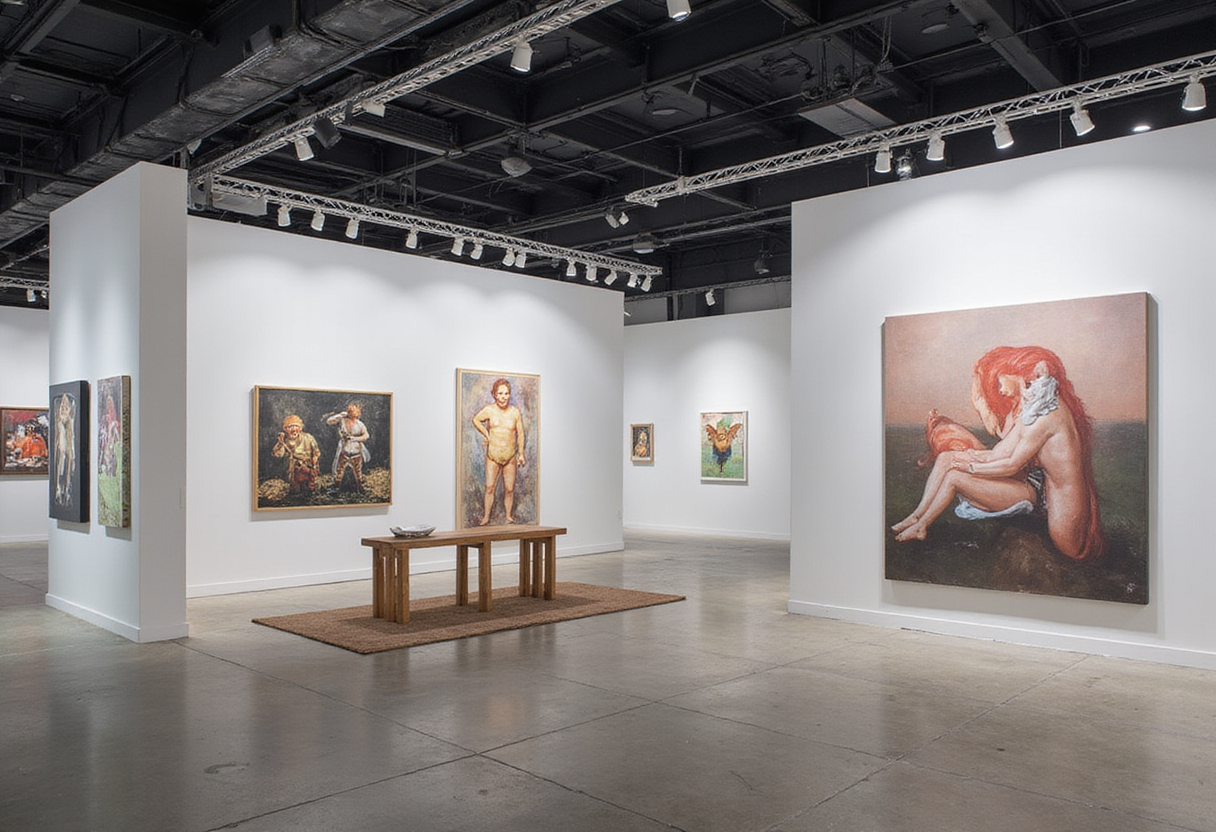
Art Basel Miami Beach has named 272 exhibitors for its 2026 edition, running December 4–6 with VIP preview days on December 2–3. The 24th edition of the fair will feature a completely revamped floor plan, fewer exhibitors and the elimination of the Meridians section for large-scale works.
"It's important for the show, now in its 24th year, to stay evolving, to stay dynamic, and to keep these conversations building, between galleries and clients who are very familiar with the show, but also to build them for people who are just now finding their way to Art Basel Miami Beach," fair director Bridget Finn told ARTnews in an interview.
The numbers are shrinking across the board. Last year's exhibitor list counted 285 galleries. Without the Zero 10 initiative, the 2026 fair has 250 galleries with booths on the main floor. The core Galleries section drops to 204 exhibitors from 227 — roughly 10 percent fewer. Nova and Positions each lose four exhibitors, while Survey goes from 18 presentations to 16.
"This reduction is more about refinement than contraction," Finn said, noting that the fair could have sold more booths if it wanted to. "A long-running ambition of the committee is to streamline, reduce, move forward" so that the fair can "provide the best structure for the galleries that do the show, to improve the pacing of the VIP experience, and to introduce a fair that feels high quality and evolving."
She rejected the notion that the changes respond to the art market's downturn. "The market correction over the last few years has caused some reactionary planning across the board. We are not working that way. We are thinking in advance of what the need is and how to provide a better experience for galleries and their businesses. That has been the critical driver this year."
A smaller, more legible floor
The fair will occupy around 12 percent less floor space in the Miami Beach Convention Center. Finn described the redesign as the product of "a longstanding conversation" with the selection committee — seven dealers, since she joined the fair three years ago — and of exhibitor feedback. The reconfigured plan brings seven galleries back to the Galleries section, among them Pilar Corrias, DC Moore Gallery, Alison Jacques, Edward Tyler Nahem and Mariane Ibrahim.
The 2025 floor plan had five plazas; 2026 will have four, enlarged and rotated "to a configuration that is more architecturally in line with the building," Finn said. Realigned plaza entrances will now feed four aisles instead of two, "allowing for people to move in a bit more of a dispersed way." She called the result "a more symmetrical and balanced show floor" — one designed to solve a chronic complaint. "The worst thing you can hear, and dealers say it all the time: 'My client couldn't find me,'" she said. "So, we're trying to address that in a way that is not reactionary, but thinks through the experience, reducing distractions and providing a very sharp, tailored experience."
The plan also redistributes blue-chip galleries to push collectors across more of the fair. Hauser & Wirth, David Zwirner, Lisson Gallery, Sprüth Magers, David Kordansky and Mendes Wood DM will relocate from Plaza A in the northeast corner to Plaza B in the southeast, joined by Stuart Shave Modern Art, which last participated in ABMB in 2018. 303 Gallery, Casey Kaplan, neugerriemschneider and Lehmann Maupin will move from Plaza B to Plaza C in the southwest. Other blue-chip galleries will stay put to "continue to hold the space, build their clients, and maintain the relationships with the galleries around them," Finn said.
The fair's back room, closest to Washington Avenue and the beach, will now house the three focused sections: Nova, for work made in the past three years; Positions, solo presentations by emerging artists; and Survey, for historical material. The majority of the more than 30 galleries making their ABMB debuts will appear in those sections, though Arario Gallery of Seoul and Galería Casado Santapau of Madrid will debut directly in the Galleries section.
Meridians, the sector for large-scale works, is gone. Finn noted that average booth sizes in Miami Beach already exceed what the venues in Basel, Hong Kong, Paris and Doha can accommodate. "We have space within the convention center for galleries to bring those kinds of works to their booth," she said. Zero 10, which shared the south end of the convention center with Meridians last year, will now occupy that space alone, with 22 projects curated by Karen Archey, head of the curatorial department at Kunstsammlung Nordrhein-Westfalen in Düsseldorf.
Beyond the convention center, the fair will unveil a new outdoor work by James Turrell with the Turrell Art Foundation, supported by Pace Gallery. In Collins Park, across from the fair, the Public Art Fund will present artist-designed ping pong tables under the banner "Between Tides," featuring Moko Fukuyama, Ilana Harris-Babou, Las Hermanas Iglesias, Carlos H. Matos, Amalia Pica and SUPERFLEX.
The move follows a broader trend: Frieze London reworked its own floor plan beginning in 2024, placing blue-chip exhibitors at the back of the tent so collectors would pass emerging and midsize galleries en route. "I commend Frieze for that change," Finn said. "Mid-career galleries are the lifeblood of our show. … How do we, as fair builders, support them in what they're doing — making sales and reaching their clients — and optimize visibility for them and their artists? Everything we've done with the show this year is working to do that."
Source: ARTnews
More from Tom Whitfield
Show full bio
Market editor covering industry trends and analytics at Arts & Voices.
204 articles