At Gwangju, Ho Tzu Nyen Cuts the Biennale Down and Widens Politics
China withdrew from the 2026 Gwangju Biennale after a Taiwan title dispute. Inside, Ho Tzu Nyen’s 43-artist show reframes politics as personal — and the smallest edition since 1995.
Programme
- China officially withdrew from the 2026 Gwangju Biennale after organizers restored Taiwan’s name to its pavilion title, citing a violation of the “one-China” policy.
- “You Must Change Your Life,” curated by Ho Tzu Nyen with Che Kyongfa, Gahee Park, and Brian Kuan Wood, runs through November 15 with 43 artists — the smallest edition since 1995.
- Foundation president Youn Bummo called the edition “regrettable and embarrassing” and said it is “about time to revamp the whole pavilion system going forward.”
China has officially withdrawn from the 2026 Gwangju Biennale, and the exhibition’s president, Youn Bummo, has publicly apologized for the diplomatic crisis that preceded its opening. The rupture began when Taiwan accused organizers of “political censorship” after Taiwan’s identity was scrubbed from its exhibition title. Taiwan’s cultural and foreign affairs ministries intervened. The Biennale restored the name. China, citing a violation of its “one-China” policy, halted its own installation and pulled out of the show.
At the opening-day press conference, speaking through an interpreter, Youn attempted to defuse the situation. “Art is art; politics is politics,” he said, asking media and viewers to separate the two. The statement rang hollow in Gwangju — a city whose Biennale commemorates the brutally suppressed 1980 Gwangju Uprising, arguably the most political site for a contemporary art biennial anywhere.
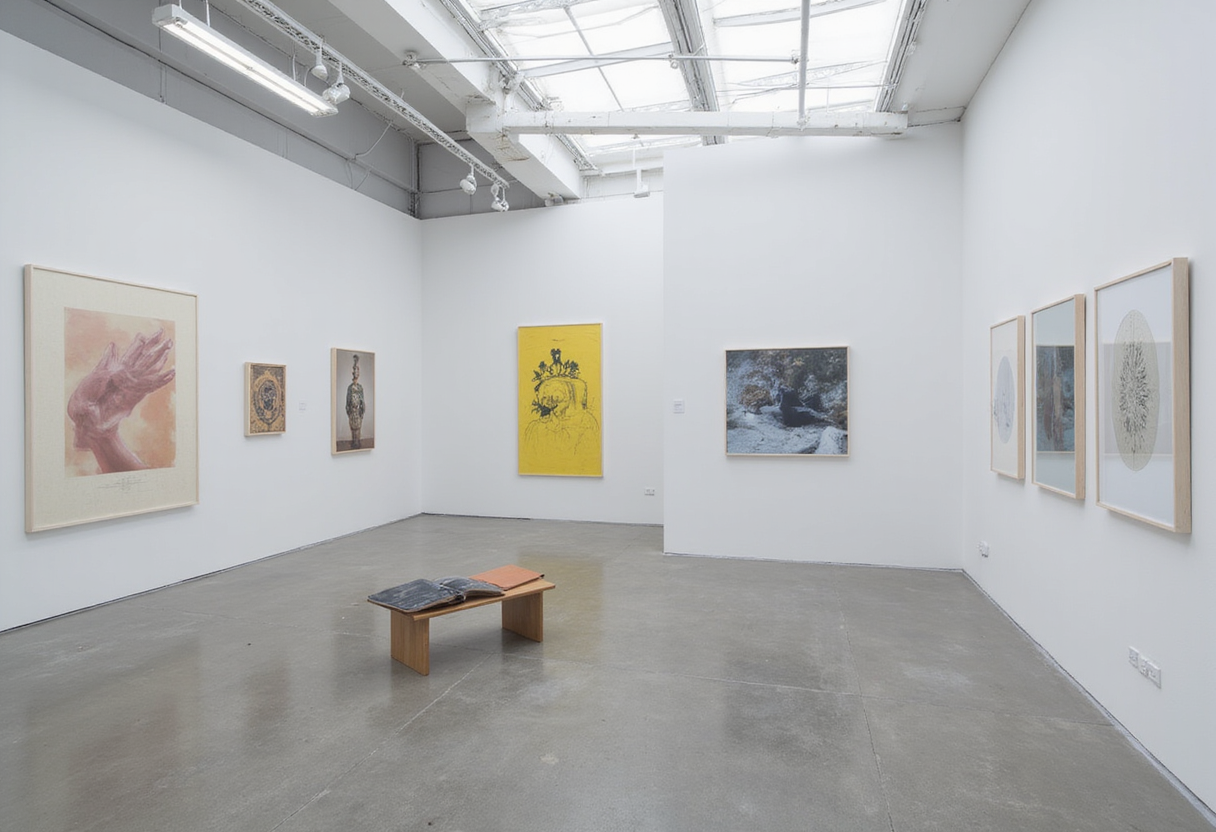
The main exhibition itself refuses that separation. Curated by the artist Ho Tzu Nyen, with Che Kyongfa, Gahee Park, and Brian Kuan Wood, “You Must Change Your Life” runs through November 15. It treats politics not as governments, nationalism, and geopolitics, but as something mundane and personal — lodged in families, relationships, bodies, and memories.
The title comes from the final line of Rainer Maria Rilke’s poem “Archaic Torso of Apollo” (1908), a text Ho has engaged with for years. His boldest move is structural: just 43 artists and collectives, the smallest number since the Biennale’s founding in 1995. Ho calls this a challenge to what he described as the “inflationary expansionist model of the biennale.”
“Biennales were getting bigger, spreading onto more and more sites,” Ho told ARTnews of his third-ever curatorial project. “It pushes the limited resources. All of these add up to this unsustainability of attention from the audience and the local management team, and it also makes artists’ processes unsustainable.”
The leaner format lets Ho use the Biennale “to showcase the practices of artists, rather than just a single artwork,” he said. Tokyo-based Japanese artist Sasaki Ken, for instance, shows 60 meticulously rendered paintings of mundane objects across multiple galleries — a sustained interrogation, per the wall text, of yōga (Western-style painting). “Stretching this timeline and seeing and sensing the developments of their artistic practices and also their life trajectories were very interesting for me,” Ho said.
Spanning five galleries, the exhibition unfolds as a guided journey through five connected terrains, with recurring artists as guides — a structure Ho likens to Virgil’s role in the Divine Comedy. Sasaki is joined by Swedish-born, Berlin-based artist Nina Canell’s experimental material installations, and even by Jeju Island’s volcanic rocks; the volcanoes of Jeju and their caretakers at Jeju Stone Park are listed as participating artists.
The first section, “Molecules and Me,” greets visitors with Rilke’s poem on a transparent panel, followed by Goldin+Senneby’s Resin Pond (2006), an amber expanse built from two tons of pine resin. “Bonds and Bodies” meditates on family and its imprint on the body; visitors can play ping pong against themselves in one of a series of mirrored tables by the late Slovakian artist Julius Koller.
“Landscapes and Learning” widens the frame with a new commission, Bullim (Augmentation), by Korean sound and performance artist Kwon Byungjun and Seoul-based media artist Park Chan-kyong. Inspired by soegeollip — a traditional Korean shamanic ritual in which a rookie shaman gathers scrap metal house to house — the artists collected donated metal objects from residents across Gwangju and South Jeolla province, melted them down, and crafted instruments and acoustic devices. They performed the resulting sound installation live at the opening ceremony.
“Cosmos and Change,” a dimly lit gallery, frames change as an ever-present force moving through an ordered universe, with monumental video projections by Wang Tuo and LuYang of China (both remained in the main exhibition despite their country’s pavilion withdrawal), Sohrab Hura of India, Saodat Ismailova of Uzbekistan, and Rotterdam-based Melvin Moti, encircling sculptural Jeju volcanic rocks. The final gallery, “Air and Articulations,” returns the journey to earth: Jacqueline Kiyomi Gork’s 2026 labyrinthine inflatable installation and multi-channel techno composition, Not Exactly BPM (Variation Rrose), fills the entire space with breathing, air-loaded forms.
Several works quietly redefine what politics means. Singaporean artist Amanda Heng — who represents her country at this year’s Venice Biennale — presents Another Woman in Gwangju 1996, 2014, 2023 (2026), photographs tracing her relationship with her mother across nearly three decades; the final images were taken just before her mother’s death. Nearby hang 322 paintings by members of the May Mothers House, a shared residence founded in 2006 for women who lived through the Gwangju Uprising. Since 2022, art workshops there have helped the mothers revisit memories of joy and upheaval — not political statements but a collective negotiation of memory decades after one of South Korea’s most traumatic events.
James T. Hong’s Apologies (2012–), 11 hours of compiled footage of political leaders’ public apologies, appears in “Landscapes and Learning” and is projected onto the Biennale building’s facade every evening. The work is less about past mistakes than about what collective memory of public apology says about present-day politics.
Youn, echoing the politicians in Hong’s work, issued his own formal apology, calling this year’s edition “regrettable and embarrassing.” The Foundation introduced national pavilions three years ago, aiming to build Asia’s answer to Venice; roughly 50 institutions applied to participate. That ambition has proved more than Gwangju could handle, and one political row now has the Foundation weighing whether to separate the two programs.
“It’s about time to revamp the whole pavilion system going forward,” Youn said. Whether the Biennale can reinvent that structure without repeating this year’s geopolitics will define its next chapter.
Original: nam02.safelinks.protection.outlook.com
More from Daniel Okafor
Show full bio
News editor covering consumer brands and retail at Arts & Voices.
172 articles