Atonement Review: Reed Van Dyk's Iraq War Debut Loses Its Nerve
Reed Van Dyk's TIFF drama adapts Dexter Filkins' New Yorker story of a 2003 Baghdad shooting, earning respect for its sincerity but frustrating with its restraint.
Programme
- Reed Van Dyk's feature-directing debut 'Atonement' screened at the 2026 Toronto International Film Festival and opens October 2 through Kino Lorber.
- The film adapts Dexter Filkins' 2012 New Yorker article 'Atonement After Iraq' about soldier Lu Lobello and the Kachadoorian family, three of whom were killed in a 2003 Baghdad shooting.
- The cast includes Boyd Holbrook, Hiam Abbass, Gheed, and Kenneth Branagh; the film is structured in three chapters told from separate perspectives.
Reed Van Dyk's feature-directing debut "Atonement," which screened at the 2026 Toronto International Film Festival and opens in theaters on October 2 through Kino Lorber, adapts one of the most charged true stories of the Iraq War — and only half succeeds in telling it.
The film draws on Dexter Filkins' 2012 New Yorker article "Atonement After Iraq," which chronicled the Kachadoorian family and Lu Lobello, one of the American soldiers responsible for their loss. During a firefight at a Baghdad intersection in 2003, the Kachadoorians drove through on their way home around the corner. Lobello and his platoon mistook them for insurgents and opened fire, killing three family members. Years later, a guilt-ridden Lobello contacted Filkins — who had reported on the incident for the New York Times — with a single request: help broker a meeting with the surviving family members, who had relocated to America, in the hope of easing his pain.
Van Dyk takes on this material with visible ambition, and his first act delivers a harrowing, refreshing alternative to traditional portrayals of the Iraq War. The film changes the names of its real-life counterparts, opening with the Khatchaturian family hiding out at relatives' home in Baghdad in 2003, filmed as a naturalistic drama. Relatives watch TV, bicker, and go about daily life in a neighborhood that looks like an actual community rather than a pending target for destruction. After decades of media portraying the Middle East through the lens of American occupation, Van Dyk captures people whose lives exist outside that lens — a fact worth celebrating on its own, and one that rings depressing in a larger context.
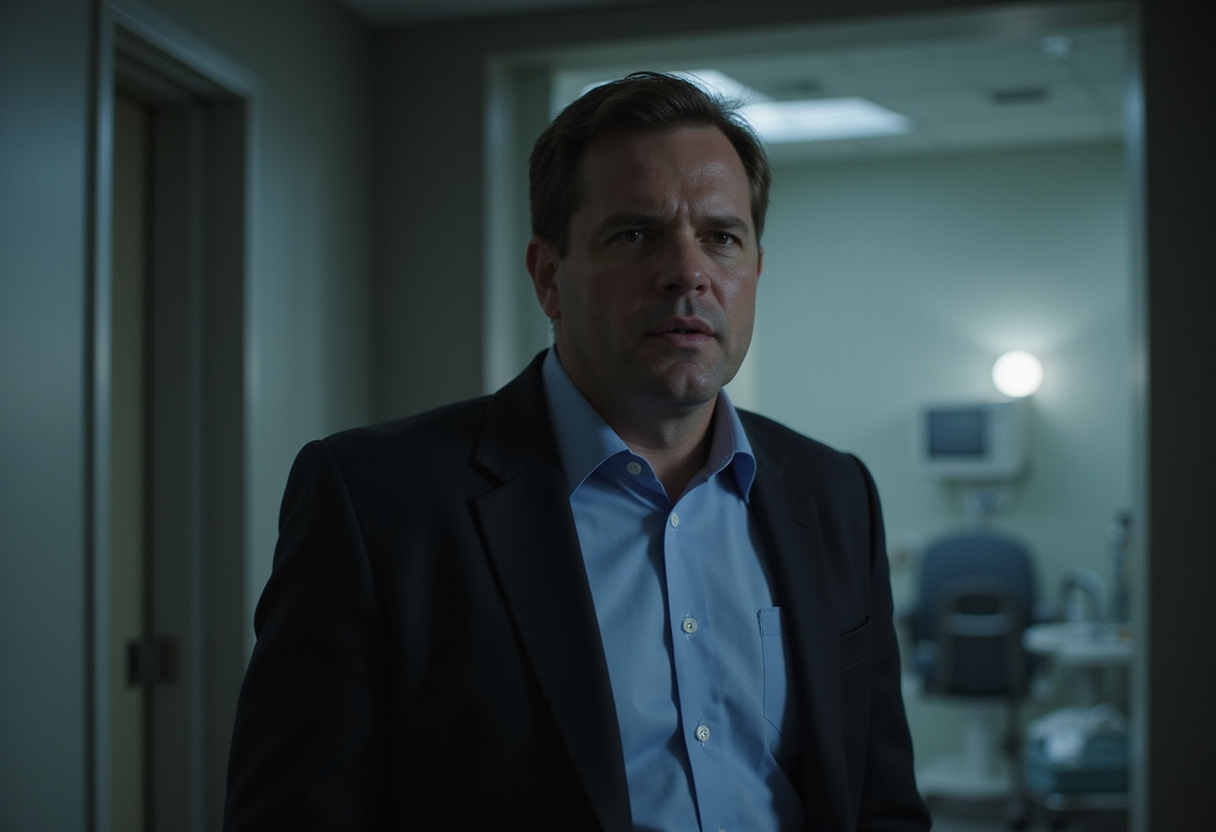
A nearby explosion sets off the chain of events that leads the family to the intersection — and into the crosshairs of Lou, played by Boyd Holbrook, who swiftly kills the husband and two sons of Mariam (Hiam Abbass) and injures her daughter Nora (Gheed). Van Dyk and cinematographer Jon Peters introduce Lou through chaotic, impressive combat scenes that place the viewer inside the heightened, paranoid perspective of the soldiers who shot the family's approaching vehicles. The tension builds until the incident itself; in its immediate aftermath, the film brings in journalist Michael (Kenneth Branagh) to follow his reporting.
"Atonement" then jumps over a decade and splits into three chapters, each focused on a single character. Lou, now a law student in San Diego, suffers from PTSD and the drug addiction that got him dishonorably discharged. When one of his former platoon members shares Michael's article before committing suicide, Lou reaches out to the journalist. The film then shifts to Michael's efforts to locate the surviving Khatchaturians before a final chapter centers on Mariam, now living in California with Nora.
"The bullet moves both ways," a character says at one point, and the film's shifting structure reflects that line's perspective shift on war. But Van Dyk never quite threads the needle in his look at the aftermath and attempted reconciliation. The deliberately fractured narrative intends for Mariam's section to put the pieces back together once everyone shares the same room, yet there are too many gaps to make it cohere.
The film remains conscientious in identifying both sides as victims of greater geopolitical forces, but its focus on Lou never quite escapes the uncomfortable feeling of a shoot-and-cry narrative — especially when it withholds Mariam's point of view for extra dramatic effect. The machinations are obvious and a touch too delicate for such a thorny topic, an inherent flaw of placing this subject within the confines of a feature-length narrative. The questions of whether any world exists in which these people could find peace with each other are present, but "Atonement" is too content to serve as little more than a prompt for them.
That restraint holds the film back from digging deeper into how people find some form of peace after living through the horrors of war. Yet, for a depiction of something so charged, there are worse pitfalls than not doing enough. Like his Oscar-nominated short "DeKalb Elementary," the new film presents Van Dyk as a promising filmmaker capable of thoughtful approaches to sensitive subjects. Something as messy and irreconcilable as what these characters face, however, seems underserved by the very deliberateness of that thoughtful attitude — a tension Van Dyk will need to resolve if his next work is to match the scale of his ambitions.
Original: newyorker.com
More from Daniel Okafor
Show full bio
News editor covering consumer brands and retail at Arts & Voices.
271 articles