Breth's Minimalist 'Turandot' Saves a Loud, Unbalanced Night in Frankfurt
Oper Frankfurt's 'Turandot' (Aug 22–Oct 3) paired an excessive orchestra and weak leads with Andrea Breth's minimalist, violence-soaked staging — and the staging won.
Programme
- Oper Frankfurt presented Puccini's 'Turandot' from August 22 to October 3.
- The production was directed by Andrea Breth and conducted by Simone Di Felice.
- The orchestra's excessive volume forced tenor Alfred Kim's Calaf to strain his voice.
- The Ping, Pang, Pong trio — Liviu Holender, Sven Hjörleifsson and Andrés Agudelo — gave the standout vocal performance.
- Set design by Breth, Hans Walter Richter and Johannes Leiacker used minimalist black-and-white staging.
Oper Frankfurt ran Puccini's "Turandot" from August 22 to October 3, in a production directed by Andrea Breth and conducted by Simone Di Felice — and the staging, not the singing, was the story of the night.
The musical side had problems from the start. The orchestra's volume was, in the reviewer's words, "so excessive" that it forced tenor Alfred Kim's Calaf to strain his voice. The sound leaned toward accents reminiscent of "Salome" and "Elektra" at the expense of Puccini's Verdi-inspired lyricism. A mezzo forte dynamic (a moderate volume marking), the review argued, would have served the score's modernity better.
The logic here is worth unpacking. Puccini, like Richard Strauss, never shook off Wagner's influence. After flirting with operetta territory in "La Rondine," he pushed "Turandot" toward the avant-garde — the orchestral score has sharp edges. Yet the vocal writing keeps a very Verdi-esque legato (smooth, connected singing). Di Felice's orchestra highlighted the first half of that equation and buried the second.
Who sang well — and who didn't?
The cast was unbalanced, favoring the supporting roles over the leads.
- Erik van Heyningen (baritone) delivered a firm, slightly metallic Mandarin — his "Popolo di Pekino! La legge è questa" suggested what a fine Timur he might one day be.
- Thomas Faulkner (bass) charmed with a deep, fluid Timur, particularly in "Perduta la battaglia, vecchio re."
- Julia Stuart (soprano) brought freshness but lacked brilliance as Liù, through "Signore, ascolta!" and up to her suicide.
- Alfred Kim (tenor) was the disappointment. He "sang almost always in the same manner," failing to convey the victorious dreamer of "Nessun dorma."
- Elza van den Heever (soprano) gave Turandot a very dry recitative — fitting, the review noted, for a bloodthirsty princess.
The trio of Ping, Pang and Pong — baritone Liviu Holender and tenors Sven Hjörleifsson and Andrés Agudelo — stood out above all, in comic timing and vocally, blending opera and cabaret while staying harmonious, unified and distinct. The chorus never disappointed either; the crowd, a true character in the work as in "Simon Boccanegra" or "Don Carlos," came off strongly from the first act's "Muoia! Sì, muoia!"
What does the production actually do?
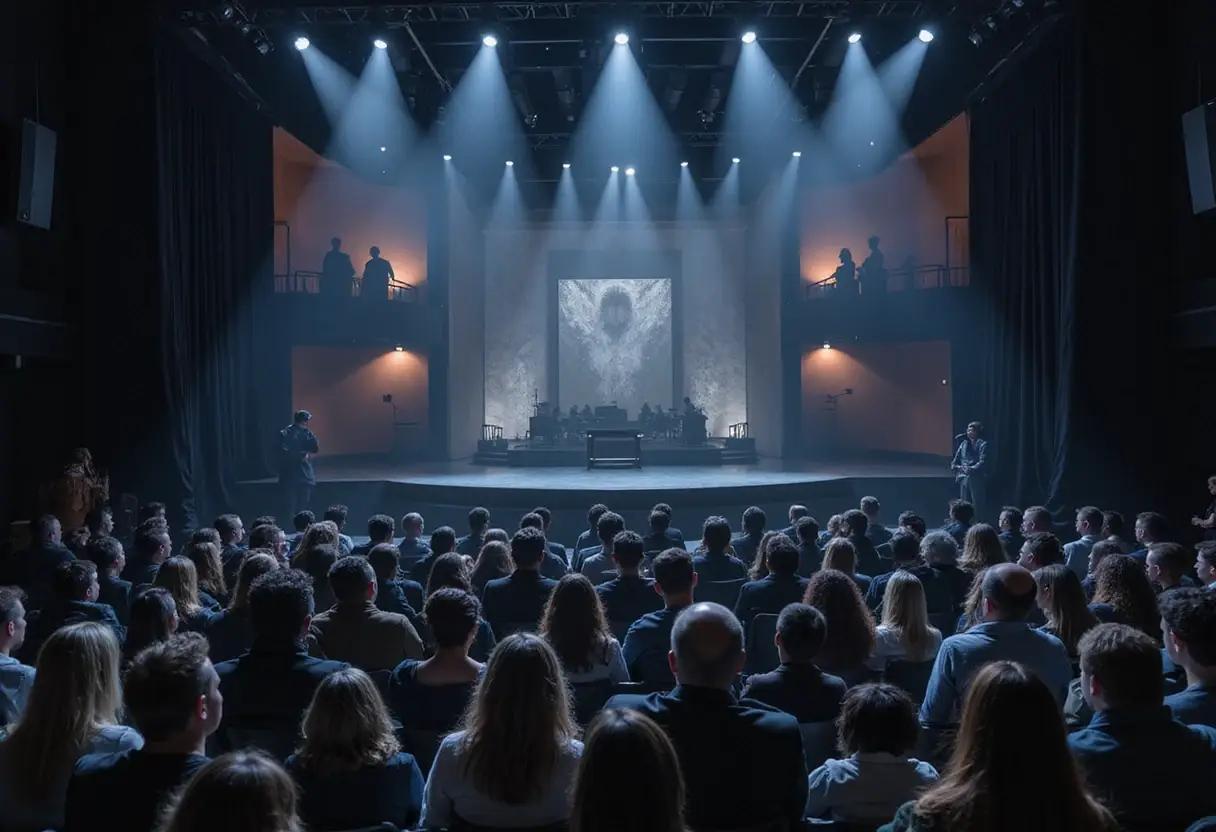
This is where the evening wins. The set design — a collaboration between Breth, her assistant Hans Walter Richter and set designer Johannes Leiacker — is minimalist in black and white. Props carry outsized weight: cages confining the crowd in Act One, a large gate at the back of the stage in the final act.
Ursula Renzenbrink's costumes stay simple and modern — a white dress and a white mask for Turandot, everyday clothing for Calaf — placing the cruel tale in an idealized contemporary setting. Though the libretto sets the drama in China, Breth's inspiration spans Asia: guards practice taekwondo, and the actors' highly codified movements recall Noh theater or Chinese ceremonies, especially in the riddle scenes.
Why violence is the key
Breth's reading rests on a clear insight: just as in the orchestral score, violence is, so to speak, everywhere in "Turandot" — and she has woven it throughout the production. The reviewer traces that trajectory in Puccini himself: after the grim world of "Il tabarro" and the psychological torment of "Suor Angelica," the composer kept shifting toward something cruel, brutal and cold.
His death cut the work short and, in the review's words, "robbed us of this new era that 'Turandot' promised." It is that promise, the review concludes, that this "very interesting production" brings to life — a reading that may well outlast the patchy singing it rode in on.
Source: Opera Wire
More from Grace Kim
Show full bio
Correspondent covering technology and product news in arts in the broadest sense at Arts & Voices.
662 articles