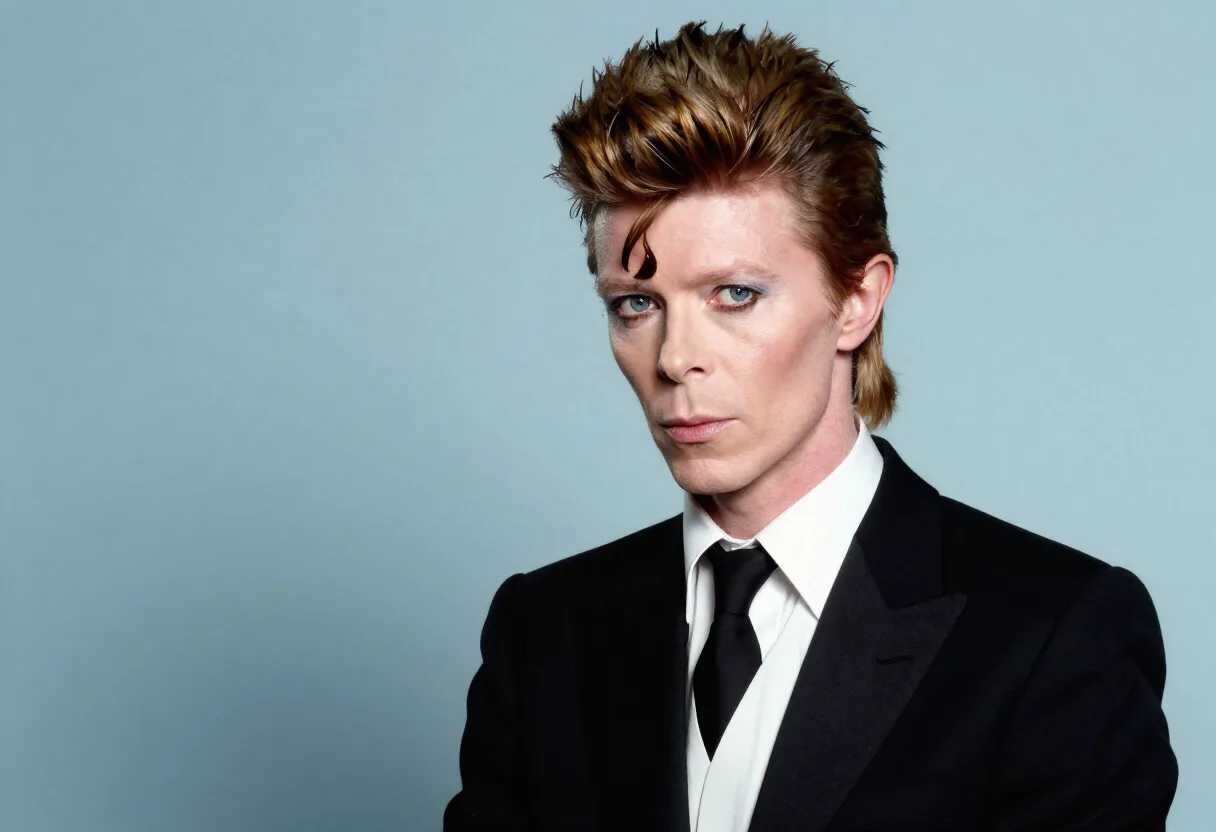
David Bowie at Home: New Photo Retrospective Traces the Houses Behind the Legend
A ten-photo retrospective maps David Bowie's homes from Bromley to Mustique — as the Heritage of London Trust plans to open his childhood house as a museum in 2027.
Programme
- The Heritage of London Trust plans to open Bowie's childhood Bromley home as a museum called Bowie's House in 2027.
- Bowie lived at Haddon Hall, 42 Southend Road, Beckenham, from late 1969 until fans forced the family out after Pin Ups reached number one in late 1973.
- Haddon Hall was demolished in the 1980s and replaced with an apartment block.
- Mercury Records refused the dress-wearing UK cover of The Man Who Sold the World (1970) for the US market.
- Bowie, born January 8, 1947, died of liver cancer in 2016.
A photographic retrospective published under the title "David Bowie at Home: 10 Photos of the Rock Legend Off-Duty" traces the singer's domestic life from his parents' Bromley house to a private island in Mustique — and arrives as one of those homes is heading for a second life as a museum.
The Heritage of London Trust's Proud Places program plans to turn Bowie's childhood residence in Bromley into a museum called Bowie's House by 2027. The trust's website frames the stakes plainly: "before there was a global superstar, there was a bedroom where a teenager listened to Little Richard records and felt the first shock of possibility."
That promise deserves scrutiny. The trust has announced a date and a name, but no opening details, funding figures or programming have been disclosed.
Where did Bowie actually live?
Born David Robert Jones on January 8, 1947, he grew up in London's Bromley borough, playing in the ruins of bombed-out buildings. In the summer of 1967, aged 20, he moved into the top floor of a Georgian terraced house belonging to his manager, Ken Pitt, because his parents' home had become too crowded.
"On Sunday, June 11, Mr. Jones drove David and his belongings up from Bromley," Pitt wrote in his book The Pitt Report. "After his father had gone, David said, 'Dad liked the flat. He said it's very masculine.'"
It was Pitt who suggested the name change from David Jones to avoid confusion with Davy Jones, who had risen to fame playing the Artful Dodger in Oliver! on the London stage before joining the Monkees.
What was Haddon Hall?
The centerpiece of the retrospective is Haddon Hall, the Victorian brick house at 42 Southend Road, Beckenham, where Bowie and Angie Barnett moved into the ground floor in late 1969. Biographer Paul Trynka called it "the epitome of crumbling magnificence" in Starman: David Bowie, describing a staircase "dominated by a magnificent Gothic stained-glass window."
Angie Bowie, in her memoir Backstage Passes, recalled "a huge stained-glass window" dominating the rear face and a central hallway "fully forty feet wide by sixty feet long."
The couple married in March 1970 and transformed the neglected house: silver sitting room, green living room, pink bedroom, a recording studio in the basement. Their son, Duncan Zowie Haywood Jones, was born on May 30, 1971. Biographer Peter Doggett, in The Man Who Sold the World, described the property as "a bohemian enclave shared with Angie, producer Tony Visconti, and assorted musicians, roadies, and associates."
What does the dress controversy reveal?
Bowie wore a dress for the Haddon Hall photo shoot that produced the UK cover of his 1970 album The Man Who Sold the World. In the United States, Mercury Records refused to release an album showing a man in a dress and substituted a photo of a cowboy. Asked by Melody Maker's Michael Watts in 1972 why he wasn't "wearing [his] girl's dress today," Bowie replied: "Oh dear. You must understand that it's not a woman's. It's a man's dress."
How did Haddon Hall end?
When Pin Ups hit number one in the UK in late 1973, fans camped outside Haddon Hall. After one broke in, the family fled — first to Maida Vale, later to Chelsea's Oakley Street. The decaying house was demolished in the 1980s and replaced with an apartment block.
Bowie moved to Los Angeles in April 1975, then Berlin in 1976. Reflecting at the Dorchester Hotel in 1977, aged 30, he told Allan Jones: "Towards the end of my stay in America, I realized that what I had to do was to experiment. To discover new forms of writing. To evolve, in fact, a new musical language. That's what I set out to do. That's why I returned to Europe."
He died of liver cancer in 2016, survived by his second wife, Iman, their daughter Alexandria, and a son — having lived his last decades between New York and Mustique, where he turned to interior design. Whether the 2027 Bromley museum can capture any of that restlessness is the question the trustees have four years to answer.
Original: bowieshouse.org
More from Tom Whitfield
Show full bio
Market editor covering people, launches and day-to-day practice in arts in the broadest sense at Arts & Voices.
759 articles