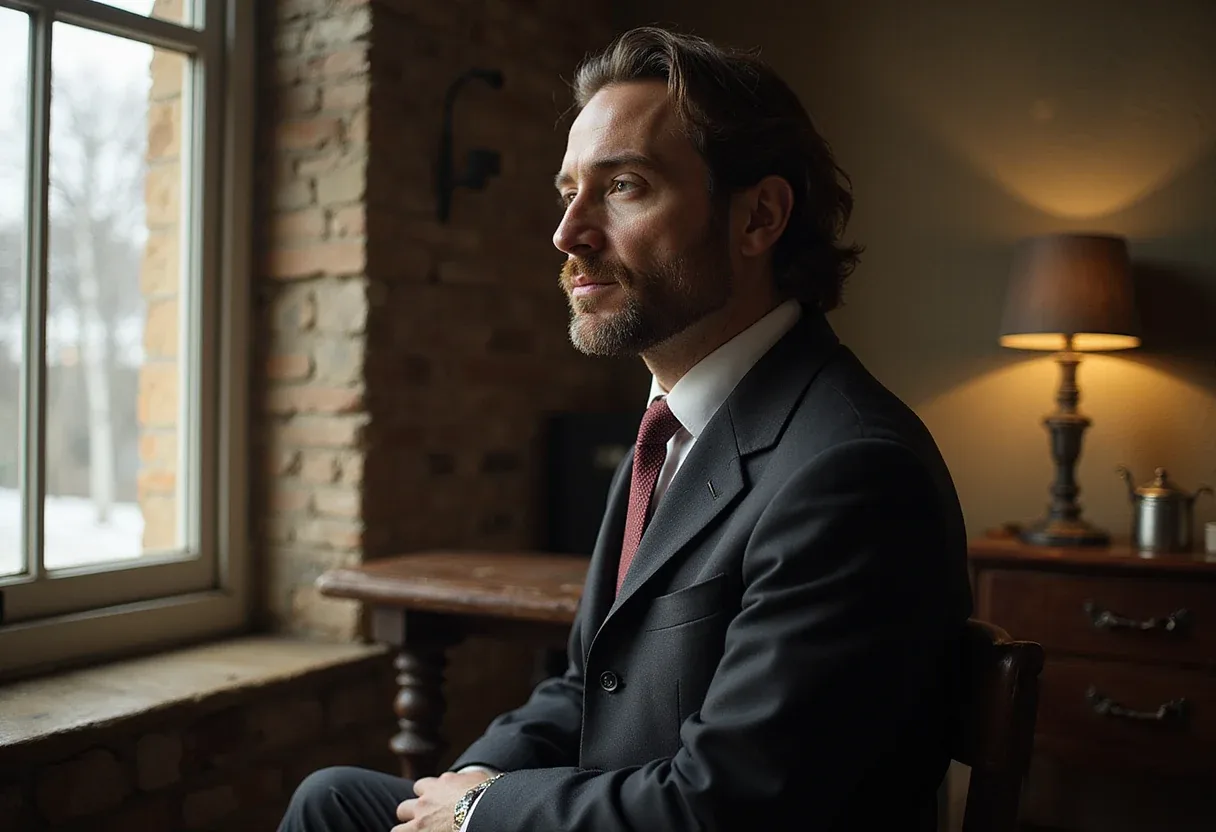
Douglas Dunn Dies at 83; Whitbread-Winning Poet of Elegies
Douglas Dunn, whose Whitbread-winning collection Elegies turned grief into exquisite poetry, has died aged 83. He published with Faber from 1969 onward, alongside Heaney and Hughes.

Programme
- Douglas Dunn has died aged 83.
- His collection Elegies won the Whitbread book of the year.
- Faber and Faber accepted his first book, Terry Street, in 1969.
- Dunn remained with Faber throughout his entire writing career.
- He cited Eliot, Pound, Auden, Larkin, Hughes, Gunn and Heaney as his Faber predecessors.
Douglas Dunn, the poet whose collection Elegies won the Whitbread book of the year, has died aged 83. His death closes a writing life spent almost entirely at a single publisher: Faber and Faber.
Dunn joined the firm in 1969, when it accepted his first book, Terry Street. He described his reaction to the acceptance with characteristic directness: Faber was "the publisher which issued Eliot, Pound, Auden, Larkin, Ted Hughes, Thom Gunn, and Seamus Heaney. When my copies arrived, I kissed them."
He stayed with Faber throughout his career. The firm, in turn, kept him.
Where did Dunn fit among the Faber poets?
The source places Dunn in the lineage of two great Faber generations. The first, led by T.S. Eliot, defined the list in the 1920s and 30s. The second — the successful quartet of Seamus Heaney, Ted Hughes, Philip Larkin and Thom Gunn — followed.
Dunn might have made that quartet a quintet. Two things set him apart, according to the obituary's account of his career: his leftwing political commitment and his adherence to rigorous prosody. Those qualities distanced him from Gunn's hedonism on one side and Heaney's likable populism on the other.
In plain terms: Dunn was a formalist with politics, occupying ground none of his more celebrated contemporaries claimed.
Why will Elegies remain his defining book?
Elegies, the collection that channelled grief into what the obituary calls exquisite poetry, took the Whitbread book of the year — the top prize in a scheme that recognised the year's best work across British publishing. For a single poetry collection to win the overall award placed Dunn in rare company.
The book's power came from its origin in personal loss. The obituary identifies grief as the raw material Dunn refined into his most celebrated verse.
The takeaway: Dunn's reputation rests on one collection that turned private mourning into formally disciplined public art.
What does his career tell us about poetic loyalty?
Dunn's relationship with Faber lasted from 1969 until his death — more than five decades with one house. In an industry where poets routinely move between publishers, that continuity stands out.
His debut, Terry Street, opened the partnership. His quotable joy at holding its first copies — kissing them — conveys the ambition he brought to a firm whose backlist included seven of the century's defining poets.
He never matched the celebrity of Heaney or Hughes. He chose instead a narrower path: strict form, left commitments, and a long fidelity to the publisher that first said yes.
Dunn's death at 83 leaves Faber's postwar generation one voice fewer — and leaves Elegies as the book by which readers will measure him.
Original: independent.co.uk
More from Elena Vasquez
Show full bio
Senior reporter covering technology and product news in arts in the broadest sense at Arts & Voices.
664 articles