East Coast Contemporary Ballet brings eight years to Fairfield
Claire Mazza and Alejandro Ulloa, partners in life and work, bring eight years of East Coast Contemporary Ballet to Fairfield University's Quick Center on November 7.
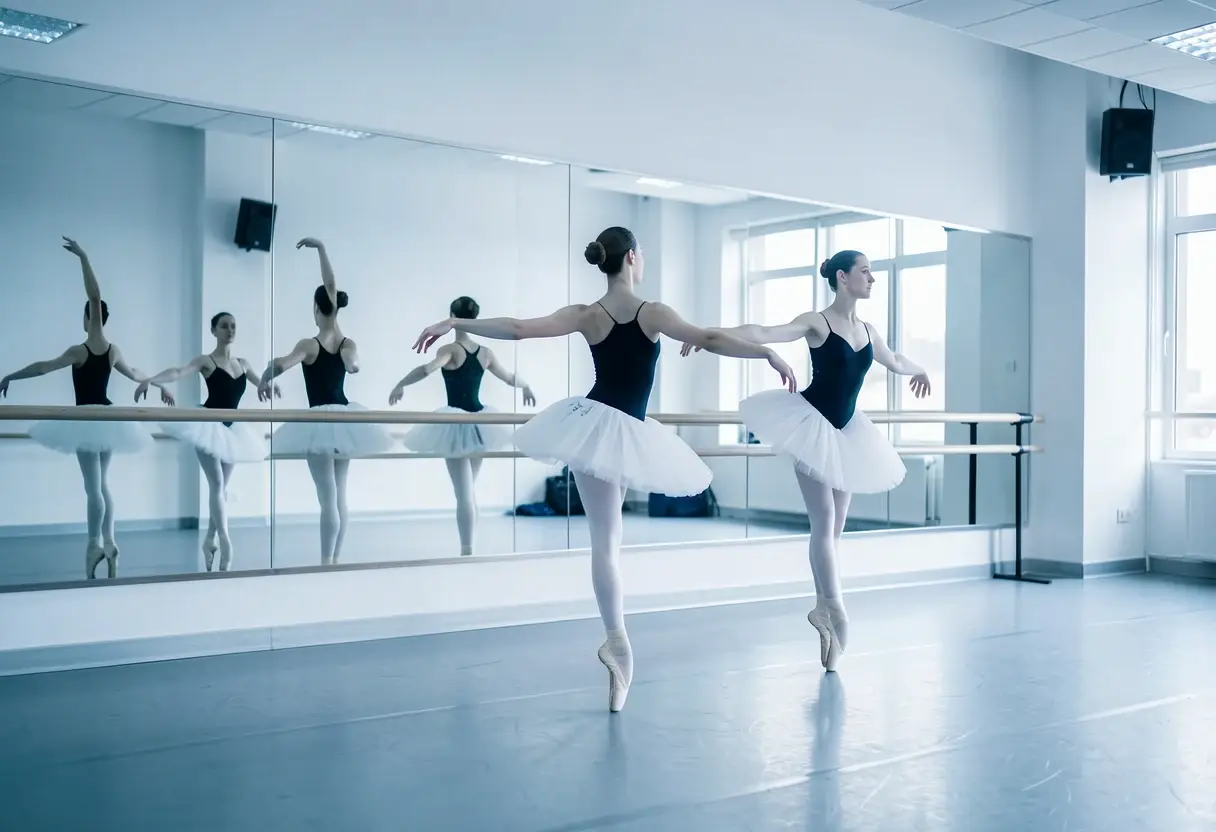
Programme
- East Coast Contemporary Ballet performs “Dancescapes” at the Regina A. Quick Center for the Arts at Fairfield University on November 7.
- The seven-piece program spans the company’s eight years, from the 2021 debut “Vessels” to Mazza’s new “Power Play.”
- The 10-member company operates on a $300,000 budget and treats paying its people as its most significant expense.
- Mazza directs the Darien Arts Center program of roughly 350 students, ages three to over 70, with 12 faculty members.
- “Through You” runs in three movements to music by Valentin Silvestrov, Dustin O’Halloran and Ernesto Lecuona.
By Tom Whitfield
East Coast Contemporary Ballet performs seven pieces at the Regina A. Quick Center for the Arts at Fairfield University on November 7, anchored by “Through You,” a three-movement duet choreographed by the company’s founders, Claire Mazza and Alejandro Ulloa.
The duet sits at the centre of “Dancescapes,” a program assembled from eight years of the company’s work. Mazza and Ulloa live together in Harlem and perform with several New York companies. They built the duet around their own separation and reunion.
“It’s our story of existing separately in the dance world, then finding each other, and falling madly in love,” Mazza said during a rehearsal at the Darien Arts Center, where she directs a dance program of roughly 350 students.
“We’ve really trusted each other because we’ve had to. It’s allowed us to be so vulnerable with each other,” she added.
The three movements use music by Valentin Silvestrov, Dustin O’Halloran and the late Cuban composer Ernesto Lecuona. In rehearsal, the strings of Silvestrov’s “Dedication: IV Andantino” filled the studio as Mazza started alone, her arms extended and her toes sliding across the floor.
Ulloa seemed to wake at the back of the room, his reflection springing forward in a wall-length mirror. They danced in parallel, then touched, backs pressed together.
“Through You” did not start as a story about partnership, Mazza said. At one point she sat in an Airbnb, listening to the music scoring the piece, with tears streaming down her face.
“It has come to a different place since we first performed it,” Ulloa said. “They tell you that you keep falling in love, and it’s true. It’s a way more mature love [that we have now]. It’s an appreciation, as well.”
“I feel privileged to be able to live with this love in my life, but to experience it with dancing, with no words at all …” he trailed off.
“It’s like falling in love all over again,” Mazza finished.
What does this change for Connecticut’s dancers and audiences?
Mazza and Ulloa met at Connecticut Ballet close to a decade ago, after separate training. Mazza began lessons in a Brooklyn neighborhood studio and grew up at the School of American Ballet in New York. Ulloa danced traditional folklore as a teenager in Nicaragua before transferring to the Escuela Nacional de Ballet.
They said Connecticut’s dance scene is diffuse and can feel small within a specific form. Their first joint project, with a small company in Westport, left its artists chronically overworked and undercompensated. Dancers often cobble together a living from several part-time jobs and punishing rehearsal schedules. Mazza and Ulloa wanted salaries that matched the labor.
“It sounds so cheesy now, but we wanted to have a place where dancers are being treated correctly,” Ulloa said. “Let’s take care of people.”
The 10-member company puts people first in a $300,000 budget, its most significant expense. That is a testable claim with thin evidence attached: neither Mazza nor Ulloa disclosed individual salaries, ticket prices or expected audience size for November 7. What they described is an intention to pay people properly. What remains unshown is whether the model absorbs a lean year or supports a larger ensemble.
For audiences, the answer is a repertory concert that mixes the personal with the institutional: one duet that has toured through eight years, a debut work, a new commission and a collaboration with a composer’s widow.
Eight years, built against the clock
The company took shape in 2018 and 2019. A pandemic-enforced hiatus in 2020 delayed the launch, and East Coast Contemporary Ballet debuted in 2021 with hours of masked rehearsals and original work set to Lecuona.
“We never wanted the company to be a project” with a finite lifespan, Ulloa said.
That same year, Mazza and Ulloa launched the Fairfield County Dance Festival alongside the New Canaan-based Thomas/Ortiz Dance. By 2022, Mazza had taken the reins of the dance program at the Darien Arts Center, where Ulloa also works as a dance educator. With 12 faculty members, the program serves roughly 350 students from ages three to over 70. Ulloa was an educator at New Haven Ballet for years.
The founders count 45 choreographed pieces; on a wider measure, the ensemble has created nearly 50 works in its repertoire since 2021. Collaborators have included the New York-based, Argentine-born bassist and composer Pedro Giraudo, Stamford’s Orchestra Lumos and the Italian sculptor Luca Serasini. Last year, ECCB launched its “Salon Series,” open rehearsals that travel to museums, galleries, studios and arts spaces to make the work more accessible.
Mazza frames the company’s style in terms of classical foundations. “I love that it [ballet] gives you all the tools to explore and be proficient in other styles of dance,” she said. “In contemporary ballet, you can use classicism as a base, but the vocabulary of dance becomes more abstract and more diversified.”
The seven-piece bill
Saturday’s program includes:
- “Through You” — the Mazza-Ulloa duet, set to Silvestrov, O’Halloran and Lecuona.
- “Vessels” — the ensemble work with which ECCB debuted in 2021.
- “Power Play” — Mazza’s new piece, devised to the music of Cristina Spinei.
- “Brushstrokes” — an Impressionism-inspired work set to the “Lautrec Suite” by the late composer Nicolas Flagello. His widow, Dianne Flagello, a former director of the Manhattan School of Music, arranged the suite in his honor.
Three further works fill out the bill; no other titles were listed.
Elizabeth Hall, a longtime dance teacher at the Darien Arts Center who now substitutes and volunteers for the Center’s annual “Nutcracker,” put it plainly: “Claire and Alejandro bring the best out in every dancer.”
She added: “I’m just so excited for them. It’s a huge, huge deal, and they’ve worked so hard to get there.”
“I’m super super proud of them, and I just feel lucky that the Darien Arts Center gets to have them as professional dancers who bring their knowledge and their expertise to everything they do,” Hall said.
On November 7, the company will have to support two claims at once: that a love duet can anchor a repertory of nearly 50 works, and that a 10-person ballet company can pay its people properly on a $300,000 budget.
Source: artsjournal.com
More from Tom Whitfield
Show full bio
Market editor covering people, launches and day-to-day practice in arts in the broadest sense at Arts & Voices.
1,190 articles