Frank Lloyd Wright's Only Planetarium Restored in Florida
Florida Southern College has reopened Frank Lloyd Wright's only planetarium, dark since 2004, after restoring 280 textile tiles, the original circular seating and Wright's Cherokee Red floor.
Programme
- Florida Southern College has restored the only planetarium designed by Frank Lloyd Wright, largely closed since 2004.
- Exterior work began in 2021 and replaced over 280 hand-cast "textile" tiles; interior work started in 2023.
- The Planetarium is one of thirteen Wright buildings on campus, built between 1938 and 1958, restored since 2007.
- The site is the largest single-site collection of Wright architecture in the world and a National Historic Landmark since 2012.
- The space is now open to the campus and public for tours and screenings.
By Daniel Okafor
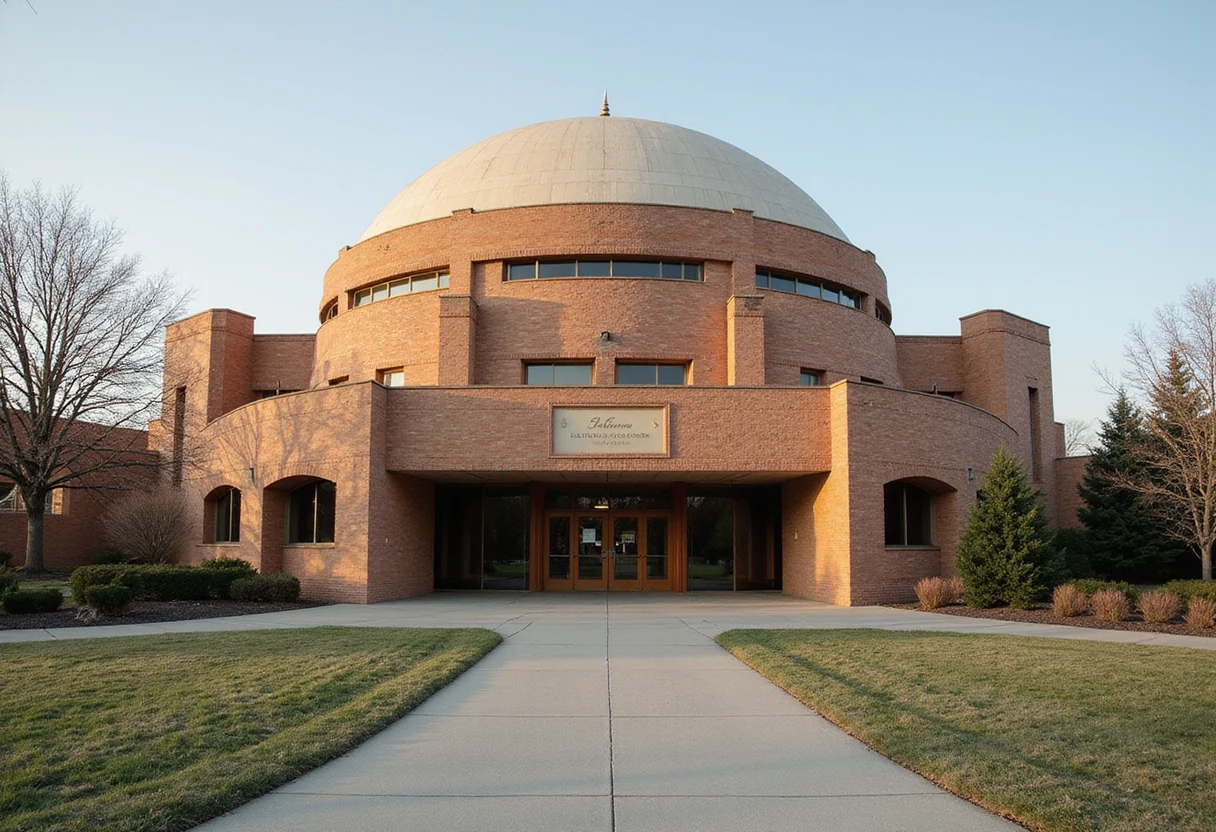
Florida Southern College has restored and reopened the only planetarium Frank Lloyd Wright ever designed. The building had sat largely closed since 2004, when its projection system failed.
The Planetarium, as the structure is plainly known, sits at one end of the Polk County Science Building on the college's West Campus in Lakeland, Florida. Its return marks another chapter in a restoration campaign the school has run since 2007 across the largest single-site collection of Wright architecture in the world.
Jeff Baker led the work. He is the college's resident campus architect and a principal at MCWB Architects, and he has spent twenty years on Wright projects at Florida Southern.
"Since the outset of these overall restoration efforts, the college was always looking for an opportunity to restore the Planetarium, knowing full well its potential to excite and inspire audiences of all ages as they get a glimpse into the heavens and the great genius of Frank Lloyd Wright," Baker told Dezeen.
What did the restoration involve?
Exterior work began in 2021. The team replaced the roof, the flashings, failed stucco on the upper facade and more than 280 hand-cast "textile" tiles lining the building's perimeter.
The team then moved inside starting in 2023, where "decades of interventions since Wright's death had dramatically altered the room," according to Baker.
The interior work included:
- Updating the projection technology and audio systems
- Repainting the walls from a deep blue back to their original scheme
- Removing insertions, including a computer closet built in the 1980s
- Restoring the original Wright-designed plywood seating with colored vinyl upholstery, repositioned to its rightful orientation
- Reinstating original paint and plaster, and refinishing the floor in "Cherokee Red"
"The removal of the old computer closet retrieved the space as it was designed," said Baker. "This removal allowed us to restore and reinstate all the seating in its original circular form, which we learned is a very rare survival in planetariums throughout the country."
Local craftsmen handled the seating restoration. Rare, apparently, is an understatement in planetarium circles.
Why was Wright's architecture the hard part?
Baker said the most challenging aspect matched his experience across the campus: Wright's "elemental" architecture leaves "no 'poche' spaces to hide modern building systems" (poché being the solid wall thickness architects traditionally use to conceal pipes and wiring).
"Frank Lloyd Wright spent his life conceiving architecture as a synthesis of art and structure," Baker said.
"At Florida Southern College, this is manifested in buildings that are elemental – the concrete floors are the ceilings for the rooms below, the concrete ceiling is also the roof above."
"We believe we were able to devise methods to insert these systems in sensitive ways that meet the needs of the college yet allowed us to retrieve Wright's vision for the space," he added.
How does it fit the wider campus project?
The Planetarium is one of thirteen Wright buildings constructed at the college between 1938 and 1958. The university has been updating them since 2007, guided by a Campus Heritage Plan prepared with support from grants including one from the J Paul Getty Foundation.
Previous phases restored the Waterdome, Wright's largest built fountain; the Esplanades, the monolithic covered walkways crossing the campus; and the Annie Pfieffer Chapel.
College president Ludd Spivey commissioned Wright in 1938, making Florida Southern the only college the architect ever master-planned. The site was designated a National Historic Landmark in 2012.
The Planetarium is now open to the campus and the public for tours and screenings — one more working instrument in the largest Wright collection anywhere, and, unusually for a landmark, one that shows you the stars.
Original: mcwb-arch.com
More from Daniel Okafor
Show full bio
News editor covering companies, deals and strategy in arts in the broadest sense at Arts & Voices.
553 articles