Ibrahim Mahama Takes Over the Fondation Cartier in Paris
The ArtReview Power 100 topper opens "The Harvest Season" at the Fondation Cartier, with 200 Asante royal stools and a reconstructed Nkrumah-era glass factory.
Programme
- "The Harvest Season" opens Thursday at the Fondation Cartier pour l'art contemporain in Paris, taking over the entire building.
- Mahama topped the ArtReview Power 100 in 2025 and received the 2026 Arnold Bode prize.
- The show adds about 200 restored Asante royal stools to a new iteration of Parliament of Ghosts (2019).
- Things Fall Apart reconstructs the Aboso Glass Factory, founded by Kwame Nkrumah in 1966 and purchased by Mahama roughly two years ago.
- After the exhibition, the glass factory will be permanently installed in Kumasi, Ghana.
Ibrahim Mahama will take over the entire Fondation Cartier pour l'art contemporain building in Paris on Thursday with "The Harvest Season," an exhibition he calls "the most ambitious exhibition I've done."
The Ghanaian artist arrives with an extraordinary run of honors. He topped ArtReview's Power 100 list in 2025, won an Art Basel Gold Award the same year and received the 2026 Arnold Bode prize. France recently named him a chevalier of the Ordre des Arts et des Lettres, an honor bestowed in Ghana by Diarra Dime Labille, France's Ambassador to the country.
What drives the practice?
Mahama credits a collective that spans market women, weavers, craftsmen, railway workers, curators and fellow artists. "We live and work in a community and nobody is an island by themselves. I built my practice based on the idea of collectivity and working with different collaborators," he told ARTnews. "I think the artist is just a vessel, and I see myself as that vessel in order to put all these different things together to do the work that we do."
He began collecting worn-out jute sacks from the Mallam Atta market in Accra while still in college. The market women were scornful at first, then came to support him. Those sack works appeared in Okwui Enwezor's 2015 Venice Biennale and made his name.
Sales revenue funds institutions he founds in Ghana, including Red Clay Studio and the Savannah Centre for Contemporary Art in Tamale, and Nkrumah Voli-ni, a converted ruin. He has also bought abandoned factories and airplanes and turned them into art and educational spaces — projects he calls a "lifetime work."
What will the Paris show contain?
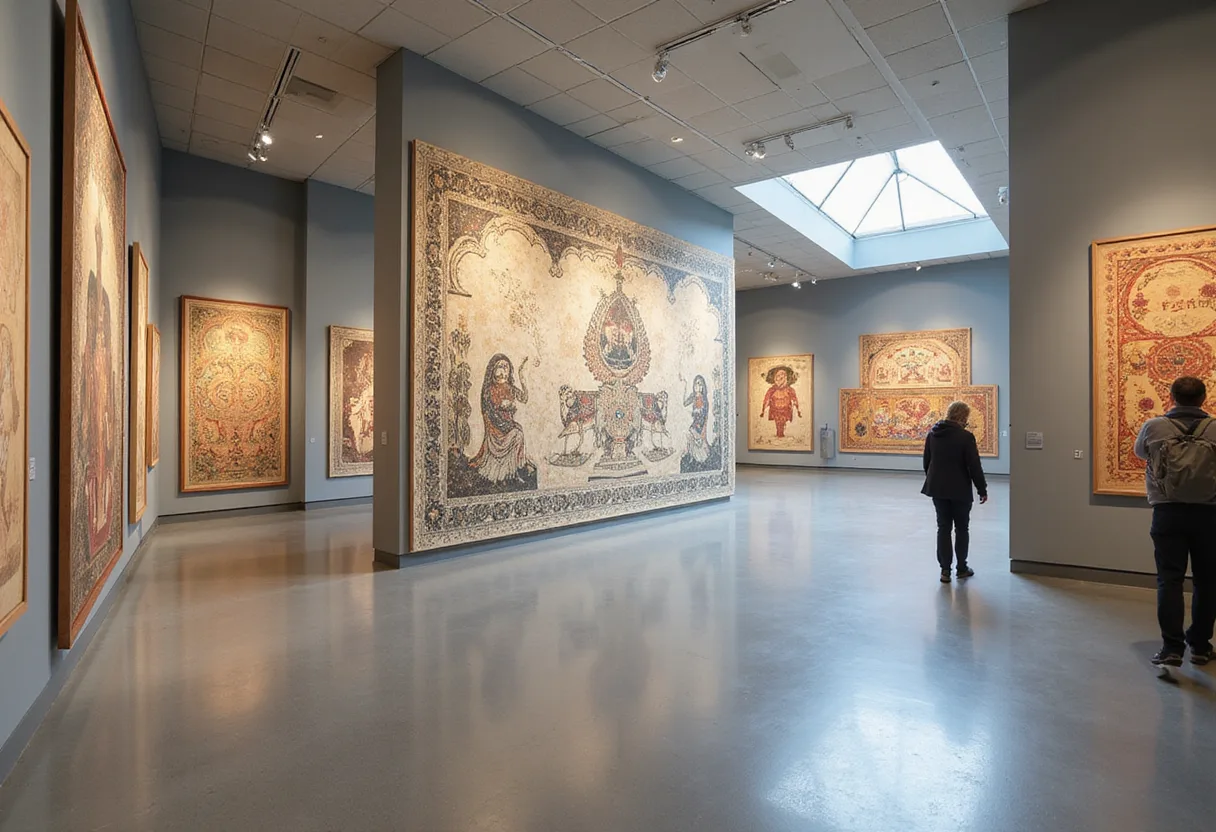
Parliament of Ghosts, first shown in 2019, returns in a new iteration built from discarded train seats, railway sleepers, school furniture, jute sacks and government archives, now joined by about 200 collected and restored royal stools from the Asante Empire. Visitors will have free access to them, without glass cases — an inversion, Mahama says, of how such stools are typically looted, exhibited and enclosed in Western museums. Bringing them to Europe as "living" objects used for their original purpose draws out their "ghosts [and] histories."
A new project, Things Fall Apart — titled after Chinua Achebe's 1958 novel — reconstructs the Aboso Glass Factory, established in 1966 by Ghana's first president Kwame Nkrumah before his overthrow that year. Mahama purchased the abandoned plant roughly two years ago with Fondation Cartier production funds. When the Paris exhibition closes, the factory will return to Ghana for permanent installation in Kumasi, where he plans to build a new institution.
The show also includes works on the Ghanaian railway system and a new textile installation of fabrics from northern Ghana, truck inner tubes, jute sacks and found textiles hung across the building's arcades.
Curator Aby Gaye-Duparc said: "There is a dialogue between this old building [constructed in the 1850s] and Ibrahim's work, which addresses the history of the 19th century in Ghana, and the links between what was happening between Europe and West Africa at that time." She added that "a lot of the installations were made first in Tamale and then travel to Paris or other venues," and that the institutions Mahama builds there have expanded access to the arts.
Featured artists and collectives include James Barnor, Gideon Appah, CATPC, Tjaša Rener, Postbox Ghana, Dorothy Akpene Amenuke and architect Courage Dzidula Kpodo, whose installation pairs a laterite wall reconstruction from Gyampo with about 100 Postbox Ghana postcards of tropical modernist buildings in Accra, Kumasi and Takoradi. "I would describe Ibrahim as someone who makes space within his own abilities and means for people that he thinks are doing interesting, important work," Kpodo said.
What comes after Paris?
The exhibition is Mahama's first major outing since a special operations unit of the Ghana Police Service viciously attacked him in Tamale earlier this year. He has received no updates in months on the Criminal Investigation Department inquiry. "I want to channel my energy into this positive part of my practice of what I do and what it means to the community," he said, adding that he hopes "at some point, we will be able to at least know more." He plans to follow up when he returns to Ghana by the end of the year, alongside explorations with cinema owners to rebuild some of the country's abandoned cinemas.
Original: fondationcartier.com
More from Marcus Bennett
Show full bio
Staff writer covering people, launches and day-to-day practice in arts in the broadest sense at Arts & Voices.
595 articles