Maren Hassinger Retrospective Turns Gray Steel Warm at BAMPFA
Maren Hassinger's BAMPFA retrospective spans knotted shipyard rope, elevator cables, a lynching-family video and pink breath-filled bags — five decades of weight made light.
Programme
- Maren Hassinger's retrospective is on view at BAMPFA, Berkeley, co-curated by Margot Norton and Anthony Graham.
- Her 2,000-pound 1972 work River was remade in 2011 for the Studio Museum.
- Leaning (1980) bundles frayed elevator cables into some two dozen bouquets.
- Birthright (2005) documents her discovery that her grandmother Puddin's father was lynched.
- Studio Z crashed the 1982 'Afro-American Abstractions' opening with a self-invited performance.
Maren Hassinger's retrospective at the Berkeley Art Museum and Pacific Film Archive (BAMPFA) radiates warmth from an unlikely stock-in-trade: gray metal sculptures with edges sharp enough to cut. The warmth comes partly from photographs by her long-term collaborator Adam Avila, printed mural-sized and filling vitrines. They show Hassinger dancing, beaming, and mirroring her sculptures' forms with her body.
The show tracks a career built on rerouting. In the 1960s, Bennington's dance department rejected her; a teacher who noticed her gift pushed her toward sculpture. "My love of motion," Hassinger says in the catalog, carried her from one discipline to the other. Clement Greenberg, a guest at her senior thesis critique, had "the gift of gab, but was a bit of a bully," she remembers.
At UCLA graduate school she was rerouted again, finding the sculpture program a boys' club — not one single woman enrolled, as she recalls. She landed in fiber instead. "Truthfully," she admits in the catalog, "I was just trying to get a degree so I could teach and make art."
How did rope become her material?
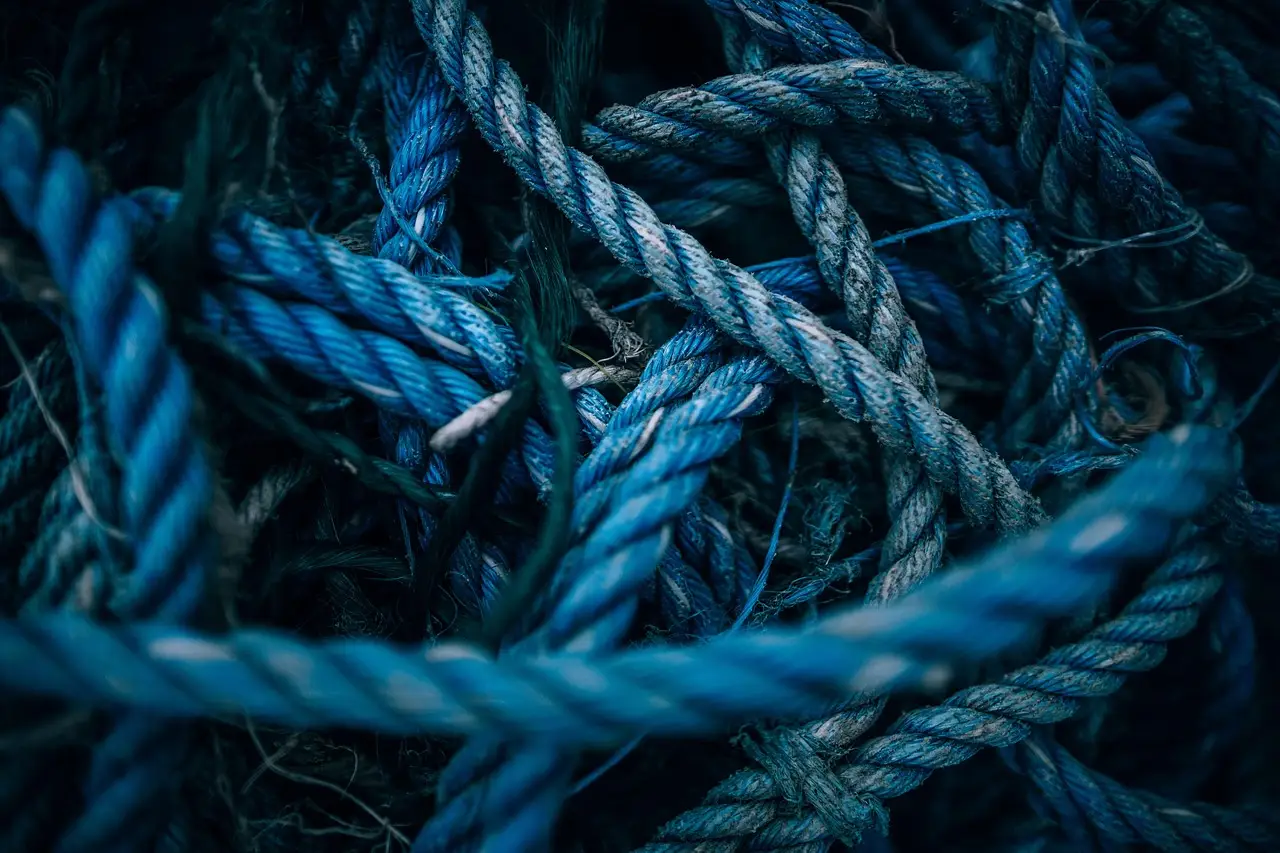
Too impatient for the loom, Hassinger gathered fibers from the world — including a weighty blonde hemp rope, discolored by oil, found in a shipyard. She unraveled strands and tied them into loose, giant macramé knots that greet visitors at BAMPFA, lying on the ground as if waiting to be pulled tight.
From then on she married craft techniques to industrial materials. She became a regular at one LA wire shop, which featured her on the cover of its trade magazine. Elevator cables entered her best-known works. Leaning (1980) bundles frayed cables into roughly two dozen bouquets; only the central arrangement sits sturdily.
Her 2,000-pound rope-chain River (1972) proved too large to store, so she let it go and remade it in 2011 for a Studio Museum acquisition — thanks, in part, to her many photographs. After school, she mainly made sculptures that could be coiled compact: a resourceful answer to real estate.
Margot Norton, who co-curated the show with Anthony Graham, said: "When she talks about the work, she moves." Hassinger's titles are often verbs: Whirling (1978), Walking (1978), Leaning (1980).
What does the show change for her legacy?
Born in 1947, Hassinger met obstacles as a Black woman with, in the catalog's words, poetry and practicality in equal measure. Of her twisted, knotted newspaper cascades from 2008, she explains the material "is very handy and cheap [laughs]."
She hardly worked alone. "Working alone is so antisocial," she quips. When Senga Nengudi saw Hassinger's work in 1975, she was thrilled to find another Black woman in sculpture and performance, and looked her up. With David Hammons, Nengudi suggested Linda Goode-Bryant show Hassinger at Just Above Midtown (JAM); that show's main work, Beach (1980), appears at BAMPFA.
Her cohort, Studio Z, invented its own opportunities. For the 1982 opening of "Afro-American Abstractions" at the Los Angeles Municipal Art Gallery, Hassinger, Nengudi, Ulysses Jenkins and others — hung on no walls, listed on no checklist — phoned to accept a nonexistent invitation: "We are so thrilled to be doing the opening performance!"
Birthright and Love
In the 1990s, without a studio, she turned to video. Birthright (2005) records her interviewing her uncle: her grandmother Puddin was the product of incest and an interracial affair, was given away to a formerly enslaved plantation caretaker, and her father was lynched by a white mob. "My legacy was to feel unloved," Hassinger concludes. Beside it hangs Love (2008/2026): hot pink plastic bags filled with human breath and love notes.
"I always felt so good when I danced," she says, "lighter, faster." The retrospective — heaviness made to look light — argues that her junkyard findings and litter become elegant arrays, and love.
Source: Art in America
More from Tom Whitfield
Show full bio
Market editor covering people, launches and day-to-day practice in arts in the broadest sense at Arts & Voices.
1,719 articles