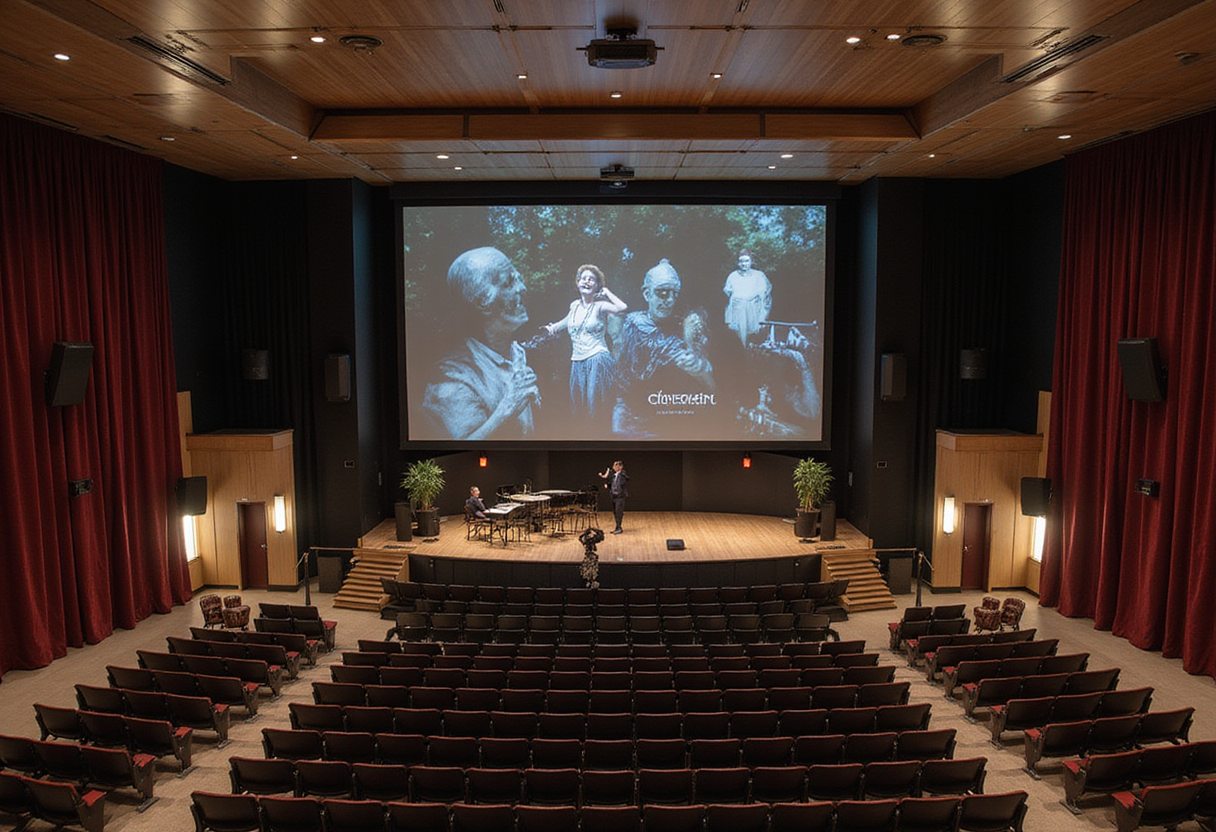
Opéra de Montréal Opens 2026-27 Season With a Rewritten Turandot
The Opéra de Montréal opened its 2026-27 season September 26 with a radically rethought Turandot: Francesca Zambello's co-production replaces Alfano's finale with an 18-minute Christopher Tin ending.
Programme
- The Opéra de Montréal opened its 2026-27 season on September 26 with a rewritten Turandot.
- The production replaces Franco Alfano's completion with an approximately 18-minute finale by Christopher Tin.
- Francesca Zambello directed; the staging originated at Washington National Opera.
- Maida Hundeling sang the title role; Paolo Arrivabeni conducted the Orchestre Métropolitain.
- Wilson Chin's dystopian industrial scenery replaced the opera's traditional chinoiserie.
The Opéra de Montréal opened its 2026-27 season on September 26 with a radically rethought Turandot that replaced Franco Alfano's century-old completion of Puccini's unfinished score with an approximately 18-minute finale by composer Christopher Tin. The production, directed by Francesca Zambello and originally created for Washington National Opera, turned the fairy-tale princess into a trauma survivor and recovering authoritarian — a transformation the orchestra and principal cast made musically credible, even as the staging drew persistent fire.
What did Zambello change about the fairy tale?
Zambello, working with librettist Susan Soon He Stanton and Tin, set Puccini's last opera in an anonymous dystopian totalitarian state. Wilson Chin's scenery — scaffolding, catwalks, and oppressive metallic masses — banished the chinoiserie of Carlo Gozzi's source text and Puccini's libretto. Key substitutions:
- Turandot recast from cruel princess to authoritarian ruler, with violence rendered political rather than folkloric
- The traditional Chinese chorus replaced by a population of Central Asian migrants
- The military and police forces rendered conspicuously female
- Ping, Pang and Pong (Nathan Keoughan, Rocco Rupolo, Angelo Moretti) reconceived as early-20th-century bureaucratic functionaries
- Emperor Altoum (Richard Margison) dying offstage before the final scene
The result, the review concluded, was "less a universalization of Turandot than an accumulation of contemporary political signifiers."
Why rewrite Puccini's ending?
Puccini died in 1924 leaving Turandot unfinished at Liù's suicide. The new collaborators seized that open status. Stanton gave Turandot a backstory of sexual violence, reframing her cruelty as trauma and her absolute power as defense against male domination. The transformation that follows Calaf's kiss became a conscious rejection of the cycle of violence, not a capitulation to romance.
The climax turned Turandot into what the review described as "a liberal empress who welcomed the displaced newcomers and renounced the authoritarian order she had inherited." Calaf became a reconciler rather than a conquering suitor. The familiar reprise of "Nessun dorma" was cut.
Did Tin's finale hold up against Puccini?
Tin's roughly 18 minutes did not attempt the discretion Franco Alfano brought to the 1926 completion. His hybrid vocabulary drew on contemporary verismo, Broadway, and cinematic sentiment. The Orchestre Métropolitain, under Paolo Arrivabeni, played the new material with the same precision it brought to Puccini — which only made the contrast more conspicuous. The original score already pointed past late Romanticism toward Expressionism; the new music announced itself as 21st-century composition.
Who carried the evening musically?
The singers did. Four performances stood out:
- Maida Hundeling (Turandot) — a dramatic soprano with "the steel, brilliance and dark tonal centre demanded by the role," gradually exposing the vulnerability beneath the icy exterior
- Kirsten MacKinnon (Liù) — "luminous tone, generous phrasing and acute acting" that turned Liù into the opera's moral center
- Andrea Shin (Calaf) — a beautifully phrased Nessun dorma with thrilling high notes, though his lyric instrument sat lightly against Hundeling's amplitude
- Raymond Aceto (Timur) — sonorous authority and humanity
Arrivabeni drew "remarkable transparency" from the orchestra, balancing "massive climaxes" without burying harmonic detail. Claude Webster's chorus impressed with rhythmic precision and dynamic control. The musicians demonstrated, the review observed, "the inherent sophistication of Puccini's score" — and "with equal precision, how conventional and mediocre the newly composed material sounded beside it."
So what did the experiment achieve?
The performance stood as a "memorable musical achievement" wrapped in what the review called "a deeply problematic theatrical experiment." The team set out, the piece argued, to rescue Puccini's fairy tale from its "Orientalist and patriarchal baggage" and to make its ending "ethically compatible with contemporary sensibilities." In doing so, they "replaced one set of ambiguities with another": the fairy tale became a political allegory, the princess a traumatized authoritarian, and the triumphant conclusion a manifesto for reconciliation and open borders.
"Puccini's unfinished masterpiece survived an incomplete ending for a century," the review concluded. "It proved less obvious that it needed rescuing from the fairy tale that had made it immortal." The Zambello staging is part of a wider North American circuit; any company that programs Tin's finale next will inherit the same question.
Source: Opera Wire
More from Tom Whitfield
Show full bio
Market editor covering industry trends and analytics at Arts & Voices.
367 articles