Oregon Artists Turn Empty Fridays Into Art Days for Rural Schools
A coalition of Oregon artists is filling the empty fifth day of four-day school weeks with art classes, reaching thousands of rural students the state does not serve.
Programme
- About 100 Oregon school districts operate on four-day school weeks.
- 27% of Oregon elementary schools offer no stand-alone arts courses.
- A $150 million bequest from Fred W. Fields in 2012 funded arts education efforts, including $6 million for Studio to School reaching 22,000 students.
- Arts in Education of the Gorge's Friday classes at Mosier Community School cost about $88,000 this year.
- The Motherline received IRS 501c3 nonprofit status in October 2025.
About 100 Oregon school districts run four-day school weeks, and a growing coalition of artists now fills that empty fifth day with art. The initiative is called 5th for the Arts. It grew out of a prior Oregon Community Foundation project and is spreading through the Oregon Arts Education Collective, a coalition of artists, arts teachers and nonprofits.
The Rural Arts Working Group of the collective leads the effort. Ariadne Grace (née Gina Angelique), artistic director of The Motherline in Cave Junction, Southern Oregon, chairs the group. Her organization has offered Friday dance classes in the Three Rivers School District in Josephine County for several years.
"We are combining ecology, the environment, agriculture, and art to create sustainable communities. Grounding. We are attracting at least 35 students every Friday who want to do more art than is available in the public schools, and that's very exciting," Grace told Oregon ArtsWatch.
Who is joining the effort?
Grace compiled the list of roughly 100 districts herself.
"There is not a comprehensive list anywhere on the web that I could find. So, I literally researched district by district. Then, we had an intern from the University of Oregon, Alice Glab, confirm my findings," Grace said.
Arts in Education of the Gorge, a Hood River nonprofit founded 40 years ago by parents, joined this year. It maintains a roster of more than 40 teaching artists, reaches over 3,500 students annually, and works in six counties on both sides of the Columbia River. In September it began day-long Friday classes at the Mosier Community School.
"We were created 40 years ago by parents who wanted more arts education in the schools, and are now the only organization in the Columbia River Gorge with a roster of teaching artists who have been going into the schools," Executive Director Amy Gray told Oregon ArtsWatch.
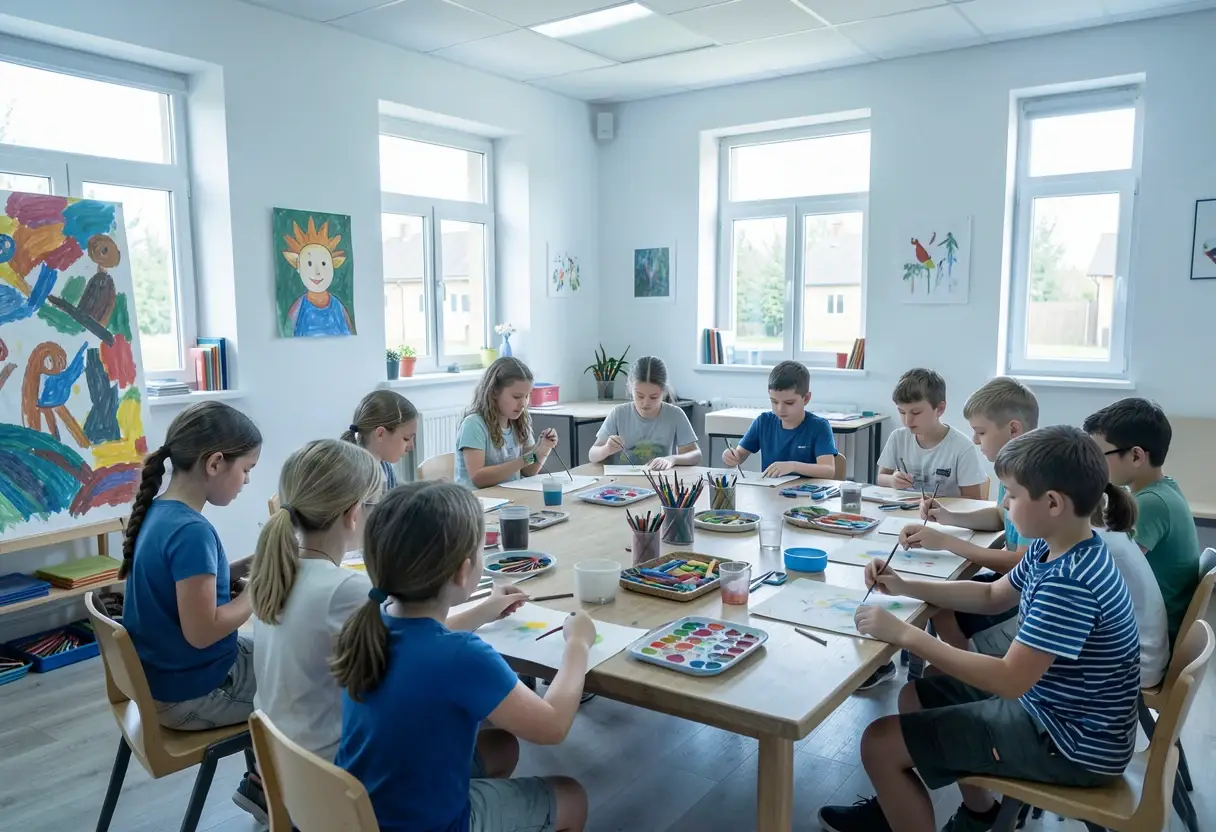
The Mosier classes run from 8:30 a.m. to 2 p.m., covering ceramics, watercolors, music and movement. Attendance grew from 60 students to 88, then settled at 69, out of a total enrollment of 205. The school contracts with the organization at a cost of about $88,000 this year, with some funding from the Columbia Gorge Foundation.
"Offering classes on longer days four times a week is more efficient for the school. And it creates the opportunity for us on Fridays," Gray said.
In Wallowa County, Eastern Oregon, musician Amy Fairchild took a different route. She surveyed her county, found seven organizations already offering arts activities on Fridays, and built an online calendar listing them, including the Wallowa Valley Music Alliance, Fishtrap, the Josephy Center for Arts and Culture and the Wallowa County Dance Academy.
"We're pretty lucky to already have so many opportunities in such a remote location," said Fairchild, who teaches musical theater on Fridays.
Why does the gap exist?
Oregon law (ORS 329.045) requires arts education, and the state board adopted Content Standards for The Arts in 2015 across Dance, Media Arts, Music, Theatre and Visual Arts. Yet the law guarantees no dedicated art or music teacher, especially in elementary schools.
The numbers are stark. According to Americans for the Arts, about 27% of Oregon elementary schools offer no stand-alone arts courses, compared with 98% of middle schools and 86% of high schools. Data from the Oregon Department of Education show 45% of rural elementary students attend a school without a stand-alone arts course, against 10% in suburbs and 20% in cities.
"Some rural school districts have a history of offering excellent arts classes, but there is no doubt there are fewer of them than in urban districts. Rural districts have fewer resources and even fewer artists living in them," Jerry Tischleder, Senior Program Officer of Arts and Culture with the Oregon Community Foundation, told Oregon ArtsWatch.
What funded the change?
A $150 million bequest in 2012 from the estate of lumber industrialist Fred W. Fields, designated for arts and education, launched the foundation's serious work on the issue. Its Studio to School project invested $6 million in 18 organizations and reached an estimated 22,000 students over five years, many of them students of color, from low-income households or from under-resourced rural communities.
One recipient, RiverStars Performing Arts in Cave Junction, reinvented itself when Covid-19 pushed its district to a four-day week and killed after-school hours. It became The Motherline, won IRS 501c3 status in October 2025, and now runs programs from Cultivate Kids to forest cleanups, funded by the Oregon Arts Commission, the Roundhouse Foundation, the Cow Creek Foundation and the Miller Foundation.
"Artists, teachers, arts organizations, and others came together to see what they could do to strengthen arts education in Oregon. It's a beautiful opportunity for collaborative partnerships. A lot of school districts are in a 'we have to cut' mindset, but groups are now coming forward and offering them more choices," said Aimee Craig, the collective's co-lead facilitator.
Fairchild plans to meet teachers, officials and artists next year to identify gaps for new programs. Tischleder sees the model spreading: "I'm very excited about the 5th for Arts idea. This is the kind of example that can make a big difference in rural school districts."
Source: artsjournal.com
More from Marcus Bennett
Show full bio
Staff writer covering people, launches and day-to-day practice in arts in the broadest sense at Arts & Voices.
1,193 articles