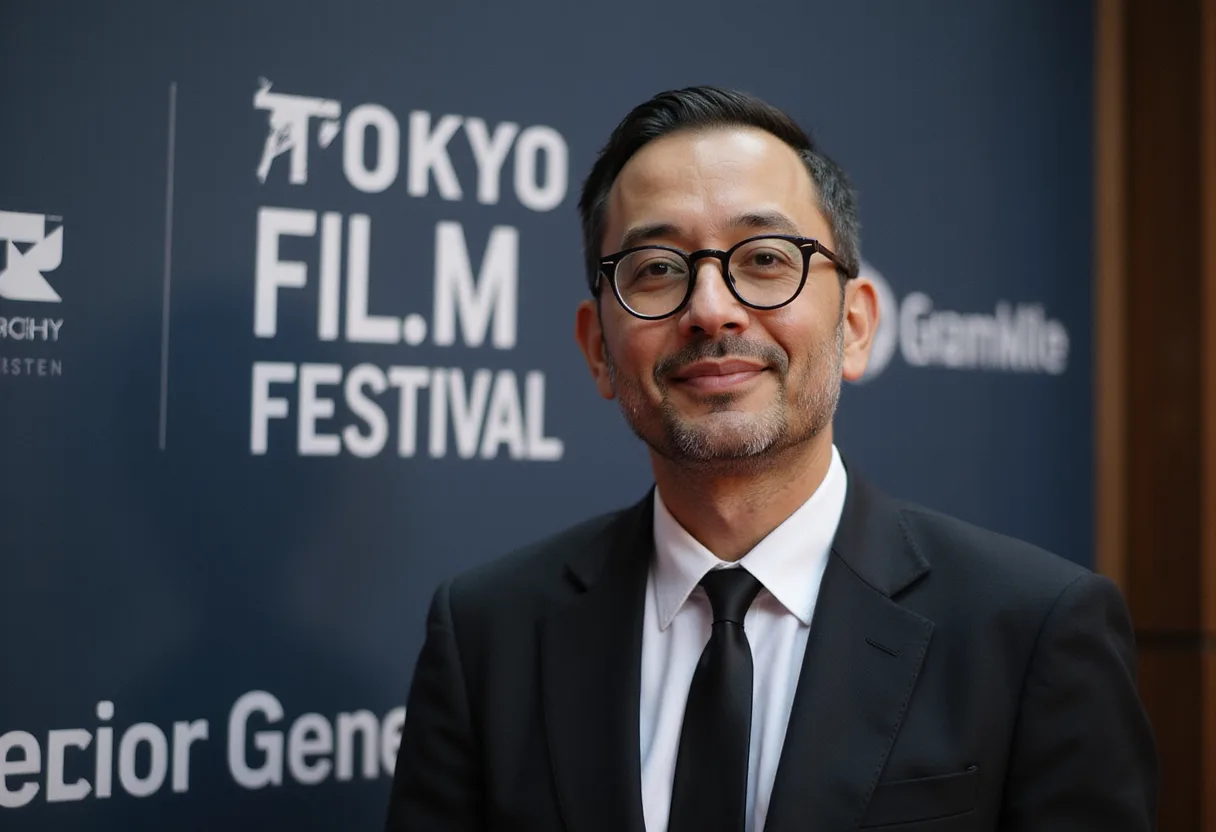
Rasoulof, Citing Panahi's New Five-Year Sentence, Receives Tokyo's Kurosawa Akira Award
Mohammad Rasoulof cited Jafar Panahi's new five-year sentence as he and O Mipo received Tokyo's Kurosawa Akira Award, calling Iranian cinema still under repression.

Programme
- Jafar Panahi received a new five-year prison sentence and property confiscation days before the Tokyo ceremony.
- Rasoulof and O Mipo are this year's Kurosawa Akira Award recipients at TIFF.
- A committee chaired by Yamada Yoji cited 'There Is No Evil' and 'The Seed of the Sacred Fig'.
- O made her first feature in nine years after Ando Sakura's 2023 Japan Academy remark.
- Rasoulof served a five-year sentence after his 2010 arrest while making a film.
By Elena Vasquez
Jafar Panahi received a new five-year prison sentence and a property confiscation order just days before Mohammad Rasoulof accepted Tokyo's Kurosawa Akira Award. Rasoulof, the exiled Iranian director, cited that sentence at a Tokyo International Film Festival press conference as evidence that repression of Iranian cinema has not eased.
"Of course, Iranian cinema continues to face repression, and my friends and colleagues remain under enormous pressure," Rasoulof said in Persian.
What did Rasoulof say about Panahi?
Panahi won the Palme d'Or at Cannes last year. Rasoulof told reporters in Tokyo that "just a few days ago" the director received "five more years in prison and the confiscation of his property."
Rasoulof said many Iranian filmmakers have resolved to confront those in power by telling their stories directly rather than hiding behind metaphor. He described his own turning point. Police arrested him in 2010 while he was making a film and sentenced him to five years. Alone in a cell, he asked himself why anyone should go to prison for making a film, and he came to see his reliance on allegory — a shield classical Persian poets used — as self-protection.
"I thought I was using metaphor to run away from the regime, but I thought I wouldn't do it anymore," Rasoulof said. "I don't need to run away anymore, so then I decided to tell things directly."
Takeaway: Rasoulof frames direct storytelling, not allegory, as his answer to state pressure.
Why did the committee choose him?
A selection committee chaired by Yamada Yoji chose Rasoulof and Japanese director O Mipo as this year's recipients. Director Lee Sang-il, cinematographer Ashizawa Akiko and festival programming director Ichiyama Shozo also sat on the committee.
The committee cited Rasoulof's films about state repression of human rights. It singled out "There Is No Evil" and "The Seed of the Sacred Fig" for treating even the enforcers of oppression as ordinary citizens. It also recognized his refusal to stop working despite pressure.
Rasoulof grew up watching Kurosawa's "Red Beard" on Iranian state television — more than 10 times by his own count. The Kurosawa film closest to him now is "Dersu Uzala.
"Whenever I feel hopeless, or whenever I feel depressed, even now, I see 'Dersu Uzala' so that I can go back to my own life and I can find some hope," he said.
How did O Mipo rebuild her career?
The committee praised O for looking at people on society's margins without moral judgment, starting with her 2006 debut "The Sakai's Happiness." It highlighted her direction of children in "Being Good," "Living in Two Worlds" and "How Dare You?"
O had her first son in 2015 and expected to return to work quickly. She found she could not make films and raise a child at the same time. After her second son was born in 2020, she assumed her career was over. The turning point came when she watched the 2023 Japan Academy Film Prize ceremony on television. Accepting the best actress award, Ando Sakura said plainly that filmmaking and child-rearing could not be done together.
"I was struck by thunder when I heard that, and at the same time I was relieved," O said.
The remark convinced O to resume working, and she made her first feature in nine years. She now wants the industry to let crews put their own lives first — children, sick relatives or anything else. When she joined the business 28 or 29 years ago, senior crew members warned her she would not be at her parents' deathbeds.
For "How Dare You?" O held weekend workshops with large groups of children instead of formal auditions and cast mostly first-time actors. Viewers often assume a hidden camera or no script. She said the reverse: the film had a full screenplay, written with Takada Ryo, extensive rehearsals, and dialogue reshaped by the children's own phrasing.
O first saw Kurosawa's "Rashomon" as a film student and trained under the late Obayashi Nobuhiko, whose making-of documentary on "Dreams" runs longer than the film itself. She said she shares Kurosawa's conviction that cinema can bring peace to the world.
Takeaway: both laureates connect Kurosawa's legacy to survival — political for Rasoulof, personal for O.
Source: Variety Film
More from Elena Vasquez
Show full bio
Senior reporter covering technology and product news in arts in the broadest sense at Arts & Voices.
982 articles