Review: 'The Flying Lovers of Vitebsk' Soars on Music, Aerials and Chagall's Colors at Theater J
Theater J's 'The Flying Lovers of Vitebsk' blended live music, aerial performance and Chagall-inspired design into a 80-minute portrait of Marc and Bella Chagall, running Oct 7–Nov 1, 2026.

Programme
- The production ran October 7 – November 1, 2026 at Theater J, Edlavitch DCJCC, Washington DC.
- Running time was approximately one hour and 20 minutes with no intermission.
- Hayley Finn directed Daniel Jamieson's play about Marc Chagall and Bella Rosenfeld.
- Four performers anchored the show: Jamie Smithson, Dani Stoller, Jeremy Allen Crawford and Katrina Michaels, plus aerialists Thomas Martin and Rachael Small.
Theater J closed its run of "The Flying Lovers of Vitebsk" on November 1, 2026, at the Aaron & Cecile Goldman Theater Trish Vradenburg Stage in Washington, DC. Daniel Jamieson's play about Marc Chagall and Bella Rosenfeld ran October 7 through November 1, clocking in at roughly one hour and 20 minutes with no intermission, and it spent that time dismantling the boundary between theatre, music and painting.
The show announces its methods immediately. It opens with a song in Hebrew or Yiddish that folds the audience into the world of the production before a conventional scene has begun. From there, director Hayley Finn builds the story one artistic element at a time — music, movement, acting, visual art and aerial performance each carry part of the storytelling.
The piece centers on the relationship between painters' couple Marc Chagall and Bella Rosenfeld, set against a world turning increasingly hostile. Finn's staging doesn't just recount their story; it finds ways to make the audience live inside it.
Who does what on stage?
Jamie Smithson and Dani Stoller play Marc and Bella. The review credits them with tracing the couple's growth "from youthful, almost childish immaturity into adults shaped by experience, love, and the realities of the world around them." Their line readings carry a musical rhythm, and the blocking (an actor's staged movement patterns) has the precision of choreography — a structure that mirrors the brushstrokes of the artists at the story's center.
Stoller's Bella stands out because Bella is a writer. She doesn't merely experience the world; she observes it and shapes it into language, which gives her dialogue an extra layer of richness.
Jeremy Allen Crawford and Katrina Michaels supply live music that functions as more than accompaniment. Their instruments establish atmosphere, punctuate scenes and even serve as sound effects. They also sing, and they slip into a range of secondary characters who fill out the world. Thomas Martin and Rachael Small perform aerial work that adds a fantastical layer to Marc and Bella's time together — and when they're offstage, the audience feels their absence alongside Bella as she misses Marc.
How does the design translate Chagall?
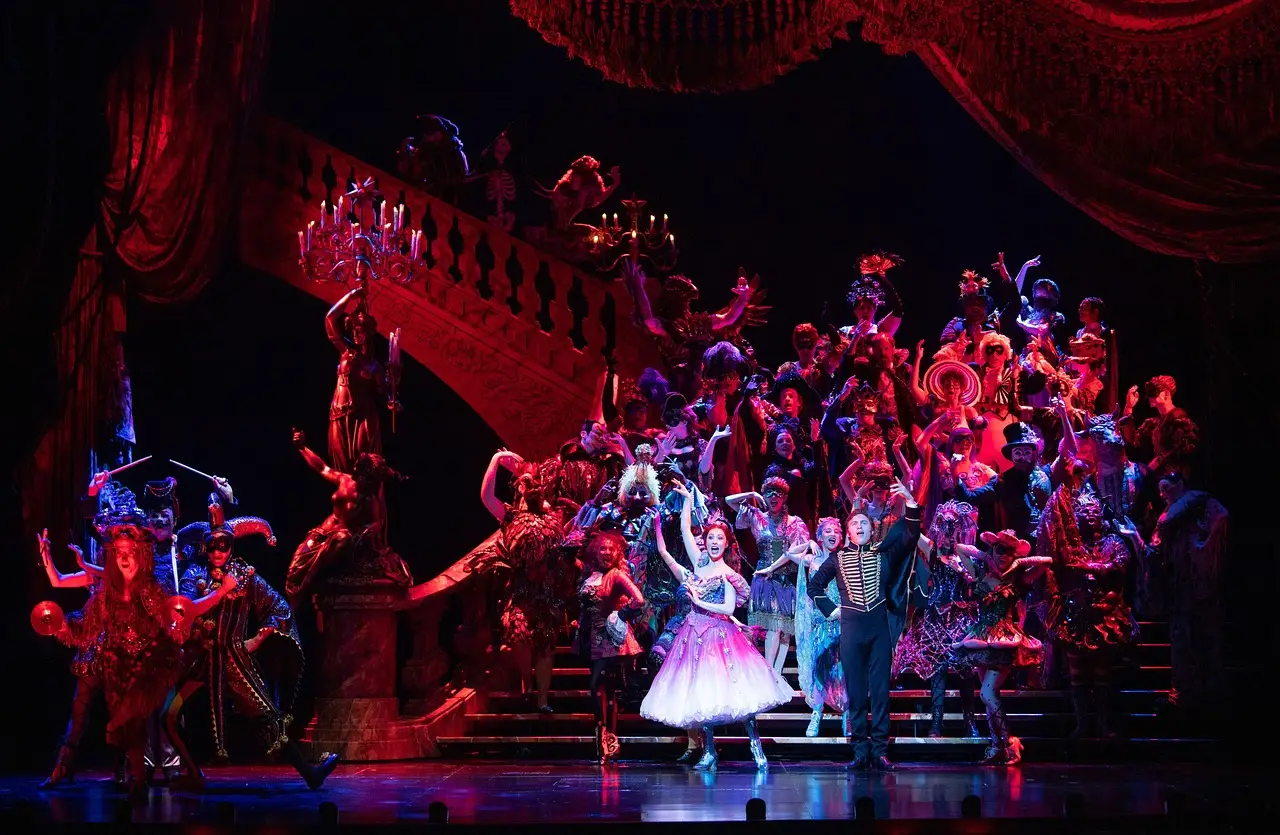
The visual design moves between abstract interpretation and near-literal recreations of Chagall's paintings. Shapes, colors and projections build original compositions in some moments and drop recognizable painterly elements into the stage picture in others. Colin K. Bills's lighting shifts color to track the emotional language of the show. Camilla Tassi's projections extend that visual storytelling, Misha Kachman's modest set relies on transformation rather than scenery, and Frank Labovitz's costumes and Aoife Creighton's props support the world without pulling focus.
The production carries a self-aware streak, poking fun at the artists themselves, the art world and theatre as a form. It also plays a running joke about interpretation: artists make work out of love and lived experience, while admirers and critics hunt for meanings that may not be there at all.
Jewish tradition runs through the show as more than background — it's woven into the characters' relationships and their historical setting. When the story turns toward the antisemitism facing Jewish communities in Russia, everything the production has built recedes. The music pulls back, the visual language dims, and the fantasy thins out. Because the show has taught the audience to associate love with light, color, movement and music, their absence becomes its own kind of storytelling.
What doesn't land?
One sound-design choice falls short. Crawford and Michaels create such an effective live soundscape with their instruments that conventional effects — the review names the gunshot — feel weaker by comparison. The reviewer wished those moments had stayed practical and consistent with the production's otherwise inventive approach.
The verdict: music becomes movement, movement becomes storytelling, and color and shape become a language of their own. As the review puts it, "Love is beauty. Love is color. Love is shape." The production reminds audiences that art doesn't have to stay confined to a canvas, a song or a stage — "Sometimes, it is found in the space between all three."
Theater J, located at Edlavitch DCJCC, 1529 16th Street NW, Washington, DC, has already moved on: tickets for its upcoming productions are available online.
Source: mdtheatreguide.com
More from Grace Kim
Show full bio
Correspondent covering technology and product news in arts in the broadest sense at Arts & Voices.
1,185 articles