Sam Rockwell and John Malkovich Play C.I.A. Men in Martin McDonagh's 'Wild Horse Nine'
Martin McDonagh's 'Wild Horse Nine' sends Sam Rockwell and John Malkovich to Rapa Nui as C.I.A. agents behind the 1973 Chile coup — his angriest, most political film yet, he says.
Programme
- Wild Horse Nine, directed by Martin McDonagh and starring Sam Rockwell and John Malkovich, is now in theaters.
- McDonagh developed the Rapa Nui-set story over roughly 15 years; the breakthrough came about four years ago via the Clash's 'Washington Bullets' from the album Sandinista!.
- The film centers on two C.I.A. agents tied to the 1973 Chilean coup that brought Pinochet to power.
- McDonagh calls it his most political film, surpassing his play The Pillowman.
- Malkovich, who adapted DeLillo's Libra for the stage, signed on immediately over the JFK angle.
Sam Rockwell and John Malkovich play C.I.A. agents stranded on Rapa Nui in Wild Horse Nine, Martin McDonagh's new film now in theaters and, by the director's own account, his most political work to date.
The film follows Lee (Rockwell) and Chris (Malkovich), two operatives who helped engineer the 1973 coup that installed Augusto Pinochet's dictatorship in Chile and then retreat to Easter Island before the fallout hits. Chris, terminally ill, plans to write his memoirs — a plan that has his C.I.A. superiors on high alert.
"I think this is my most political film, for sure," McDonagh said. "Some of the plays touched on those aspects, but The Pillowman's sort of bleak... But because this is about real life events, it feels much more angry in its political context."
McDonagh named The Pillowman — his play set in an unnamed totalitarian state — as the earlier benchmark. The difference here, he argues, is grounding. "Being against overthrowing a democracy — quite an easy stance to take, I think. Unless you're in the CIA."
How the Clash unlocked the story
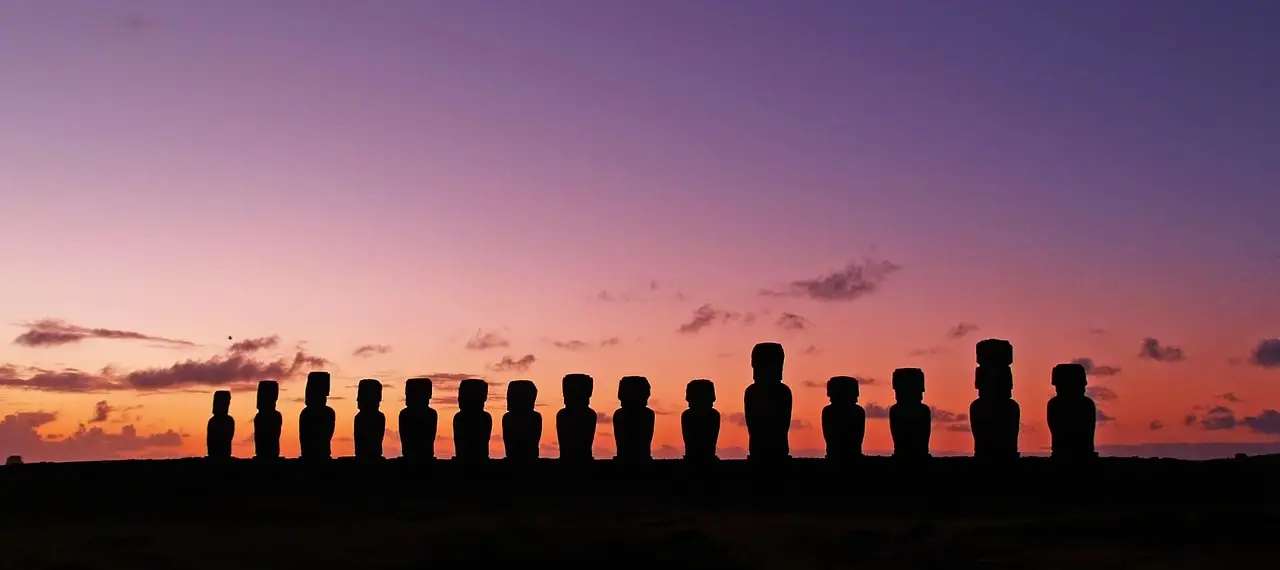
The project took McDonagh roughly 15 years to crack. He first visited Rapa Nui about a decade and a half ago, drawn to the moai — the giant stone heads that anchor the island's tourism — and started sketching a two-man story set there. Early drafts made the pair a father and son. Another version made them actors, and one draft opened with them discussing Harold Pinter.
Nothing clicked until about four years ago, when "Washington Bullets," a track from the Clash's quadruple album Sandinista!, gave him the missing mechanism. The song had first taught a young, punk-loving McDonagh about the 1973 Chilean coup and the C.I.A.'s role in destabilizing a democratic election. Chile's proximity to Rapa Nui supplied both stakes and a setting.
"It's funny you mention Pinter, because he's always been a big influence," McDonagh said. "In Bruges is literally me doing The Dumb Waiter — and Pinter smiled when I told him that. Steal from the best, right?"
The Dumb Waiter is Pinter's play about two assassins waiting to kill a target — the same blueprint McDonagh used for In Bruges (2008), his debut feature about hitmen adrift in Belgium. Wild Horse Nine now functions as that film's unofficial companion piece.
Why Rockwell and Malkovich
McDonagh wrote Lee for Rockwell, his collaborator on Seven Psychopaths (2012), Three Billboards Outside Ebbing, Missouri (2017) and the Broadway production of A Behanding in Spokane (2010). Rockwell credits their bond to "teasing, shit-talking, and our mutual love of old movies."
Malkovich brought his own obsession to the role of Chris, whose dirty-tricks career may have included a presence in Dallas on November 22, 1963. The actor had previously adapted Don DeLillo's novel Libra — which wrestles with JFK assassination conspiracy theories — for the stage, and he signed on immediately.
"I mean, these guys — they're quintessentially American jackasses," Malkovich said. "DeLillo referred to Kennedy's death as 'the seven seconds that broke the back of the American century,' and I believe these were the kinds of guys who would have been involved in something like that."
What does the politics change for the comedy?
Not much, structurally. The film keeps the formula McDonagh has run since The Lonesome West (1997), the play that closed his reputation-making Leenane Trilogy: two men, dialogue splitting the difference between Pinter and David Mamet, sudden bursts of violence. Here the pair riff on national cheese superiority, surrealist bomb decoration and a Western shot from a horse's point of view.
The anger sits underneath. "Old men can rage, too," McDonagh joked. "We just do it slower." He's screened the film for several audiences and heard "the laughs and the gasps at things that happened in 1973, but feel like they're coming very much from a 2026 viewpoint."
Still, McDonagh insists the film's engine is affection, not politics. "All my work is really about love," he said. "It had to be... the joy of them being together one last time in Easter Island and the love underneath all of the political stuff."
"Male friendships are at the center of so much of Martin's work, and he kept emphasizing the love between these two guys," Rockwell said. "None of this works if you don't get the sense that my character and John's character have a real bond, you know?"
McDonagh closed with a jab at the present: "Nixon had to resign because of the shit he'd done. There's like 100 times worse stuff in the last year that they don't even care about keeping secret, and we don't hold them accountable for it. But don't worry. Our movie is going to fix all of that!"
Whether audiences take the film as a love story or an indictment, awards season will now decide — Wild Horse Nine arrives with the junket circuit, and the Battle of the Tables, already in full swing.
Source: rollingstone.com
More from Grace Kim
Show full bio
Correspondent covering technology and product news in arts in the broadest sense at Arts & Voices.
1,156 articles