Scientists Say Van Gogh's 'Starry Night' May Date to July 1889, Not June
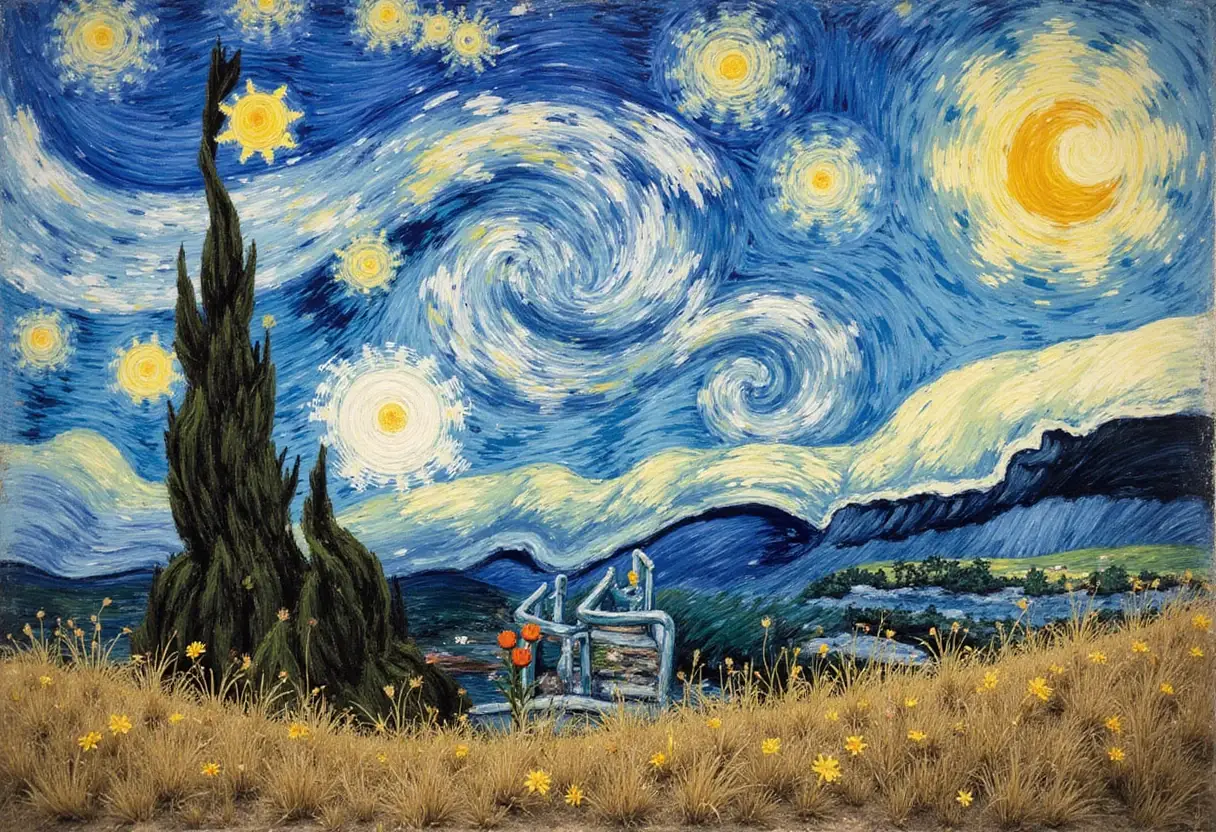
A Scientific Reports study by four South Korean researchers argues that van Gogh's 'The Starry Night' depicts a July 1889 night sky, challenging the accepted June dating of the MoMA masterpiece.

Programme
- The study was published in Scientific Reports on Thursday, October 22.
- Researchers propose July 1889 as the painting date, one month later than the accepted June 1889.
- The team of four South Korean researchers used star-position analysis, weather models and van Gogh's letters.
- The Starry Night is in the permanent collection of the Museum of Modern Art in Manhattan.
- Van Gogh painted the work during his yearlong confinement at the Saint-Rémy-de-Provence asylum.
By Elena Vasquez
A study published Thursday, October 22, in Scientific Reports argues that Vincent van Gogh painted The Starry Night in July 1889, not June 1889 as scholars have long held. A team of four South Korean researchers — Elijah Jeong-hyun Kim, Suna Kang, Jungwoo Song and Ho Jin — contends that the painting's celestial forms match a night sky that appeared a month later than the accepted date.
The stakes are art-historical. The Starry Night hangs in the permanent collection of the Museum of Modern Art in Manhattan and ranks among the most reproduced images in Western art. Its dating has rested on the calendar of van Gogh's stay at the French asylum in Saint-Rémy-de-Provence, where he began a yearlong confinement in 1889, months after severing his left ear during a quarrel with the painter Paul Gauguin. The view from his asylum window is thought to have inspired the canvas.
What does the new study claim?
The researchers analyzed the painting's stars using tools that track star patterns and positions, combined with contemporary weather models and van Gogh's letters. They describe the method as a "multidisciplinary framework."
Their central finding: several celestial forms in the painting contradict the June 1889 date and align better with conditions in July of that year.
"Earlier astronomical readings, constrained by the conventional June dating, reached mutually exclusive conclusions, and the painting's celestial arrangement was never quantitatively tested," the report's abstract reads.
The team goes further in its conclusion: "These findings suggest that the night sky in The Starry Night originated from observation of a specific celestial arrangement, and call for reconsidering the June dating."
Why the dating has resisted quantitative testing
The June 1889 attribution has stood for generations without a statistical test of the sky itself, according to the authors. Previous astronomical readings, they write, produced results that could not all be true at once — mutually exclusive conclusions that left the question unresolved.
The new approach changes that. By quantitatively testing the positions of the painted stars against reconstructed skies and weather conditions over Saint-Rémy-de-Provence, the researchers claim to identify a specific celestial arrangement that van Gogh could have observed — in July, not June.
In plain terms: the study shifts the painting's likely origin by roughly one month, from a sky visible in early summer to one visible in high summer.
What happens next?
The study is a peer-reviewed call for reconsideration, not a settled revision. MoMA has not, according to the published report, responded with a recataloguing, and any change to the painting's official date would require corroboration from van Gogh scholars, conservators and the museum itself. If the July dating holds, curators and biographers would need to re-anchor one of the world's most famous paintings to a different stretch of the artist's turbulent asylum year — and to a slightly later night above Provence.
Original: nature.com
More from Elena Vasquez
Show full bio
Senior reporter covering technology and product news in arts in the broadest sense at Arts & Voices.
716 articles