Stacey Dooley’s Kangaroo Island journey finds fire, fluff and limits
Stacey Dooley reaches Kangaroo Island, where fire survivors, wildlife carers and a determined 17-year-old contractor complicate a fluffy Channel 4 travel series.
Programme
- Half of Kangaroo Island was destroyed by bushfires seven years ago.
- Kangaroo Island is Australia’s third-largest island and has just 5,000 residents.
- Dooley reaches Kangaroo Island on a 45-minute ferry from Cape Jervis.
- Dooley learns from Rodney that the worst night brought 16 lightning strikes.
- Jack, 17, has run his contracting business on Kangaroo Island for four years.
By Marcus Bennett
Half of Kangaroo Island was destroyed by bushfires seven years ago. Stacey Dooley’s Australia: Off the Beaten Track begins in the aftermath, carrying its presenter from trauma toward pleasure.
She reaches Karta Pintingga, also known as Kangaroo Island, on a 45-minute ferry southwest from Cape Jervis in mainland South Australia. Australia’s third-largest island is slightly larger than Cornwall and home to just 5,000 people. Its communities have rebuilt carefully since the fires.
Dooley established herself on BBC Three by covering child labour, sexual exploitation, poverty, religious extremism and homelessness.
Her lack of television-star pretension and direct questions distinguished her work. Since winning Strictly Come Dancing in 2018, she has moved toward mainstream television. She also sits at the centre of a three-documentary BBC One run about murder, suicide and addiction.
Channel 4 now gives her an inoffensive schedule-filler built around personality. The travel series offers less evidence than her earlier reporting, but its subject supplies several tests of her ability.
At Kangala Kangaroo and Wildlife Rescue, Lisa and Jared Karran set up the centre during the fire. They saved orphaned kangaroos, koalas, wallabies and possums from the flames and have continued caring for them.
Lisa’s account supplies one of the programme’s flashes of singular colour. Recounting what she found, she describes kangaroo mothers standing on scorched ground after lifting their offspring back into the pouches they had occupied when smaller. The joeys were safe. The mothers’ feet had been burned to the bone, and the injuries proved fatal.
The fire itself remains horrific in ways that resist both imagination and articulation. Ben, a sheep farmer who lost his house and flock, says, “It’s hard to put into words,” and reaches the limit of what direct speech can convey.
On the way to Ben’s farm, Dooley watches smartphone video of his engulfed back yard. It is the first footage of the fire she has seen. Her turn-up-and-wing-it approach does not unlock a particular emotion. Facing Ben, she says, “The video – this is such an obvious thing to say, but the video – utterly, utterly terrifying,” and gives him little to respond to.
What does the lighter format change for Dooley?
It changes her task. The hard-news reporter becomes a presenter looking for interest in ordinary encounters, and that shift exposes both warmth and limitation. The format also obliges her to conjure a story from ordinary life. Light factual can be harder than reporting from a war zone or a cult when no exploitation or outrage supplies the dramatic engine.
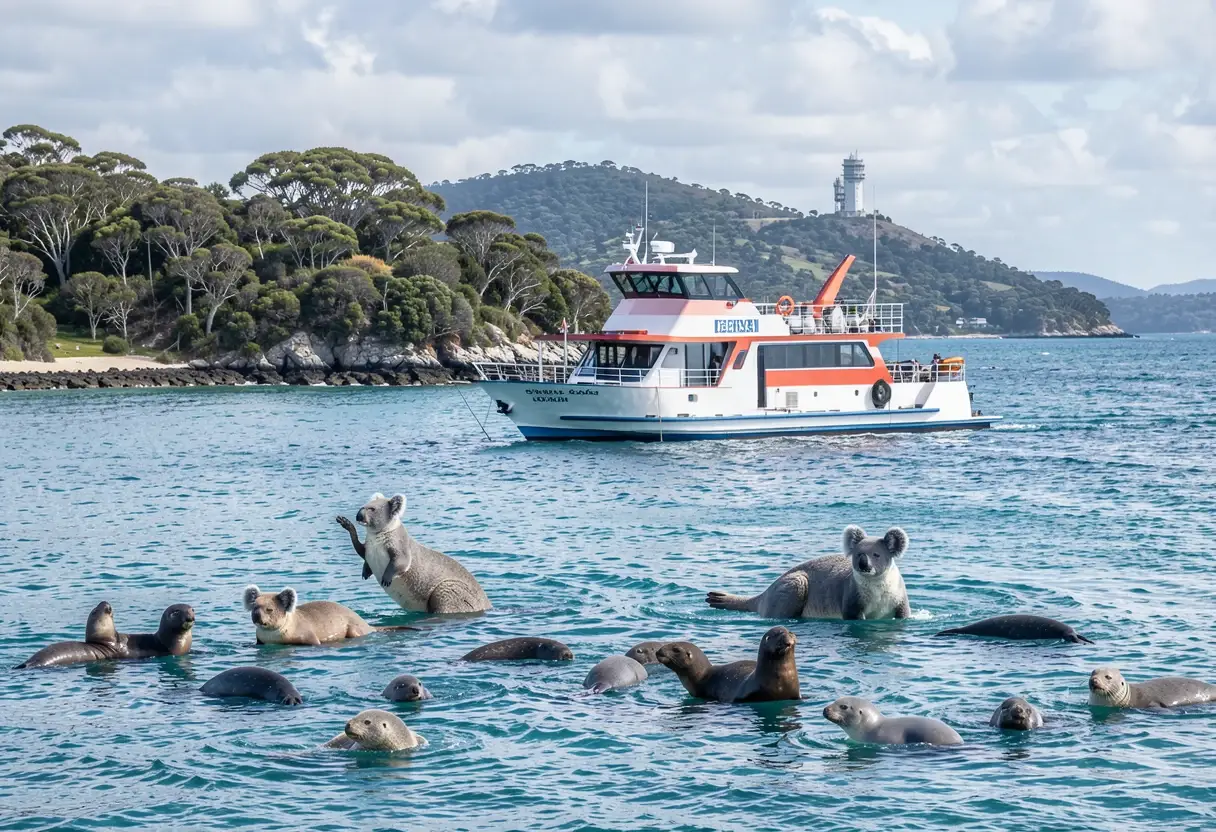
After leaving the fire’s aftermath, Dooley heads for the island’s pleasures, including a boat trip to swim with seals. She admits that she was surprised the animals have fur. Her joyful anticipation—“This feels like such – such an amazing opportunity!”—carries a note of self-mockery as she catches herself mid-platitude.
The seals look nice and cute. Bobbing cheerfully in the cold ocean, Dooley delivers a piece to camera before the ad break: “I didn’t quite realise it would be this spectacular. This has been like, for me, top tier. Unbelievable!” Her performance supplies excitement rather than insight. Bill Bailey or Jane McDonald might have matched the blandness.
Signs of a firmer voice appear when she returns to the bush blazes. At a fire station, she interviews Rodney, the man in charge, about swathes of his patch being obliterated. Her response, “It must have been devastating”, shows more restraint than her earlier reactions.
She learns from Rodney that the worst came from a night when Kangaroo Island was hit by 16 lightning strikes. Her second response, “That’s unbelievable. I didn’t realise there were quite so many lightning strikes”, still registers surprise more than understanding.
At the volunteer-run Western Districts Football Club, Dooley has an amusing go at learning Australian rules football. She bonds with 17-year-old Jack. His extreme mullet and desire to stay on Kangaroo Island for life make him compelling. He has run his own contracting business there for four years.
Dooley returns by ferry with a decent snapshot of this part of the world. Obtaining it was hard work.
The Karrans’ rescue work, Ben’s ruined livelihood, the lightning-driven fire and Jack’s plans supply more specificity than the seal excursion. Dooley serves the island best when people, evidence and consequence replace reflexive astonishment. The lighter format will stand or fall on whether she preserves that discipline.
Source: theguardian.com
More from Marcus Bennett
Show full bio
Staff writer covering people, launches and day-to-day practice in arts in the broadest sense at Arts & Voices.
1,204 articles