Teatro alla Scala's Faust returns after 16 years, led by Rebeka
Teatro alla Scala's Faust returned after 16 years. Marina Rebeka's Marguerite led Erath's circus staging and Rustioni's pit, after a strike moved the 20 October premiere.
Programme
- Gounod's 'Faust' returned to Teatro alla Scala after a 16-year absence, having last played there in 2010.
- The premiere scheduled for Tuesday, 20 October was cancelled by a strike seeking a 15 percent pay rise; the second performance became the premiere.
- The production was co-produced with the Palau de les Arts, the Staatsoper Unter den Linden and the Teatro Real, with Johannes Erath directing his La Scala debut.
- Marina Rebeka sang Marguerite, Vittorio Grigolo sang Faust and Alex Esposito played Méphistophélès under Daniele Rustioni.
- The 2026–27 programme adds Bizet's 'Les Pêcheurs de perles' in January and February and Massenet's 'Don Quichotte' in May and June, after 'Otello' opens on 7 December.
By Elena Vasquez
Teatro alla Scala's Faust returned after a 16-year absence, and OperaWire's review named Latvian soprano Marina Rebeka the undisputed star of the evening. The Gounod opera had not played at the Milanese theatre since 2010.
The production closed the 2025–26 season, OperaWire reported, with Verdi's Otello opening the next one on 7 December. Scala assembled it with the Palau de les Arts in Valencia, the Staatsoper Unter den Linden in Berlin and the Teatro Real in Madrid.
Why did the 20 October premiere change?
The premiere scheduled for Tuesday, 20 October was cancelled after a strike by orchestra, chorus, technical staff and theatre employees, OperaWire reported. Workers demanded a 15 percent pay rise, better work organisation, employee benefits and fewer working hours.
An agreement was reached, and the second performance became the premiere.
Plainly, the strike moved the premiere to the next scheduled performance, and the season finale stayed on the programme.
What does the circus setting achieve?
Johannes Erath signed the production, making his debut at the historic theatre, OperaWire noted. A trained musician and former violinist with the Vienna Volksoper, Erath had explored distorted, dreamlike worlds in Maria de Buenos Aires in Düsseldorf.
Here he sets Faust in a circus: not merely entertainment, but a symbolic stage where opposing meanings confront. A carousel of circus apparitions unfolds, with acrobats and tumblers of outstanding visual quality.
OperaWire found the images sustained a recognisable narrative thread and landed with force when the score called for them. The reviewer judged the exaggerated elements sometimes misplaced in passages demanding intimacy.
Some directorial choices remain hard to decipher, OperaWire noted, yet the concept works overall, succeeding in the apotheotic ballet finale and the church scene transformed into a ritual with blasphemous overtones.
Satanic altar boys leap and fly across the stage as Méphistophélès, dressed as a trouserless Pope, presides over the ceremony. The boys scatter incense and descend into the stalls to beg alms. Later, Méphistophélès kills Valentin, while a double holding a balloon leaves the stage, a symbol of Valentin's soul in transit.
OperaWire praised the ending for cinematic beauty: dark hues, and a gradual fading of opera and life.
Set designer Heike Scheele and Bibi Abel's projections carried the transformations, OperaWire credited, moving from a mysterious black space to a colourful circus, then to a church.
The final scene left an empty stage with an autopsy table and corpses in supposedly open refrigerators. Fabio Antoci's lighting supplied the cornerstone, combining cold light and smoke in close synchronisation with the music and movement.
In short, Erath's visual argument lands hardest in the church ritual and the image of a life dissolving at the close.
What did the orchestra and chorus contribute?
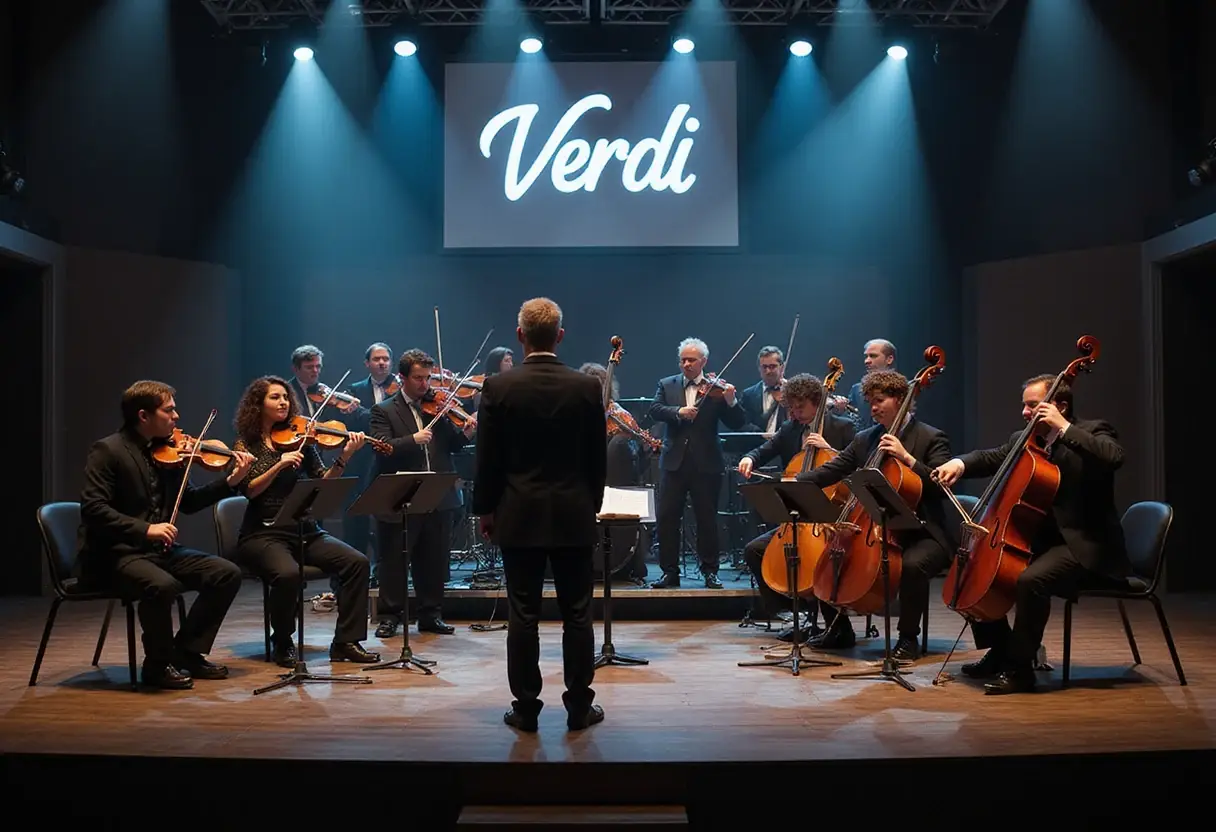
Daniele Rustioni conducted with a clear, assured and perceptive baton, OperaWire reported. The review highlighted his command, interpretive flexibility, grasp of French repertoire and control of dynamics, revealing Gounod's stylistic contrasts through transparency and balance.
Rustioni also watched the singers' volume and intensity, OperaWire said. The reviewer singled out his introduction to 'Il était un roi de Thulé', the late dramatic passages and the apotheotic ballet opening Act four.
The Teatro alla Scala Orchestra again demonstrated its high musical standards and versatility, OperaWire judged. The internal organ gave the church scene sheer grandeur, while chorus master Alberto Malazzi led an outstanding ensemble whose members sang and danced during the Act two waltz.
Their 'Gloire immortelle de nos aïeux', the soldiers' chorus, justified its exceptional volume and moved the audience in Act four, the review reported.
Plainly, the pit supplied discipline and the chorus supplied spectacle of its own.
Who defined the cast?
Vittorio Grigolo's Faust combined splendid timbre, good technique, stage presence and theatrical temperament, OperaWire found. The Tuscan tenor's impeccable French diction let him portray an old man willing to strike a pact with the devil to regain his youth.
His duets with Marguerite and Méphistophélès carried expressiveness, and 'Salut! demeure chaste et pure' built from filato to fortissimo, very much alla italiana, OperaWire wrote.
Alex Esposito's Méphistophélès moved through irony and uninhibited physical command, OperaWire said. The review listed his disguises: a dead man revived in a funeral parlour, a lion tamer with a whip for 'Le veau d'or', an orchestra conductor, the Pope, the devil and a surgeon.
A splendid timbre and exceptional technique in the lower register made the seduction musical as well as theatrical, the review concluded, calling him one of the production's greatest successes.
Rebeka combined class and elegance with delicacy, strength, lightness and dramatic intensity, OperaWire wrote. Her voice, in one of its finest moments, covered the entire tessitura with an immaculate upper register.
Her 'Il était un roi de Thulé' turned melancholic, and 'Ah! je ris de me voir si belle', the Jewel Song, became one of the evening's great moments. Elegant phrasing, impeccable French diction and colours of the highest calibre completed the portrait.
The supporting cast held its own, according to OperaWire. Ernesto Petti's Valentin showed beautiful vocal quality and great expressiveness in 'Avant de quitter ces lieux', as he commends his sister to God.
Marcela Rahal's Siebel, in love with Marguerite, excelled in 'Si le bonheur à sourire t'invite'. Hyeonsol Park played Marthe, Marguerite's neighbour, and Xhieldo Hyseni played Wagner, Valentin's friend.
In short, Rebeka's Marguerite set the vocal standard, with Grigolo's dramatic tenor and Esposito's shifting devil around her.
What comes after the season finale?
The entire company received prolonged applause at the curtain, OperaWire reported. The review lists two further French works for 2026–27: Bizet's Les Pêcheurs de perles in January and February, and Massenet's Don Quichotte in May and June, after Otello opens on 7 December.
The test ahead is whether that Bizet-and-Massenet pairing can match the international co-production model that brought Faust to Milan.
Source: Opera Wire
More from Elena Vasquez
Show full bio
Senior reporter covering technology and product news in arts in the broadest sense at Arts & Voices.
1,164 articles