Tom McCarthy's The Rhyl Poster Plants a Spy Drama Inside the EU Court
Tom McCarthy's The Rhyl Poster, a riddling spy drama set inside the EU's Court of Justice in Luxembourg, tests how far the once-rejected author can now push his readers.
Programme
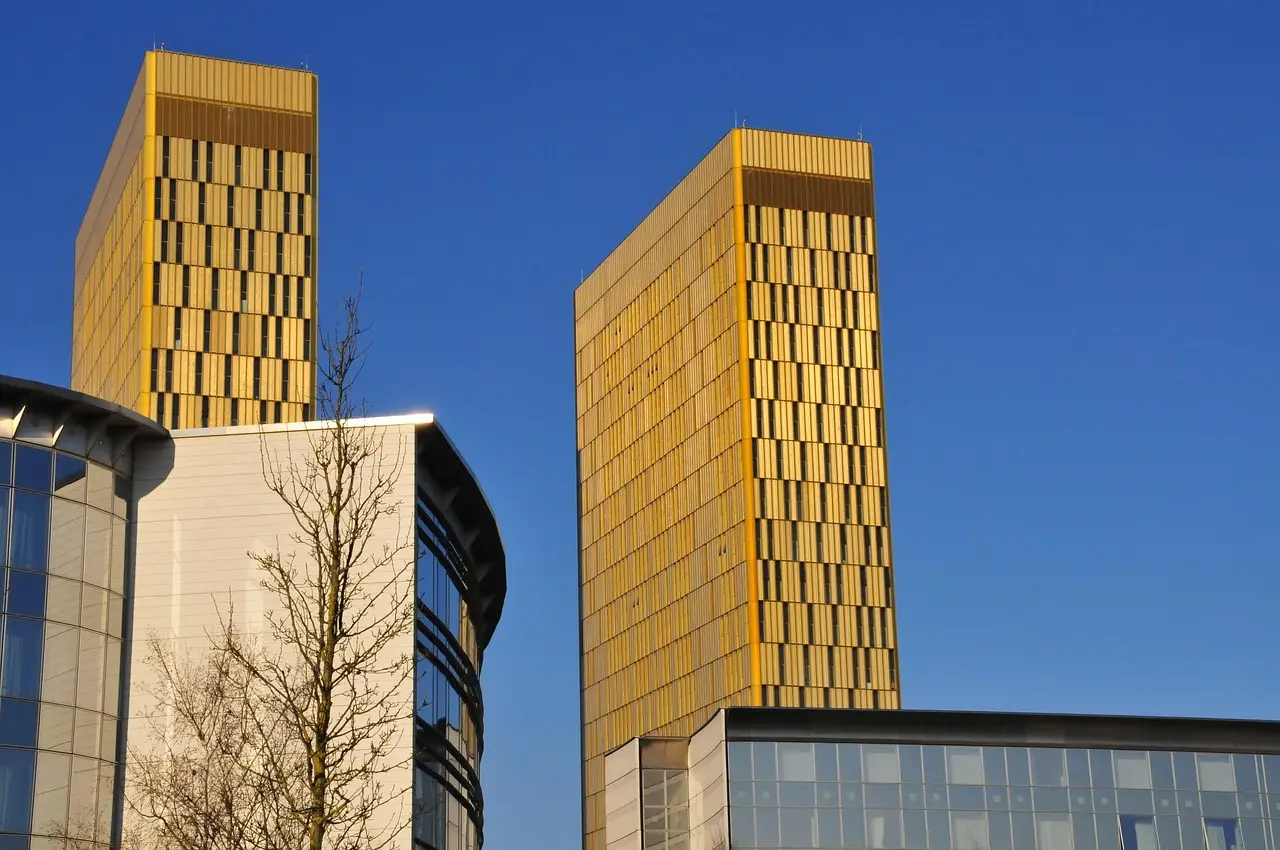
- Tom McCarthy's new novel The Rhyl Poster is set inside the Court of Justice of the EU in Luxembourg.
- McCarthy self-published Remainder via a Paris art collective in 2005 after British publishers rejected it.
- C (2010) and Satin Island (2015) were both Booker-shortlisted; The Making of Incarnation appeared in 2021.
- The Goldsmiths prize for formally daring fiction was established in 2013.
- The Guardian published its review of The Rhyl Poster on 2 November.
Tom McCarthy's new novel, The Rhyl Poster, is an abstruse spy drama set deep inside the polyglot operations of Luxembourg's Court of Justice of the European Union. The choice of venue carries an edge. McCarthy, a longtime Berlin resident who holds a Swedish passport after Brexit, has immersed himself in the minutiae of the institution his native Britain elected to leave.
The Guardian's reviewer frames the book as the latest test of a question that has shadowed McCarthy's career: when the mainstream and the avant-garde become kissing cousins, what remains for the novelist who built his reputation on challenging the establishment?
How did McCarthy get here?
The story begins in 2005. British publishers rejected McCarthy's debut novel, Remainder, about an amnesiac who spends a windfall restaging his past. McCarthy responded by releasing it in a limited edition from a Paris art collective, bypassing orthodox routes to market. Three years later, Zadie Smith celebrated the novel in an essay as a path-breaking overthrow of establishment-sanctioned "lyrical realism". The literary press soon gave McCarthy more room, and his regular denunciations of English fiction — not least its "middlebrow" ignorance of challenging ideas from the continent — shaped bookish conversation at the turn of the decade.
McCarthy belongs to a cohort of experimental novelists whose renown grew after the 2008 financial crash, alongside Deborah Levy, Eimear McBride and Claire-Louise Bennett. His zeal has not pleased everyone. The New Statesman once called him Britain's "most galling interviewee".
What does the mainstream's embrace change for McCarthy?
The reviewer's answer is that the terrain has shifted in McCarthy's favour. Fitzcarraldo Editions, the publisher of innovative European writing, has become a commercial force. The Goldsmiths prize, established in 2013 to spotlight formally daring fiction amid panic about the philistinism of award panels, now feels less urgent. M John Harrison's The End of Everything — a novel the reviewer calls inscrutable — sits on this year's Booker shortlist and is a bestseller besides.
Against that backdrop, McCarthy has pushed readers harder rather than eased off. His previous novel, The Making of Incarnation (2021), was a dense, Pynchonesque espionage yarn about motion capture technology. The reviewer reads it as evidence that McCarthy took the Booker shortlistings of C in 2010 and Satin Island in 2015 as a green light to raise the difficulty. The Rhyl Poster, another riddling spy story, supplies further evidence for that theory.
Not that the new book earns an unqualified welcome. The review's opening line describes "the hallucinatory crisis of a war-scarred jurist with a painkiller dependency" and warns that it makes for frustrating reading. The verdict on whether the riddles reward the patience they demand sits behind the Guardian's paywall, in the full review published on 2 November.
For readers tracking the fate of experimental fiction, the stakes are clear enough. A novelist who once had to publish himself in Paris now releases demanding work through established channels to a market that has learned to buy it. Whether The Rhyl Poster confirms that McCarthy's instincts outran his readers, or the reverse, will shape how his next move is read.
Source: Guardian Books
More from Marcus Bennett
Show full bio
Staff writer covering people, launches and day-to-day practice in arts in the broadest sense at Arts & Voices.
950 articles