Toronto Biennial's 'Things Fall Apart' Asks What Rupture Teaches
The fourth Toronto Biennial, 'Things Fall Apart,' curated by Allison Glenn, spans 13-plus sites with works by Dawoud Bey, Antonio Obá and more, through December 20.
Programme
- The fourth Toronto Biennial of Art, 'Things Fall Apart,' runs through December 20 across more than 13 Toronto sites plus venues in Anchorage and Times Square.
- Curator Allison Glenn assembled more than 30 artists and collectives, taking the Great Lakes and water as the edition's point of departure.
- Dawoud Bey's two-channel video '350,000' (2023) anchors 'Material Histories, Living Landscapes' at the Art Gallery of Ontario.
- Antonio Obá's 'A Folia: travessia' (2026) reimagines Douglas Martin's 1957 photograph of 15-year-old Dorothy Counts integrating a Charlotte, North Carolina high school.
- Rouzbeh Akhbari's 30-minute film 'Of Wool and Diesel' (2026) at Mercer Union follows the informal sheep trade around the Strait of Hormuz.
The fourth Toronto Biennial of Art, titled Things Fall Apart, remains on view across more than 13 Toronto sites and select venues as far afield as Anchorage and Times Square through December 20. Curator Allison Glenn gathered more than 30 artists and collectives for an edition that takes the Great Lakes as its point of departure.
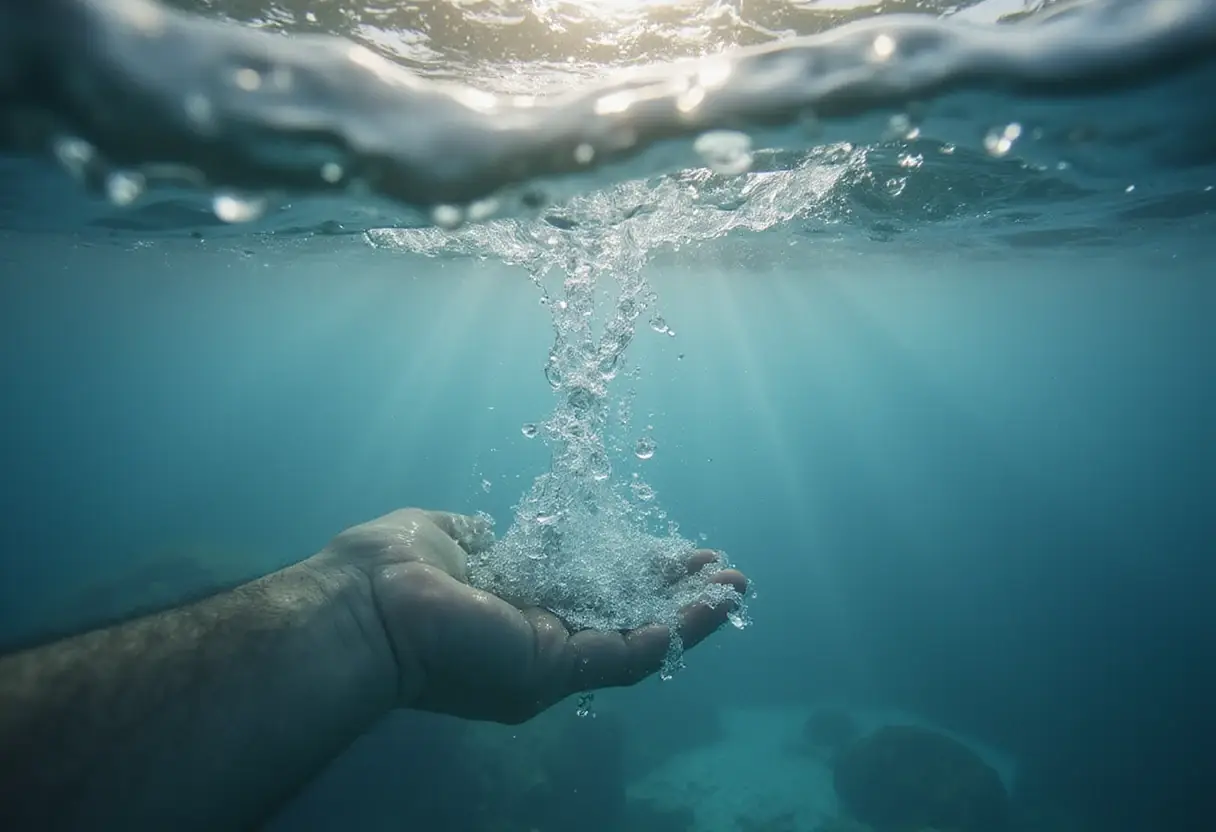
The catalog quotes Canadian Prime Minister Mark Carney, who declared at this year's World Economic Forum in Davos that the world is "in the midst of a rupture, not a transition." With Canada–United States relations at an unprecedented low, a cross-border exhibition built around shared waterways lands at a fitting moment. Glenn, who spent her childhood in Detroit crossing into Canada through Windsor, keeps the Biennial's long-running focus on water and asks what artists working with rupture can teach us about histories, borders, and movement.
What carries the show?
The most affecting works treat rupture as an imaginative encounter rather than a settled narrative. At the Art Gallery of Ontario, Dawoud Bey's Material Histories, Living Landscapes hangs photographs from three landscape series around his two-channel video "350,000" (2023), alongside sculptures and ritual objects from the AGO's collection with roots in Nigeria, Ghana, and the Kingdom of Kongo. The pairing sets up a sonic and visual call and response across the Middle Passage, showing how the afterlife of slavery permeates the physical world around us.
At the University of Toronto Art Centre, the main venue, Antonio Obá strings rows of brass bells across a gallery for "Jardim" (2022–26); the work sounds only when bodies move through it, so memory is reperformed rather than stored. The path leads to "A Folia: travessia" (The Revelry: A Crossing, 2026), a large painting that reimagines Douglas Martin's 1957 photograph of 15-year-old Dorothy Counts integrating a high school in Charlotte, North Carolina. Obá replaces the jeering crowd with one resembling a supportive march and a New Orleans-style street carnival, an intervention that points toward a restorative alternate reality.
A second group of works draws on knowledge held in bodies and materials:
- Wen Liu's "In Light, Where Edges Yield" (2025) suspends Chinese herbal medicines, prescribed after her father's death, in a human-scale steel-and-resin sculpture built around a spinal column; the herbs glow like stained glass.
- Taqralik Partridge's "umiakkut (by boat)" (2026) revisits her grandmother's journey across the Hudson Strait in a mirrored room, conjuring the vessel from found materials, sewing, and beadwork while an elder relative's voice drifts through a soundtrack of water.
- At the Royal Ontario Museum, Raphaël Barontini's "Follow the North Star – a Tribute to Harriet Tubman" (2026) fills the Crystal Court with draped textile panels connecting Caribbean aesthetics to the Underground Railroad.
- In Scarborough, Nirbhai (nep) Singh Sidhu's "A Deathless Potential In Remembrance By You" (2026), a permanent structure at the Scarborough Gurdwara built with earth from Sirhid, Punjab, is made for simran, the Sikh practice of stillness and deep listening.
- Rouzbeh Akhbari's 30-minute film "Of Wool and Diesel" (2026) at Mercer Union follows the informal sheep trade around the Strait of Hormuz, made as war in Iran was shutting down trade routes.
What does the exhibition miss?
Cohesion is one challenge. The physical distance between sites and the range of subjects, from Inuit migration to Gulf smuggling, make the Biennial hard to hold as a whole. The deeper problem is conceptual. Rupture, as Carney and others envision it, presupposes a prior unity, and the exhibition never satisfactorily troubles that perceived unity. Glenn's catalog essay raises the right question — rupture to what, and by whom? — but the show seldom pursues it with rigor. Was there a time since modernity, tied to slavery, colonial extraction, empire, forced migration, and genocide, when the world order did not feel ruinous to those on its underside? The rupture may be less new than newly felt by those who sought to order the world to their liking. Even so, Things Fall Apart stands as a provocative exploration of artists who adapt to social, political, and ecological realities rather than mourn what has broken.
Original: artmuseum.utoronto.ca
More from Marcus Bennett
Show full bio
Staff writer covering people, launches and day-to-day practice in arts in the broadest sense at Arts & Voices.
696 articles