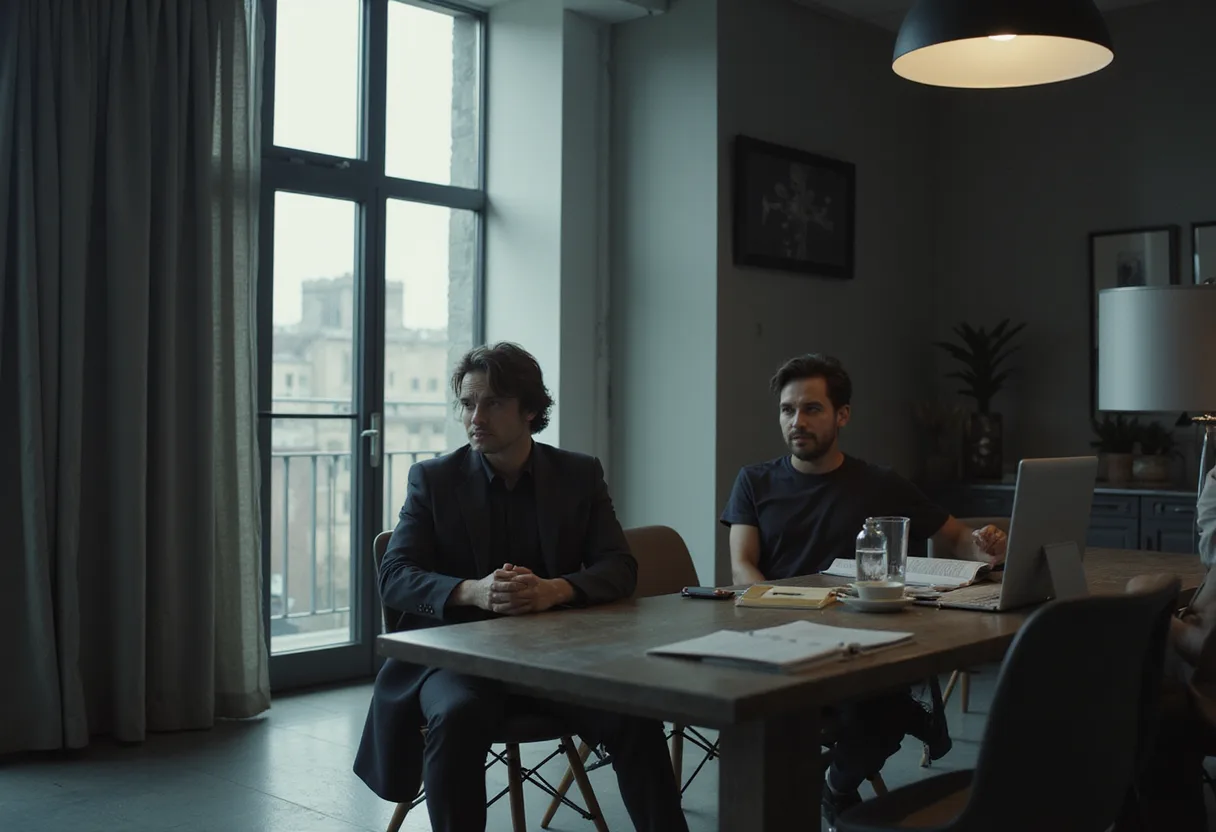
Adam Driver's Gary Pearl Anchors James Gray's 'Paper Tiger'
James Gray's 'Paper Tiger' stars Adam Driver and Miles Teller as Queens brothers ensnared with Russian mobsters in the 1980s — a Greek tragedy drawn from Gray's own family history.
Programme
- James Gray wrote and directed 'Paper Tiger', set in 1970s-80s Queens and the go-go 1980s.
- Adam Driver plays Gary Pearl; Miles Teller plays Irwin; Scarlett Johansson plays Hester.
- Irwin and Hester are based on Gray's parents; Gary is a composite of Gray's uncle and his father's business partner.
- Gray's previous film, 'Armageddon Time' (2022), also drew on his Gotham adolescence.
- The plot turns on Russian mobsters developing the Gowanus canal area as the Italian mafia's grip fades.
James Gray's "Paper Tiger" pits Adam Driver's Gary Pearl against Miles Teller's Irwin in a Greek tragedy set in 1980s Queens. Gray wrote and directed the film, which draws on his own family history.
Cain had Abel, Biff Loman had Happy, Michael Corleone had Fredo — and Irwin Pearl has his older brother Gary. Irwin, a lower-middle-class engineer dreaming of escaping Queens, loves his sibling. The affection shows in their teasing, their talk, their inside jokes. It does not free him from Gary's shadow.
Gary once served as a New York City cop in the 1970s and early 1980s. He quit the force, built and sold a business, and made a fortune. Now he wears expensive Italian suits and drives a Mercedes. Irwin's wife Hester, played by Scarlett Johansson, puts it plainly: Gary "has more money than God." He is the life of the party, the beloved cool uncle who shows his teenage nephews — Scott (Gavin Goudey) and Benjamin (Roman Engel) — the revolver in his ankle holster and, when dropping in late for dinner, has Peter Luger's steakhouse cater it.
What drives the plot?
The Italian mafia's grip on Brooklyn is fading, and Russian mobsters are moving in. They want to develop the polluted no-man's-land around the Gowanus canal. Gary brokers deals between the newcomers and the city's bureaucratic powers, and he recruits Irwin as a "consultant" to bring the area up to code. Both brothers see dollar signs. But the old rules Gary knows no longer apply to this new breed of gangster — the miscalculation that gives the film its title.
Gray has filmed the Amazon ("The Lost City of Z") and outer space ("Ad Astra"), but New York remains his natural territory. "Armageddon Time" (2022), arguably his best film, added autobiographical strains of his own Gotham adolescence. "Paper Tiger" combines his crime-thriller obsessions with those memories. The plot turns when Irwin takes his sons late at night to his new workplace in Carroll Gardens to impress them. The Eastern European clients are not keen on after-hours visits. Things go south. Gary cleans up the mess, and that goes south too.
How much is autobiography?
Irwin and Hester are based on Gray's parents. The encounter with thugs comes from a real-life incident. Gary is a composite of Gray's uncle and a business partner of his father's. The melodramatic third-act pivot for Hester also comes from the filmmaker's direct experience. Gray has said he wanted to revisit the period when the American Dream drove a wedge into his family relations, to argue that a moral compass still matters.
Who delivers on screen?
The ensemble feels like an actual family, from teenage eyerolls to Hester's henpecking. Teller underplays panic while leaning into in-over-his-head helplessness. Johansson handles the melodramatic turn with deftness. Driver gets the meatiest role and pitches Gary's Teflon swagger exactly right — a man who thinks his mere presence equals flashing a badge. In one early scene, Gary dines with his brother at an Italian restaurant, "the last holdout of the Genovese family," moving at ease among mafiosi despite being one of the few non-corrupt cops on the force. He also gets a standout shootout in the tall grass near LaGuardia airport.
The film's power rests on the love between the alpha and beta brothers that circumstances rend asunder. It is an American tragedy — one of relentless ambition and grass-is-always-greener greed — that no loving family escapes. Gray delivers it not as a look back in anger, but as a look back in sorrow.
Source: rollingstone.com
More from Elena Vasquez
Show full bio
Senior reporter covering technology and product news in arts in the broadest sense at Arts & Voices.
1,362 articles