After 20 Years Watching Dancers, a Pianist Says His Technique Changed
Ballet pianist Massimiliano Greco, with 20+ years in the studio, argues in Pointe Magazine that watching dancers reshaped his technique at the keyboard—starting with his eyes.
Programme
- Massimiliano Greco has worked as a ballet pianist for more than 20 years.
- Greco argues the first transformation occurs in the pianist's eyes, not the hands.
- The essay was published by Pointe Magazine.
- Greco says constant improvisation for ballet classes reshaped his muscular and interpretive habits.
- Greco frames the ballet pianist as an artist whose technique evolves through observing human movement.
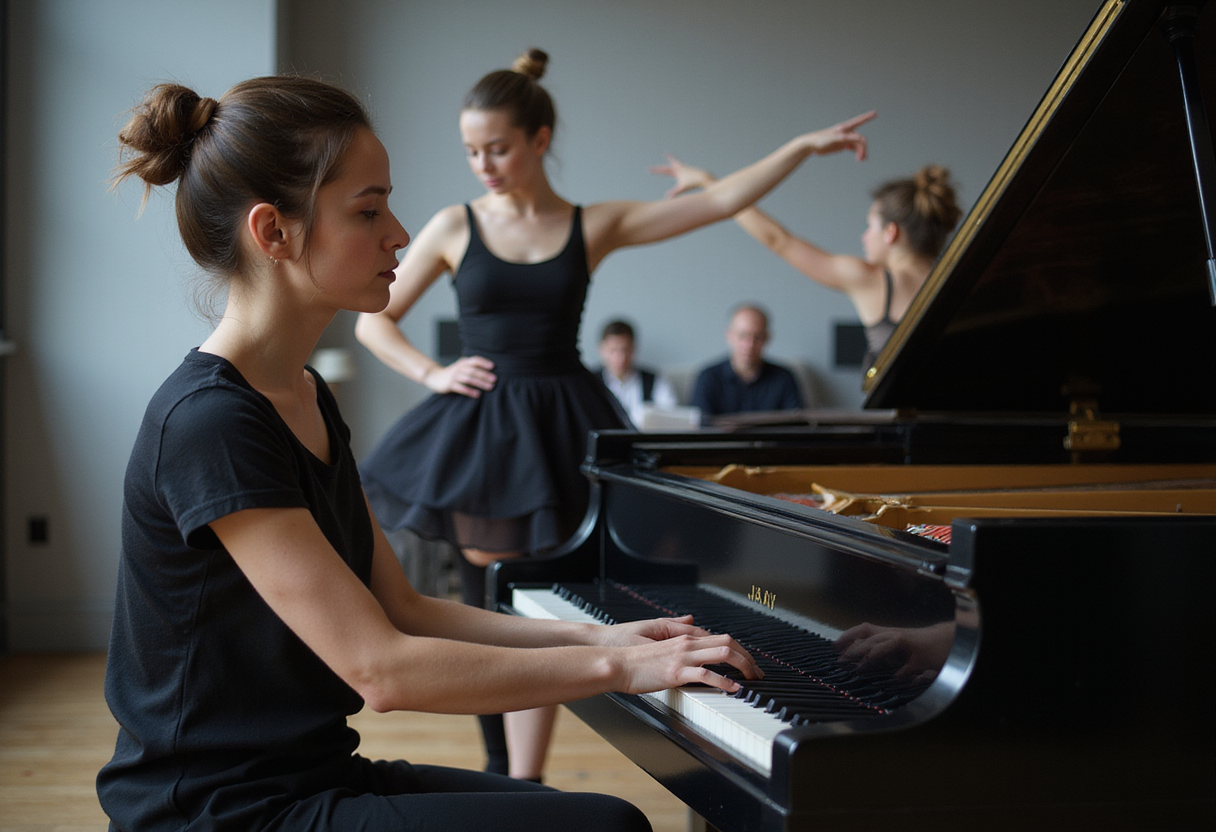
After more than 20 years of playing for ballet classes, pianist Massimiliano Greco argues that the watching changed him as much as the playing. In a recent essay for Pointe Magazine, the accompanist describes how observing dancers reshaped his technique at the keyboard.
Greco's claim is specific: the change begins in the eyes, not the hands. "The eye is no longer reading notes," he writes. "It is reading movement, and movement begins to reshape the pianist's technique."
What does a ballet pianist actually do?
A ballet pianist plays live music for dancers in the studio. Unlike a concert pianist, they rarely play fixed repertoire. Every barre exercise (a warm-up routine done at a wall-mounted rail) and center combination (work away from the rail) calls for improvised accompaniment that matches the teacher's tempo and the dancers' momentum.
Greco frames this role as reading two scores at once: the printed page and the moving dancer. Over years, he argues, the second score begins to override the first.
How does the body reorganize?
Greco identifies several shifts. The first is visual. Ballet pianists, he says, train their eyes to track weight, balance, and spatial intention—dancers' terms for how a body uses gravity and space—almost continuously. They translate that data into musical decisions in real time.
The second is muscular. Playing for hours daily demands what Greco calls "an exceptional economy of movement." His own effort distribution changed, he writes, gradually through interaction with dancers. Tension and release now follow the breath patterns of the room.
The third is interpretive. A legato (smooth, connected) passage accompanying a port de bras (a sweeping arm movement) calls for different physical organization than one supporting a grand rond de jambe (a large circular leg gesture). The audible result may sound similar, Greco notes, but the body's internal choreography does not.
Why hasn't this been documented?
Greco acknowledges a blind spot in both fields. Music scholarship has studied the ballet accompanist's supporting role and improvisational craft. Dance scholarship has studied the pianist as collaborator. Neither, he argues, has examined whether dance itself physically reshapes the pianist.
"Something changes—not only in the music, but in the body that produces it," Greco writes.
What does this change for piano training?
Practically, it suggests conservatories might reconsider how they train collaborative pianists. Standard pedagogy focuses on score interpretation and keyboard mechanics. Greco's experience points to a third axis: motor learning (the process of acquiring movement skills through repetition and feedback) drawn from watching another art form.
For dancers and teachers, the piece reframes the studio pianist as more than a tempo-keeper. The accompanist becomes a co-performer whose instrument recalibrates with every class.
Greco frames his essay as an opening, not a verdict. "This is where one of the most fascinating intersections between music, dance, and motor learning remains to be explored," he concludes. Pointe Magazine has placed his account at the center of a conversation about who, exactly, the ballet pianist is becoming.
Source: Pointe Magazine
More from Grace Kim
Show full bio
Correspondent covering technology and product news in arts in the broadest sense at Arts & Voices.
444 articles