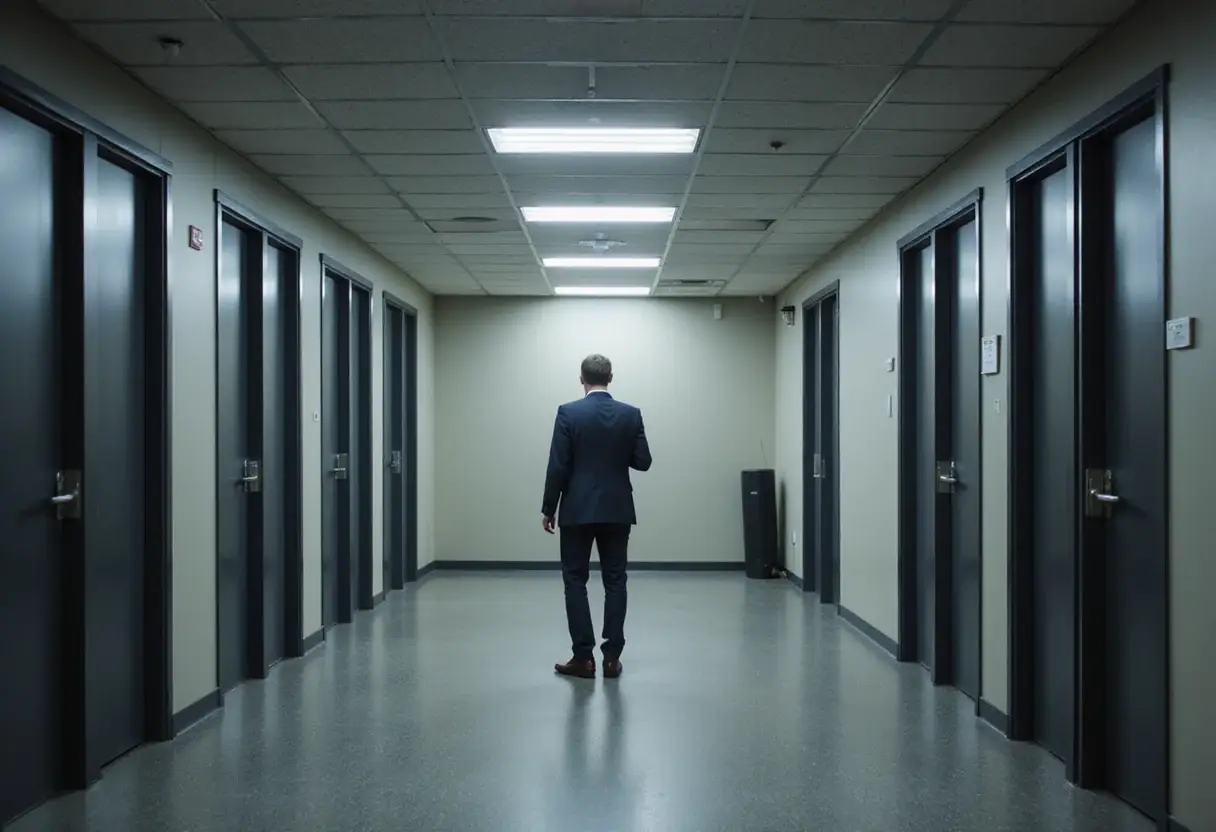
'Backrooms' VFX Supervisor Reveals How Kane Parsons' Blender Pipeline Built the Film
"Backrooms" VFX supervisor Edward Douglas explains how Kane Parsons' Blender-built sets and a DIY pipeline shaped A24's under-$10-million hit, which carried over ten minutes of full CG.

Programme
- "Backrooms" cost less than $10 million and contains over ten minutes of full CG, VFX supervisor Edward Douglas said.
- Director Kane Parsons built 100,000 square feet of virtual sets in Blender during pre-production.
- Douglas revealed the workflow at IndieWire's recent Craft Roundtables.
- Parsons, 20, adapted his own viral YouTube series into the A24 feature.
- The team gave Parsons direct login access to VFX servers so he could tweak shots himself.
Edward Douglas, the VFX supervisor of Kane Parsons' "Backrooms," built the film's visual effects pipeline around Blender — because that's how the 20-year-old director talks.
Speaking at IndieWire's recent Craft Roundtables, Douglas broke down the unusual workflow he developed with Parsons during pre-production on the A24 release. Parsons, who adapted his own viral YouTube series into a feature, was used to making his own effects in Blender (the open-source 3D animation software). So the crew met him there.
"The first conversation I had with Kane Parsons was 'How do you like to work?' And we embraced his process," Douglas said. "Because his way of communicating with the entire crew was first, through Blender. He built 100,000 square feet of sets in Blender and passed it off to the production designer. And it immediately crashed his computer. But that let us start breaking down everything."
How do you make a Hollywood film with a YouTube native?
You don't make a traditional movie. That, according to IndieWire's framing, is part of what made "Backrooms" a critical and commercial success for A24. Audiences embraced Parsons as a major new filmmaking voice, and his crew was just as eager to work with him.
The economics were unusual too. The film cost less than $10 million, yet it carried a significant number of VFX shots — more than most films at that budget level would dare.
"It was an indie budget film, but it had over ten minutes of full CG," Douglas said. "Some of it was traditional, and some of it was Backrooms found footage exploration. That ended up being a hybrid VFX process."
What did the hybrid pipeline actually look like?
Douglas described two parallel tracks running through production:
- Traditional sequences, handled by veteran VFX artists working in what he called "VFX Blenders" — the professional studio setup.
- A DIY pipeline for Parsons himself, covering the found-footage-style shots rooted in the original YouTube series' aesthetic.
The DIY track went further than most productions would allow. The team set up direct server access so Parsons could intervene personally.
"We set it up so that Kane could actually log into the VFX Blender servers and tweak things, set up shots. Because that was his way," Douglas said. "He could say, 'Here are the notes,' or 'Can I show you?' And we'd want to create a way for him to show us. Because he is, at his heart, a VFX artist."
That last line is the whole story in seven words. The director didn't stop being a VFX artist when A24 signed him; the infrastructure simply bent to accommodate the fact.
Why the workflow matters beyond one film
The "Backrooms" model — a director's amateur toolkit absorbed into a professional pipeline rather than replaced by it — offers a template for the next wave of YouTube-to-Hollywood transitions, where the filmmaker's native software is the starting point, not an obstacle.
IndieWire says more coverage from its Craft Roundtables will be published over the coming weeks.
Source: indiewire.com
More from Daniel Okafor
Show full bio
News editor covering companies, deals and strategy in arts in the broadest sense at Arts & Voices.
1,577 articles