Bacteria, Failed Postcards and a Bruised Rimbaud at Paris Photo
Paris Photo's 29th edition leans into photography's instability: bacteria-eaten film, re-enacted arrests, failed postcards and a possible bruised Rimbaud anchor a restless fair.
Programme
- Paris Photo held its 29th edition as a three-day fair during France's photography bicentenary.
- Art Basel Paris closed two days early under protest pressure; Paris Photo proceeded unaffected.
- Lara Tabet's Vitreous Body uses Marseille bacteria to eat photographic film into living abstract works.
- Ponte City by Patrick Waterhouse and Mikhael Subotzky examines Johannesburg's 54-storey tower over 15 years.
- A rare 19th-century portrait possibly showing Rimbaud with a black eye anchored the fair's historical thread.
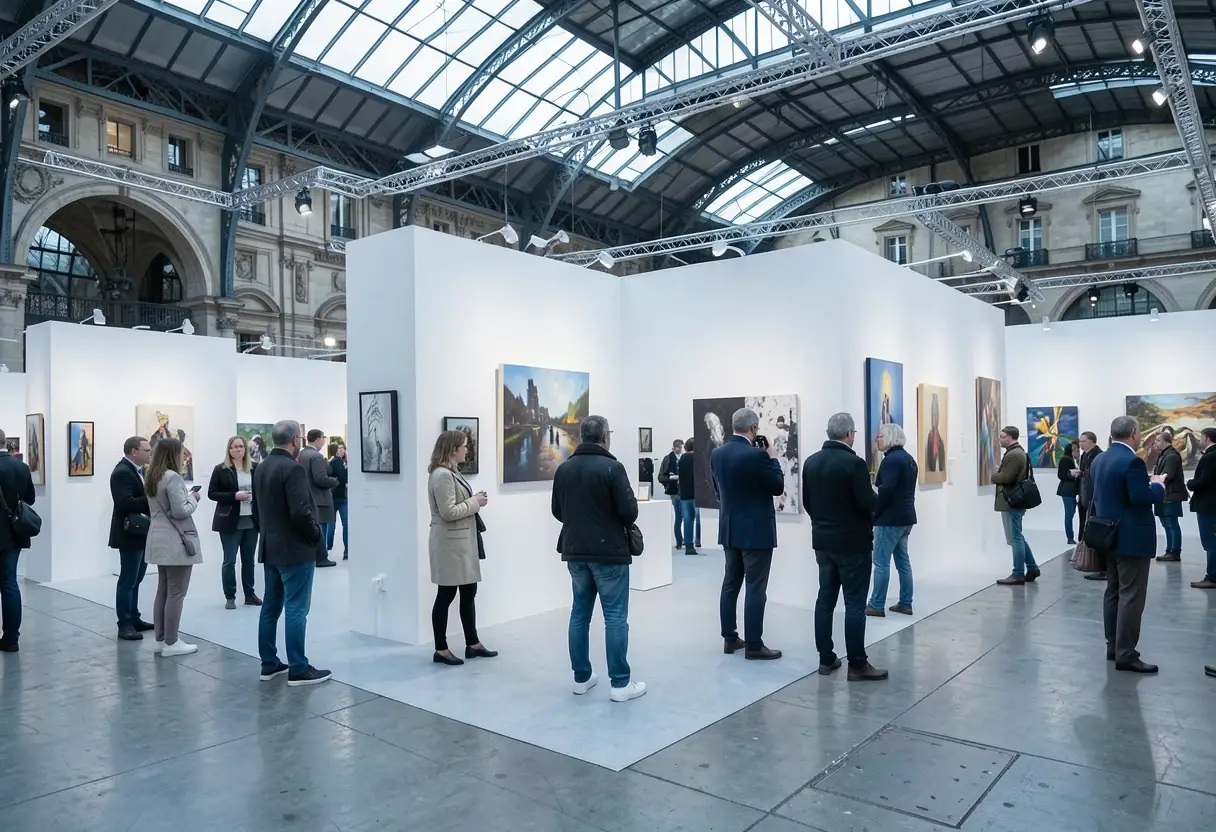
Paris Photo's 29th edition opened days after Art Basel Paris closed two days early under protest pressure — and nobody at the photography fair seemed bothered. "Photography isn't expensive enough," one gallerist joked. The three-day fair, held amid France's bicentenary of photography, spent its anniversary looking backward at the medium's oldest problems: what a photograph proves, and what it merely performs.
What did the bicentenary actually show?
The 19th-century headliner was a portrait thought to be an extremely rare depiction of Arthur Rimbaud with a black eye. The poet was a known ruffian who often got physical over literary squabbles. Whether the photograph really shows Rimbaud exposes the question that has dogged photography for two centuries: does the truth matter more than what we believe the truth to be? The strongest thread at Paris Photo was precisely this instability — photography as evidence that collapses into fiction.
Bacteria as co-author
Lara Tabet's Vitreous Body, developed with curator Yasmine Chemali, ranked among the fair's most conceptually adventurous projects. Tabet, trained as a medical biologist, collected water samples from canals, natural sources and waterways around Marseille, then mixed them with photographic film. The bacteria in the samples eat away at the emulsion (the light-sensitive coating on film) and turn it into brightly coloured abstract compositions — portraits of the city made by microorganisms invisible to the naked eye.
The works on agar bioplastics (a gelatinous organic base) are the sharpest: the bacteria keep transforming the material, so the work stays alive and keeps changing. The results are both beautiful and disquieting. Nature isn't just depicted; it collaborates in the image.
Bodies, buildings and bad postcards
Felipe Romero Beltrán, a young Colombian artist who frequently works with African migrants in Europe, especially dancers, took a different route into representation. His carefully constructed black-and-white photographs show collaborators re-enacting the positions police use to subduce someone they're arresting. Stripped of uniforms, weapons and institutional power, the choreographed movements become surprisingly tender. Institutional control becomes intimacy — the bodies carry the narrative without directly showing the state violence those same bodies regularly endure.
Kourtzi Roy's Failed Postcards series turned travel photography's vernacular language into something ambiguous, strange and at times hilarious: saturated colours, theatrical poses and awkward fails staged before picturesque tourist views. Beneath the polish sits a darker rumination on how experience gets commodified.
Silina Syan's Made in Bangladesh series, rooted in Bidyakut, her father's village, documents the elaborate mansions financed by family members living abroad — buildings that stand in striking contrast to the surrounding vernacular architecture. Some photographs come encased in their own carved wooden frames or sculptural elements. The architecture becomes a portrait of absent people.
A tower of archives
One of the fair's big draws was Ponte City by Patrick Waterhouse and Mikhael Subotzky. Developed over 15 years, the project examines Johannesburg's famous 54-storey residential tower through photographs, documents, objects and residents' stories. A new book-box presentation turns the archive into a modular installation of mobile towers, books, images and material. It raises hard questions about the ethics of documenting a community — how to honour residents' lives without reducing them to an art object.
Where does the medium go from here?
The bicentennial produced plenty of nostalgic booths at the fair and across Paris's institutions, and the honest answer is that the anniversary itself mattered less than the work probing photography's future: its capacity to absorb other disciplines and challenge reality as we know it. Two hundred years in, the medium's most interesting question may no longer be what it can show us, but what it can make visible that we were previously unable — or unwilling — to see.
Source: theguardian.com
More from Grace Kim
Show full bio
Correspondent covering technology and product news in arts in the broadest sense at Arts & Voices.
1,537 articles