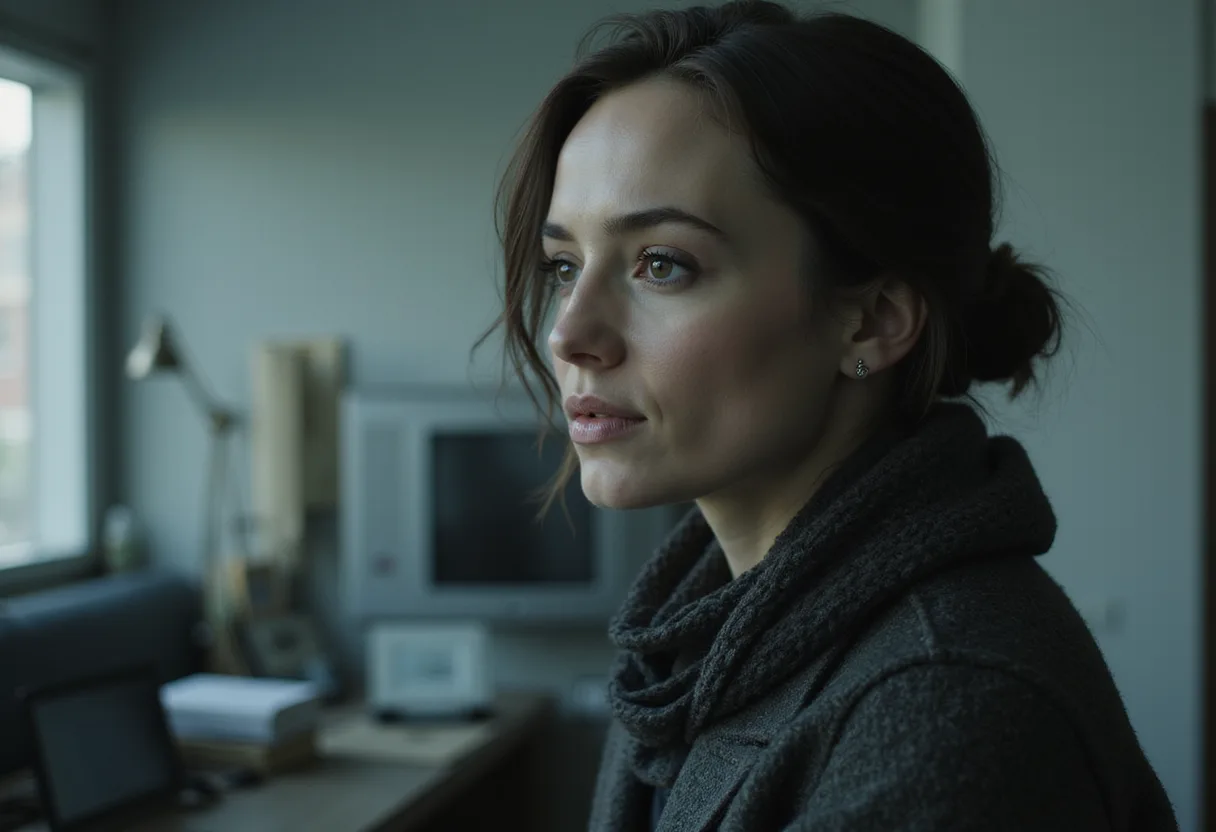
Black Doves’ Keira Knightley on motherhood, spies and Season 3
Keira Knightley discusses Black Doves Season 2 with Joe Barton, explaining Reed’s backstory, Helen’s prime-minister-wife role, a five-take Somerset House fight and hopes for Season 3.

Programme
- Black Doves Season 2 is streaming on Netflix and reunites Knightley, Ben Whishaw and Sarah Lancashire.
- Knightley completed the Somerset House one-take fight in five takes.
- Barton framed Season 2 around Reed’s backstory and a Berlin-in-the-1980s spy story.
- Wallace becomes prime minister, placing Helen in a role at Number 10 Downing Street.
- Barton is in a writers’ room for Season 3 and said the team is hoping.
By Elena Vasquez
Keira Knightley completed a Somerset House fight in five takes for Black Doves Season 2, Joe Barton’s spy series now on Netflix. The sequence paired Knightley’s Helen Webb with Ambika Mod’s Laila under director Julian Farino. Spoilers follow for Season 2 and any Season 3 news.
What changes in Season 2?
Season 2 reunites Knightley as Helen, Ben Whishaw as Sam Young and Sarah Lancashire as Reed. The Netflix season runs on action, blood and bodies: Reed goes missing, Sam makes a Faustian pact with a shady benefactor, and Helen nearly exposes her secret identity.
In the story, Wallace (Andrew Buchan) is now prime minister, placing Helen in a role at Number 10 Downing Street and making her the prime minister’s wife.
The focus moves away from Helen, whose background remains largely unexplained after Season 1, and toward Reed. Barton told Variety that Reed’s backstory emerged organically from the storytelling. He built the season around old sins returning and making everyone suffer, while also seeking a Berlin-in-the-’80s spy story.
The second season turns old personal history into new political danger.
How does Helen balance motherhood and killing?
Knightley and Barton described a Season 2 flashback in which Helen, soon after childbirth, tries to balance parenthood, marriage, friendship and a career involving killing. Barton joked that his partner tells him about motherhood every day; Knightley said the writer had a front-row seat to it.
Helen laments killing Marie (Molly Chesworth) by asking how hard it is to find a good nanny. Knightley said Barton’s script proposed shooting the nanny, but she objected that Marie stayed late and supplied what she called the childcare of dreams. Once Marie took the children, however, Helen had to kill her.
The show also shows Helen leaking breast milk as she prepares to shoot Franz (Rainer Wöss), mirroring Season 1 when she fired at assassins while heavily pregnant. Knightley said: “life doesn’t stop just because you’ve got other stuff.” She described motherhood’s pressures as the human counterweight to the heightened action.
Motherhood acts as a working condition on Helen’s assignments, not a pause between fights.
How realistic is the prime minister’s wife?
Barton said the prime minister’s wife does not receive a security detail. Knightley said she had not known that before his research. A hat and glasses explain why nobody recognizes Helen during the Somerset House fight, although the scene remains deliberately improbable.
Knightley asked how far the production balanced action and reality. Barton called the effort tricky and conceded they did not always succeed. Knightley put the distance from reality at one foot off the floor, sometimes two, while Barton widened the gap to a couple of metres in practice.
He contrasted Black Doves with Apple TV’s London spy thriller Slow Horses, which he placed in the real world. His series keeps recognizable elements but otherwise draws from James Bond and Mission: Impossible fantasy. He concluded: “We have our cake and eat it too, basically.”
Barton said he did not know what Keir Starmer’s wife looked like. Knightley recalled that, during filming, the real-world comparison was Keir Starmer’s wife; Variety’s exchange notes that Starmer resigned in June. Knightley said the production knew neither the woman’s name nor appearance, leaving room for Helen to be doing anything. Barton concluded that she could be a spy.
The production uses research selectively and sacrifices realism whenever the scene needs exaggeration.
Why did Helen not kill Dani?
At the end of Season 1, Knightley asked Barton to let Helen kill Dani (Agnes O’Casey), who tried to have sex with Knightley’s husband and kill her on Christmas Eve. Barton instead killed Dani and gave the Season 2 honor to Gabrielle Creevy (Eleanor), who lobs a grenade into an elevator. Knightley said the nanny substitution denied her the revenge she wanted.
Barton explained that he had kept Dani alive because he planned to place Helen in a position to kill her, but the story did not support that move. On set with O’Casey, known as Aggie, Barton said he liked working with her and believed the character had more potential. O’Casey said a new job would make her unavailable for another series. Barton accepted the change, and Knightley answered with a quip about catching a grenade.
Barton also killed off Neve Campbell, who played presidential aide Cecile. He said the choice would be shocking for Campbell; Knightley said she did not see it coming.
The deaths cleared the cast while denying Knightley the Season 1 death she requested.
How did they film the Somerset House chase?
Knightley said she and Mod had little time to rehearse when Farino announced that he wanted to shoot the Somerset House sequence in a oner. The director chose the unbroken approach before they had learned the fight. Knightley and Mod questioned the plan; the crew offered good luck and an attempt to make it work.
They completed it in five takes. Knightley said success was never guaranteed on the day. Barton agreed that the finished sequence worked despite those odds.
The stunt turned an underrehearsed gamble into one-take action with five completed attempts.
How did Christmas shape the production?
Season 1 was built around Christmas, and Barton said the team felt Christmased out by its end. Season 2 contains only a small nod, with festive elements appearing briefly and intermittently. The cast filmed over the holiday period again, making seasonal details unavoidable.
The crew reached Trafalgar Square after Christmas and had to invent a tree, then add it digitally. Barton said the first season chased Christmas while the second ran from it. The real Trafalgar Square tree looked threadbare, so the production wanted to improve it.
The Norwegian government, which gives the United Kingdom a tree each year, required the digital version to match the real tree’s type and could not make it too bushy.
The production treats Christmas less as a story setting than as a practical constraint.
Is there a Season 3?
Barton said he is already in a writers’ room for Season 3 and that the team is hoping to make it. He offered no plot or casting details in the edited and condensed Variety exchange. A third season remains possible rather than confirmed.
A third season depends on the writers’ room turning its current hope into a commissioned production, and no public commitment has followed so far.
Original: bbc.co.uk
More from Elena Vasquez
Show full bio
Senior reporter covering technology and product news in arts in the broadest sense at Arts & Voices.
1,088 articles