Cannupa Hanska Luger Turns the Bison Table on America
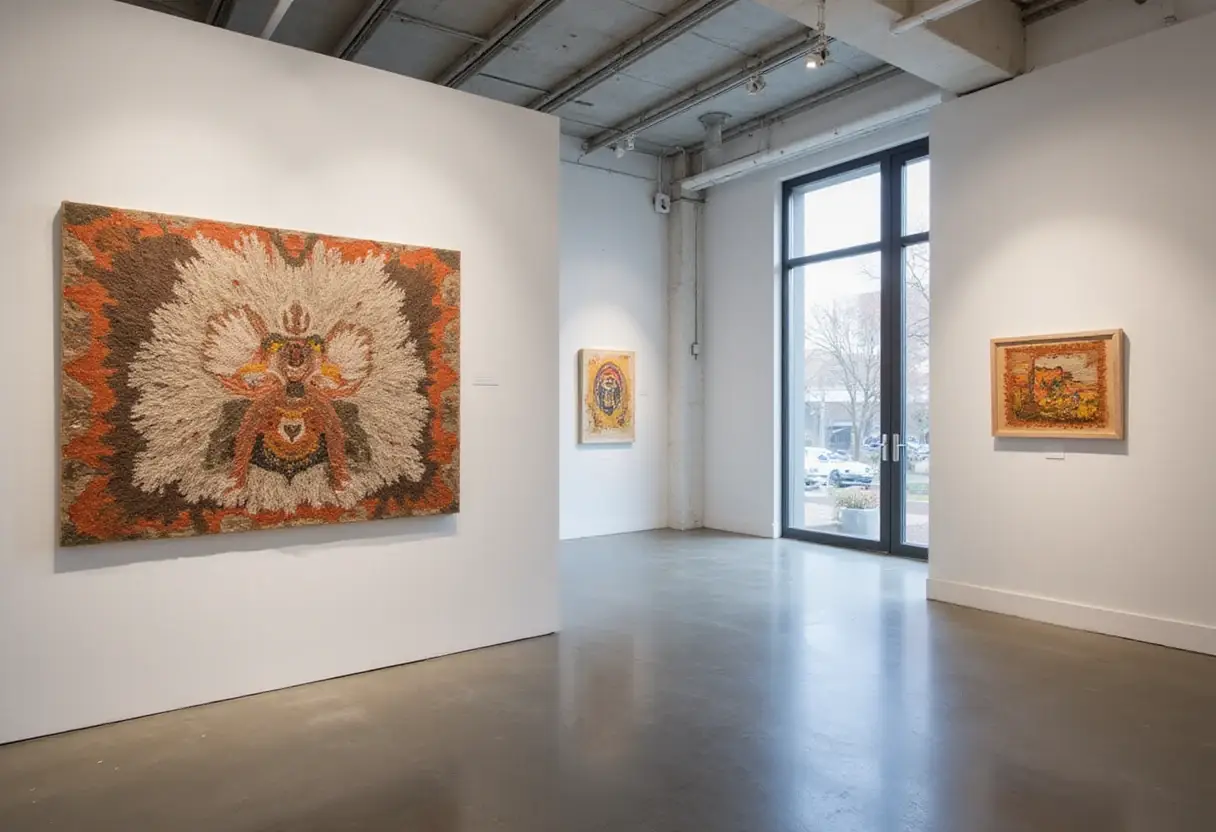
Cannupa Hanska Luger's 'American Traditional' at Garth Greenan Gallery stages the bison genocide in wood, ink and archive — his strongest, most declarative work yet.

Programme
- Cannupa Hanska Luger's exhibition 'American Traditional' is on view at Garth Greenan Gallery in Soho.
- Works include 'Requiem' (2026) and 'Shoots Today, Kills Tomorrow' (2026).
- General Philip H. Sheridan urged in 1875 that hunters 'kill, skin and sell until the buffalo are exterminated.'
- Mari Sandoz's 'The Buffalo Hunters' was first published in 1954.
- Luger was born on the Standing Rock Reservation and is a citizen of the Three Affiliated Tribes of Fort Berthold.
Cannupa Hanska Luger has set aside the participatory ceramics he's known for and built, in his own words, his most declarative work yet: a black abstracted bison set atop a blackened 19th-century American dining table. The piece anchors American Traditional, his new exhibition at Garth Greenan Gallery in Soho, and according to Hyperallergic's critic it is "his strongest work yet" — a synthesis of wood, ink and archive.
Luger doesn't approach this history as an outsider. He was born on the Standing Rock Reservation and is an enrolled citizen of the Three Affiliated Tribes of the Fort Berthold Reservation. His people lived the destruction the show confronts: the industrial-scale slaughter of the North American bison by European settlers and their horses, guns and railroads.
What did the slaughter actually mean?
The historian Mari Sandoz, writing in The Buffalo Hunters: The Story of the Hide Men (1954), noted that bison once outnumbered humans on the continent and faced no meaningful disease threat. She called the animal "almost the sole subsistence of the Plains Indian — his shelter, clothing, food and fuel."
The Cree scholar Tasha Hubbard goes further. For Plains nations, buffalo were kin — part of the First Peoples, not a separate species. In her account, the extermination campaign was a genocide carried out by proxy, "a second major wave of trauma for Plains Indigenous peoples," after epidemic disease.
The U.S. Army said the quiet part out loud. Hubbard quotes Colonel Richard Irving Dodge's advice to hunters: "every buffalo dead is an Indian gone." In 1875, when the Texas legislature proposed protecting the bison, General Philip H. Sheridan objected, in buffalo hunter John R. Cook's record: "These men have done more to settle the vexed Indian question than the entire regular army has done in the last thirty years … Send them powder and lead if you will, but for the sake of a lasting peace let them kill, skin and sell until the buffalo are exterminated."
How do you show a crime like that?
The critic's reference point is telling. Two years ago, the Baltimore Museum of Art showed the infamous 1892 photograph of two men beside a hill of buffalo skulls as part of Preoccupied: Indigenizing the Museum. A small wall-mounted curtain by Yurok artist Stormi Turner covered it. Visitors had to lift the cover themselves — the same protocol museums now apply to human remains.
That gesture honored an animal many Native communities lived with in symbiosis for millennia. Luger's table-and-bison works, including "Requiem" (2026) and "Shoots Today, Kills Tomorrow" (2026) — the latter shown with the artist pointing at it — perform a related operation in sculpture: they stage the domestic furniture of settler comfort underneath the animal that comfort consumed.
So what does this change for Luger's career? It marks a shift from collective making to declarative authorship, and it suggests the archive — Sandoz, Hubbard, Cook — can carry as much weight in a gallery as clay does.
Original: artbma.org
More from Grace Kim
Show full bio
Correspondent covering technology and product news in arts in the broadest sense at Arts & Voices.
614 articles