Golshifteh Farahani Stars in Anti-Taliban Thriller 'When She Hears the Bells'
Chabname Zariab's €3.5M debut 'When She Hears the Bells,' starring Golshifteh Farahani, premiered Nov. 18 at Tallinn's Black Nights Film Festival and next competes at Torino.
Programme
- "When She Hears the Bells" world-premiered Nov. 18 at the Black Nights Film Festival in Tallinn, Estonia.
- The debut feature cost €3.5 million ($3.8 million) and stars Golshifteh Farahani.
- Le Pacte handles international sales and French distribution; the film next competes at the Torino Film Festival.
- The production relocated from Iraqi Kurdistan to Morocco after Israel-Iran bombing began in 2024.
- Farahani received Locarno's Excellence Award Davide Campari in 2025.
Golshifteh Farahani stars as a widow rescuing exploited children in Taliban-era Kabul in "When She Hears the Bells" ("Les cloches de Kaboul"), a €3.5 million ($3.8 million) debut feature premiering Nov. 18 at the Black Nights Film Festival in Tallinn, Estonia.
The film, written and directed by Afghan-born, Paris-based filmmaker Chabname Zariab with her sister Parande Zariab, will screen in the festival's first feature competition. Le Pacte, which also produced, handles international sales and French distribution. After Tallinn, it competes at the Torino Film Festival.
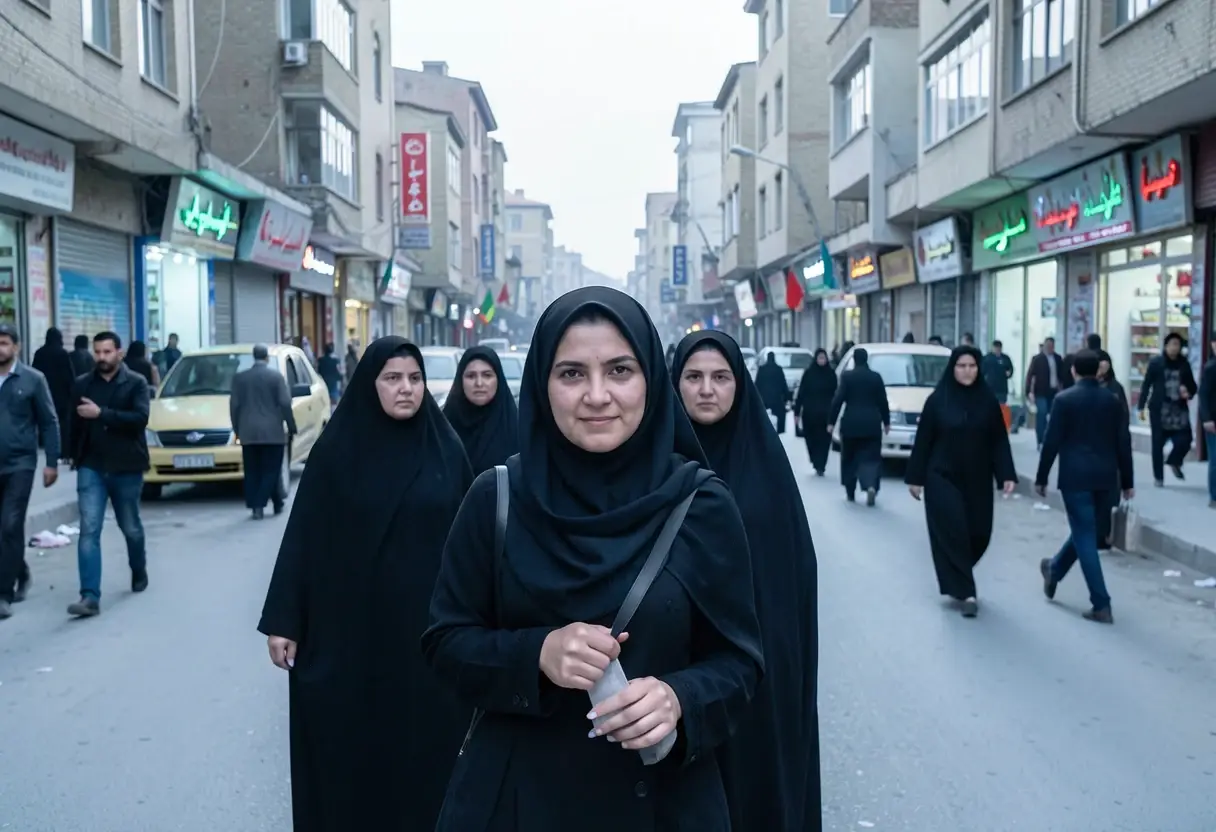
Set in summer 2021, as Kabul teeters on the edge of Taliban control, the thriller follows Leila, a young widow who arrives in the city and takes a kitchen job in a "Bacha Bazi" house. The term — literally "playing with boys" in Persian — names a still-practiced tradition in Central Asia, Zariab notes, in which boys dressed as women are forced to dance for men and suffer abuse. Leila decides to help a group of these boys escape as the city collapses.
Why return to a subject she'd already filmed?
Zariab explored Bacha Bazi in her 2015 short "When You Hear the Bells." This time, she told Variety, the subject works differently. She didn't return to dig deeper into the practice itself but to use it as a symbol of a society under Taliban rule.
"In reality, when you remove women from the public sphere, you also repress the desire for them which leaves room for all types of abuses. It becomes a sick society," she said.
The Oscar long-listed director (for her 2020 short "Hizia") cited Tarik Saleh's films and Saeed Roustayi's Cannes-selected "Leila's Brothers" as genre references. Once she built the thriller form, she said, the substance fell into place. The genre borrowing was deliberate: she and her sister wanted the largest possible audience for the subject.
How Farahani got the part — and why she took it
Casting Farahani ("Pirates of the Caribbean: Dead Men Tell No Tales," "Alpha") was, in Zariab's words, "an obvious choice." Zariab had followed her career since Asghar Farhadi's "About Elly" and admired her authentic Afghan Persian in Atiq Rahimi's "The Patience Stone." Farahani's women's rights activism sealed the decision.
"Not only did she deliver an exceptional performance, but her professionalism on set was astonishing," Zariab said. She cast Farahani opposite mostly Afghan theatre actors and non-professionals to keep the film authentic.
Farahani, who received Locarno's Excellence Award Davide Campari in 2025, listed three reasons for joining: "First of course, it was the powerful, well-written script and the humanitarian message behind it. The story needed to be told. Second, it was the incredible perseverance of Chabname who never gave up on me. And finally, it was that inner feeling telling me there was no way I could skip this one. As if it were simply part of what was written."
On Leila, she said she was compelled by "her ability to adapt and change," adding that the character shows "the potential within every human being to be pushed to the edge and find absolute courage." Leila moves "from a frightened, lonely woman to a lioness who decides to change the destiny of these [Bacha Bazi] children, even at the risk of her own life."
Working with children and first-time actors was, Farahani said, both a challenge and a blessing. "They can become the most wonderful acting partners," she said, singling out Fatima Tawakkuli, who plays Leila's friend Mari, and newcomer Mojtaba Ahmadi as the elder dancer Tamin.
What does a €3.5 million debut actually take?
The production, led by France's Alta Rocca Films with Belgium's Versus Production, Germany's Starhaus Filmproduktion and Arte France Cinéma, faced practical hurdles. The team planned to shoot in Iraqi Kurdistan, which resembles Afghanistan, but bombing between Israel and Iran in 2024 forced a move to Morocco. A friend-cinematographer inside Afghanistan captured the wide shots of Kabul.
Zariab thanked cinematographer Pierre Cottereau ("Café de Flore") and first AD Benjamin Blanc, and called producers Lou Chicoteaux and Jean-Etienne Brat of Alta Rocca — also behind "Hizia" — "truly exceptional partners who understood the urgency of this film."
"I'm well aware that I was fortunate to have such a substantial budget for my debut, especially at a time when funding is tightening across the board," she conceded.
Brat admitted that "getting people on board this wild adventure" was not easy, but the director's legitimacy settled it: "she herself had fled her home country because of the Taliban. From the West, she watched her nation suffer and sink into despair and had to make this film."
For him, beyond the Bacha Bazi symbol of societies undergoing radicalisation, the film is at its core "the story of a woman who risks her own life to save children. She emerges as a true heroine."
Farahani framed the film's stakes in explicitly artistic terms: "Artists tell stories about these horrors and make people pay attention to what is happening in our world. I feel their work is more important than what politicians do."
"Artists create bridges, while politicians and extremists create separation and duality," she said. "People may be poor in regions and countries like Afghanistan, but that doesn't mean they lack dignity or wisdom. Art helps polish people's judgements, often shaped by propaganda, into something more human, nuanced and real."
With Le Pacte steering sales and a Torino competition slot ahead, the film now tests whether a genre-shaped debut can carry its message to the broad audience its makers built it for.
Source: Variety Film
More from Grace Kim
Show full bio
Correspondent covering technology and product news in arts in the broadest sense at Arts & Voices.
1,537 articles