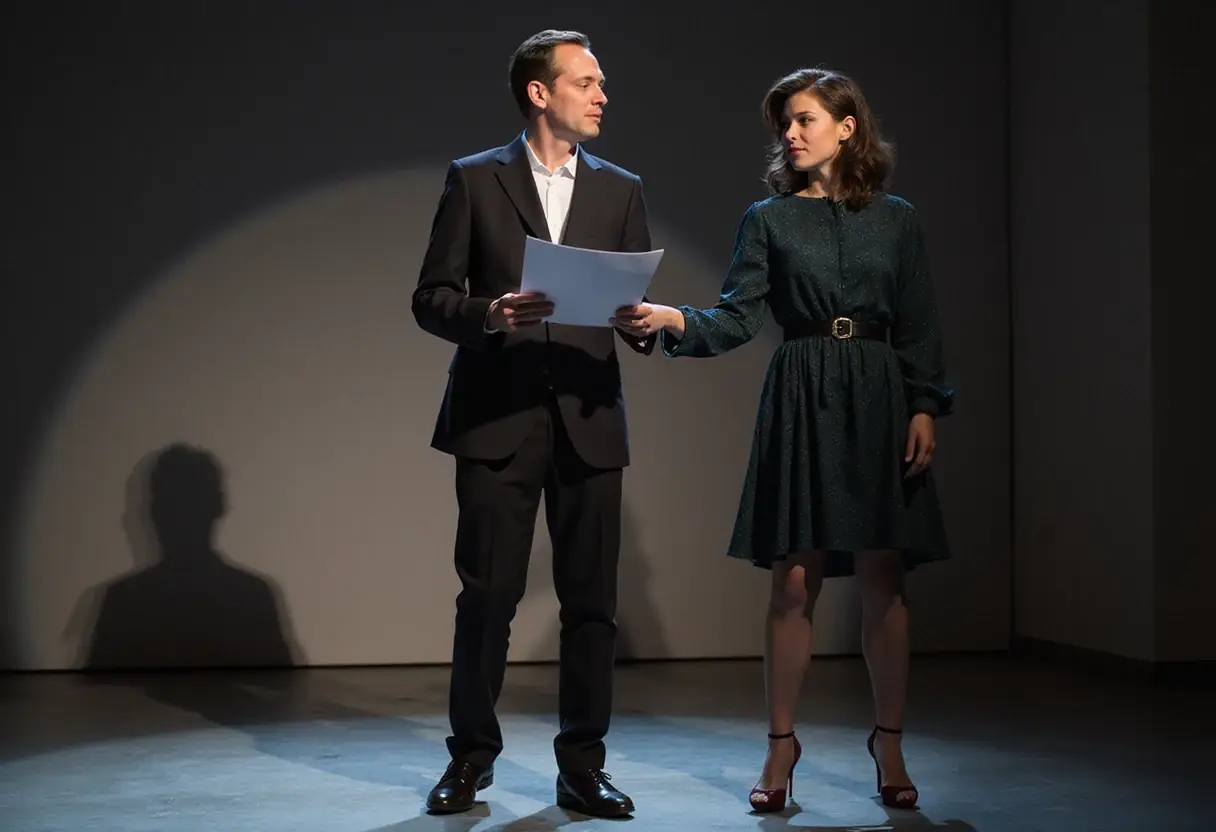
'Jimmy' Review: KJ Apa Captures Stewart's Drawl, Not His Soul
KJ Apa captures James Stewart's drawl in Aaron Burns's faith-adjacent biopic "Jimmy," but the review finds only a sentimental semblance of a soul — and a hollow everyman.

Programme
- "Jimmy," directed by Aaron Burns and starring KJ Apa as James Stewart, is released by Fathom Entertainment.
- The film rewinds to 1941, when Stewart received his draft letter after his Oscar win for "The Philadelphia Story."
- Stewart served as a bomber pilot with the 453rd Bombardment Group in England, taking a five-year screen hiatus.
- Burns's previous two features were produced by the streaming arm of Christian studio Affirm Films.
- The review finds the film captures Stewart's manner but grants him "only a sentimental semblance of a soul."
KJ Apa plays James Stewart in "Jimmy," a new biopic released by Fathom Entertainment, and mostly captures the star's signature drawl and aw-shucks persona. What the film never finds, according to the review's verdict, is the man himself — granting him "only a sentimental semblance of a soul."
Directed by Aaron Burns, whose previous two features were produced by the streaming arm of Christian studio Affirm Films, "Jimmy" is not explicitly faith-based but is at least faith-adjacent. It leans heavily on Stewart's Presbyterian background and stages more than one moment of religious epiphany when the chips are down. Its most detailed glimpse of his Hollywood career is a reconstruction of the famous bridge prayer scene in "It's a Wonderful Life" — the scene Stewart himself named as his favorite from all his films.
What does the film choose to show?
The focus falls far less on Stewart's artistry than on his military service. As one of Hollywood's staunchest Republicans, Stewart receives a glowingly conservative portrait. The reviewer argues this suits the popular conception of Stewart as an all-American mensch and everyman hero, yet says precious little of interest about him as a human or an icon.
Justin Strawhand's script makes Stewart less the everyman of American cinema than an interchangeable nice guy with distinctive vocal mannerisms. When the film does try to get under his skin, it lands on a fairly generic snapshot of WWII-related PTSD. The protagonist becomes a bland vessel for one-size-fits-all virtue.
How does the story unfold?
The film opens in medias res, with Stewart being pitched "It's a Wonderful Life" by close friend and fellow serviceman Frank Capra (Max Casella) — and not being sold on Capra's claim that "a hundred years from now, this film will be remembered." The film then rewinds five years to 1941. Stewart, fresh from his Academy Award win for "The Philadelphia Story," has just received his draft letter from the U.S. Army.
Louis B. Mayer, played by a ripe Jason Alexander, waves the letter away, keen for the star to capitalize on his post-Oscar glory. Gossip columnist Hedda Hopper (Sarah Drew) reports that Stewart dodged the draft. His stern, salt-of-the-earth father (Neal McDonough) dismisses his military aspirations in amusingly sneery fashion: "Go back to Hollywood and make peace with the fact that you are what you are."
Determined to serve, Stewart enlists in the Air Force, cuing a five-year screen hiatus. Stationed in England as a bomber pilot for the 453rd Bombardment Group, he bonds with the less famous men under his command and engages in aerial combat shot in synthetic video game style. He also enters a tedious, fictionalized romance with a brittly aristocratic Englishwoman named Julia (Kara Killmer).
What does this change for the Stewart legacy?
The review finds the consistently phony, ennobling tone squanders any opportunity to portray the conflict between Stewart's celebrity, soldierly and civilian identities. Stewart speaks mostly in clunky platitudes — "I'd like to look at myself in the mirror and see a good man looking back at me" — that make him a bit of a pill. DP James Mather applies the same smoothly gilded finish throughout, whether capturing Hollywood artifice or combat, so the seismic shift from backlot to battle never registers.
At his lowest, most trauma-ridden point on the "It's a Wonderful Life" shoot, Stewart receives advice that snaps him back into form: "What the audience needs is truth — are you brave enough to give it to them?" The review closes on the verdict: "Jimmy ultimately is; 'Jimmy,' not so much."
Source: Variety Film
More from Marcus Bennett
Show full bio
Staff writer covering people, launches and day-to-day practice in arts in the broadest sense at Arts & Voices.
1,075 articles