Just 4% of London’s public monuments are devoted to named women
Only 4% of London monuments are devoted to named women. Tschabalala Self and Nicole Eisenman answer that imbalance at Trafalgar Square and the Royal Academy of Arts.
Programme
- Art UK says only 4% of London’s public monuments are devoted to named women.
- London has twice as many animal statues as sculptures of specific women, according to Art UK.
- Lady in Blue will remain on Trafalgar Square’s Fourth Plinth for two years before moving to Fornebu, Norway.
- Stack stands more than 8 metres tall outside the Royal Academy of Arts on Piccadilly.
- Across its 258-year history, the Royal Academy of Arts has shown works by only two living women in its main galleries.
By Elena Vasquez
Only 4% of London’s public monuments are devoted to named women, according to charity Art UK. Art UK says the capital has twice as many animal statues as sculptures of specific women. That disparity now frames two new commissions made by women: Tschabalala Self’s painted-bronze Lady in Blue and Nicole Eisenman’s more-than-8-metre Stack, now visible together in central London.
What does the monument count reveal?
Art UK’s figure makes the absence of named women measurable. London still bristles with sculptures of men, while the monuments around Trafalgar Square and the Royal Academy of Arts concentrate that imbalance in two prominent sites. The comparison with animal statues makes representation a matter of numbers, not a general claim about visibility. The two artists place women at the centre of their respective sites, while the older men remain visible nearby.
The baseline is plain: only 4% of London’s public monuments commemorate named women.
What does Lady in Blue change at Trafalgar Square?
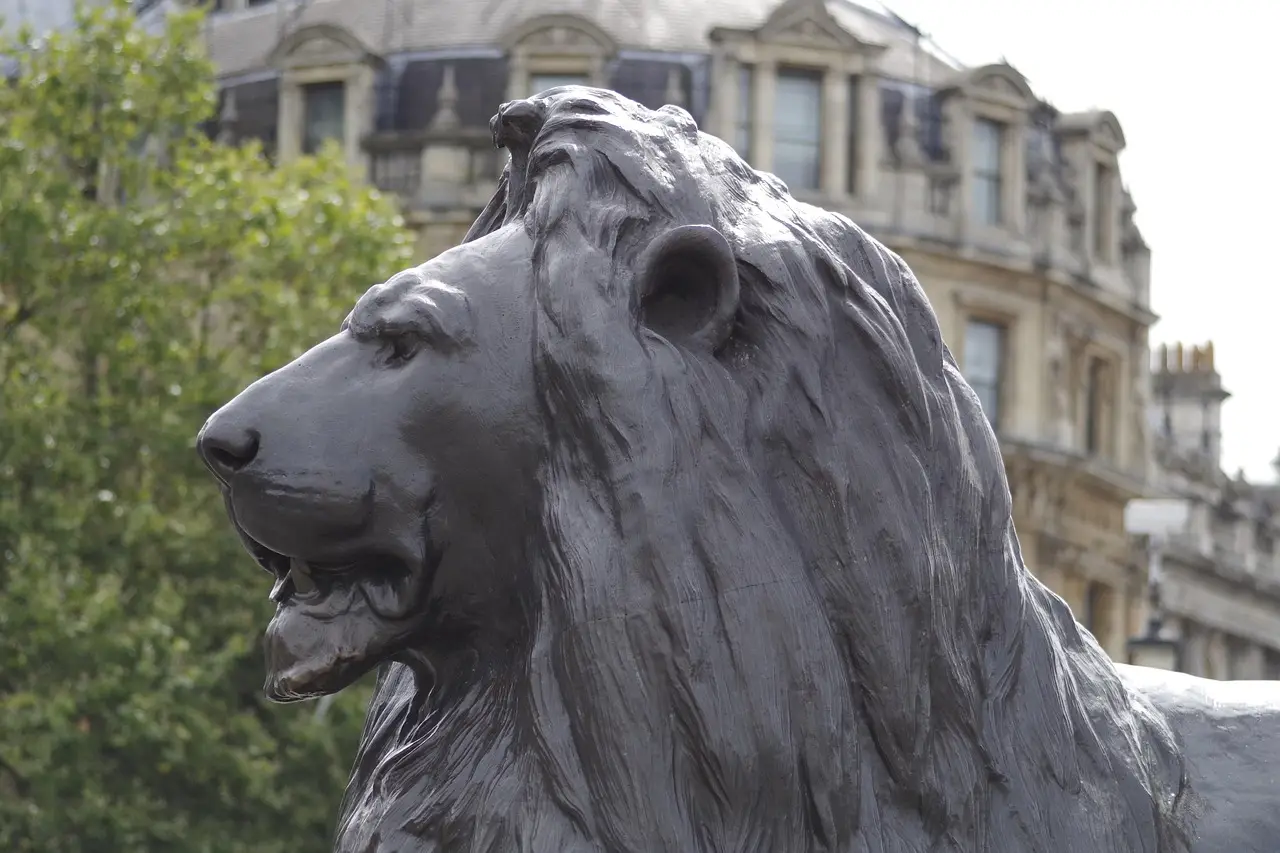
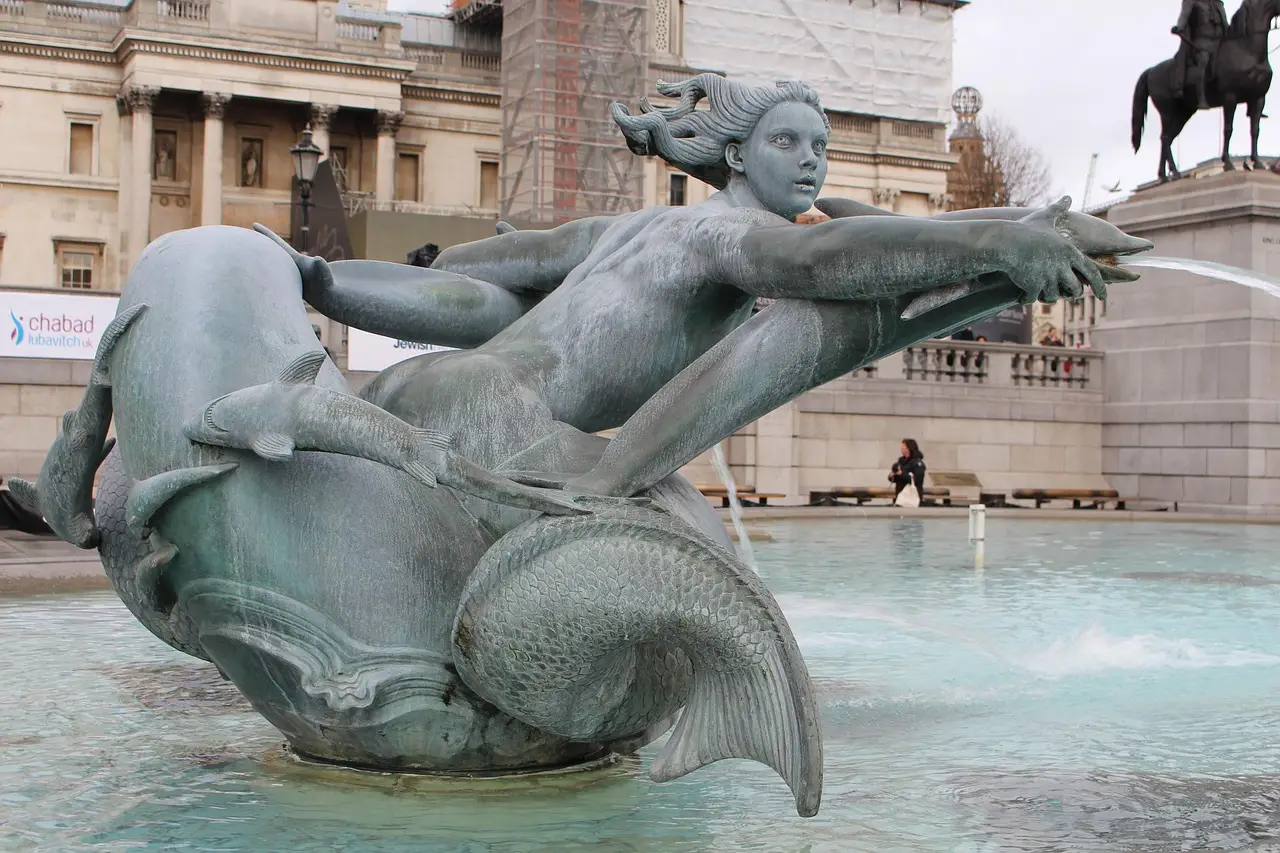
Since 1999, Trafalgar Square’s Fourth Plinth has hosted a programme of contemporary sculpture commissions. Lady in Blue now occupies the formerly empty plinth on the square’s northwest side. Set against depictions of monarchs and militia nearby, and Admiral Nelson’s 51-metre-high column across the square, Lady in Blue introduces a different public vocabulary without erasing the capital’s inherited symbols. The painted-bronze figure holds her head aloft. A vivid blue dress clings to her ample curves, and high heels accent her forward stride. The pose conveys purposeful confidence and optimism. After its two-year placement, the sculpture will move to a permanent home in Fornebu, Norway.
At the unveiling, Self said: “She’s not an idol to venerate or a historic figure to commemorate, she’s an everyday young metropolitan woman much like those who use the square every day.”
She also described Lady in Blue as moving rather than static. She hoped the work would inspire optimism and collective movement among everyone who encounters it. Self said the sculpture redresses racial and gender imbalances in public art in her native United States, the UK and Norway. She added that most cities underrepresent women, especially women of colour, and called for more images and visual representation.
For two years, the Fourth Plinth will foreground a contemporary woman rather than another ruler, soldier or celebrated man.
How does Stack unsettle the heroic monument?
A few streets away, New York-based Eisenman’s Stack rises more than 8 metres outside the Royal Academy of Arts (RA) on Piccadilly. The RA’s exhibition record gives the setting a sharper edge: in 258 years, its main galleries have shown works by only two living women. Stack assembles figures and objects in bronze, oak, brass, steel, nylon, acrylic resin and tin, turning its height into an anti-monumental column rather than a conventional heroic figure. It faces Alfred Drury’s bronze Joshua Reynolds, the RA’s first president, who holds a paintbrush and easel outside the main entrance.
Eisenman reached the Fourth Plinth shortlist in 2021. Stack now gives her an adjacent column of her own, irreverently anti-monumental in scale and structure. At its base, a craggy, androgynous figure in Birkenstocks carries a wooden barrel on its back and clutches an empty wine glass, possibly serving as Eisenman’s stand-in.
On the barrel sits a giant potato above a puddle resembling gooey melted cheese. A rusty leonine cat, modelled on Edie, Eisenman’s studio companion, lolls across the potato. The summit holds a smiling seated figure of the late artist Phyllida Barlow, rendered in gleaming sky-blue aluminium and balancing a vase of flowers on her head.
Barlow died unexpectedly in 2023 and was a Royal Academician. The location makes Stack read partly as a memorial to the much-loved and widely mourned artist. Eisenman is a major admirer. She first encountered Barlow’s colossally ambitious, consistently anti-hubristic sculpture when they were both at the Carnegie International in 2013, and they became friends.
In 2022, an apparently amused Barlow visited Eisenman’s New York studio to be 3D-printed for the work. Eisenman recalled at a recent talk at the Royal Institution that Barlow was in good humour about the process. Eisenman makes clear that Stack is not only a tribute to Barlow, while also remaining reluctant to offer specific interpretations. She said the work was conceived with London in mind: “It’s amazing to me that it is at the RA. I hope it can stay in London.” She also said Stack emerged during the pandemic and forms a personal testament to a period when life pared down to food, wine, art and her cat.
Stack turns verticality away from heroic elevation and toward figures, animals, food, tools and memory.
What do these commissions make possible?
The works offer alternative monuments to aspects of life rarely acknowledged in public art. Their shared focus reaches women of every age and origin, while Self explicitly ties her project to racial as well as gender representation. Both works occupy sites long associated with male commemoration. They test not only who receives a monument, but also whether accepted forms of monumentality can carry ordinary, collaborative and self-referential lives. The approaches differ. Lady in Blue advances through an individual figure and a stated hope for optimism; Stack accumulates a studio visit, a dead friend, food, animals and domestic tools. After two years, Lady in Blue is due to move from Trafalgar Square to Fornebu, Norway; Eisenman hopes Stack will remain outside the RA. The next measure is whether London and other cities commission more monuments for women, including women of colour.
Source: theartnewspaper.com
More from Elena Vasquez
Show full bio
Senior reporter covering technology and product news in arts in the broadest sense at Arts & Voices.
1,285 articles