Racist Backlash to Tschabalala Self's Fourth Plinth Sculpture
Tschabalala Self's Lady in Blue on Trafalgar Square's Fourth Plinth drew more than 6,000 comments, many racist, after its September unveiling, curator Priya Khanchandani reports.
Programme
- Tschabalala Self's Lady in Blue was unveiled on the Fourth Plinth in September 2026
- Priya Khanchandani's Instagram post about the unveiling drew more than 6,000 comments, many racist
- The Fourth Plinth stood empty for over 150 years before hosting contemporary sculpture from 1998
- Trafalgar Square was designed by Charles Barry in 1840; Nelson's column rises 50 metres
Tschabalala Self's bronze sculpture Lady in Blue was unveiled on Trafalgar Square's Fourth Plinth in September 2026. Writer and curator Priya Khanchandani, who attended the unveiling, now reports that her Instagram post about the event drew more than 6,000 comments, many of them racist.
Khanchandani made the disclosure in an opinion essay for Dezeen titled "Lady in Blue is as fitting a monument to our era as any I can imagine." Many commenters, she wrote, were "either subtly or openly racist and often suggesting the sculpture doesn't fit its context."
What does the sculpture depict?
Lady in Blue shows a Black woman caught mid-stride, one leg pushing through the fabric of her bright blue dress. Her head looks toward Whitehall. Her left arm and fingers are outstretched. Like the admirals and generals around her, she is cast in bronze. Unlike them, she is not posed in command — she is on her way somewhere.
Khanchandani read the vivid blue as evoking lapis lazuli, the stone ground into pigment since antiquity. The color, she argued, is "far from an attack on the Western canon, but rather in conscious conversation with it."
What is Trafalgar Square's history?
The site previously held the royal stables serving Whitehall Palace. Charles Barry designed the square in 1840 as a stage for Britain's image of itself. Its plinths carry George IV in Roman robes on horseback and generals Henry Havelock and Charles James Napier, whose reputations were made in the violent consolidation of British rule in India — the latter for the conquest of Sindh, where all four of Khanchandani's grandparents were from.
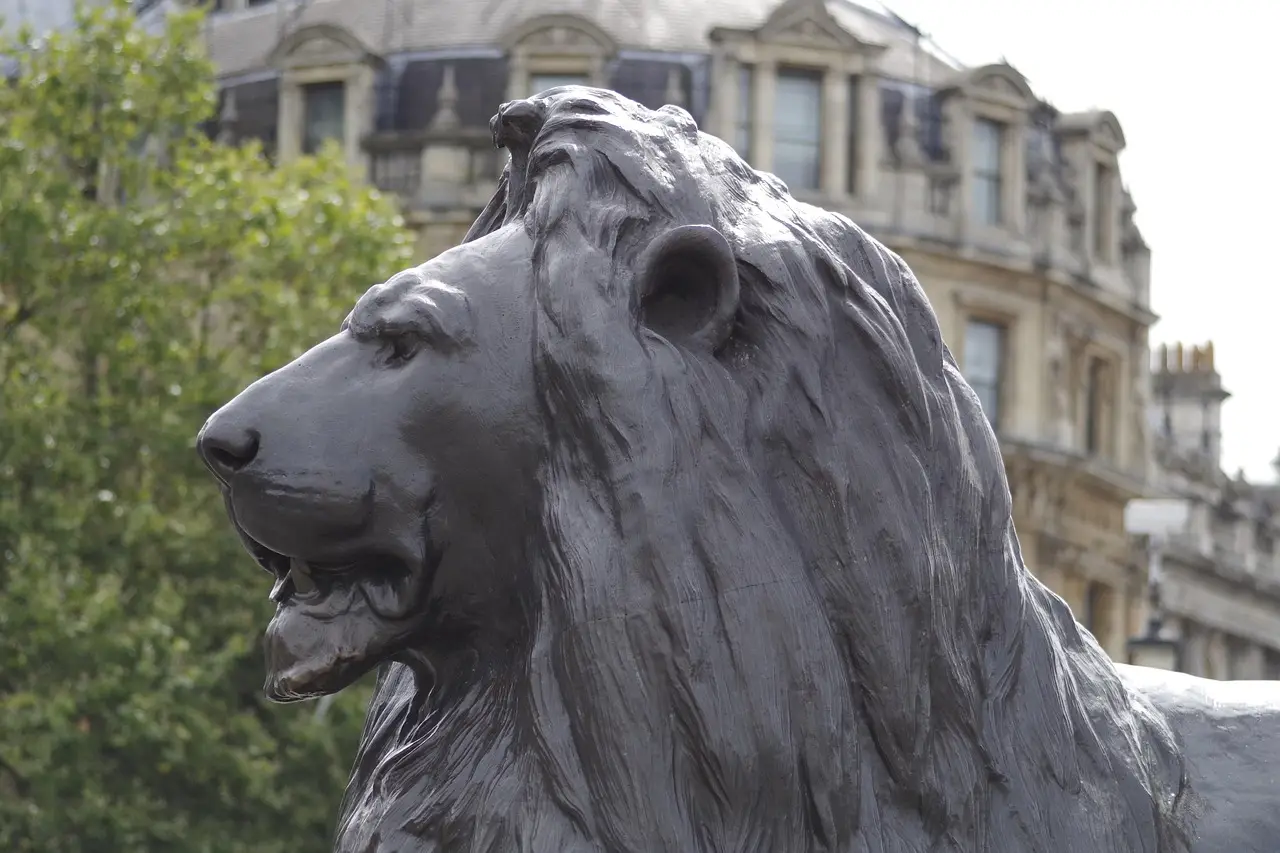
Admiral Horatio Nelson overlooks them from 50 metres high atop a granite Corinthian column, guarded by four bronze lions. The composition, Khanchandani wrote, represents a particular vision of 19th-century imperial power.
The square has also long served as a space of assembly and protest — from Bloody Sunday to the suffragettes to Black Lives Matter and the Palestine Coalition. A 2003 scheme by Foster + Partners and Atkins closed the road along its northern edge and turned a traffic island into a pedestrianised space.
Why does the Fourth Plinth matter?
The plinth was originally intended for an equestrian statue of William IV. It stood empty for more than 150 years before becoming a space for contemporary sculpture in 1998. Past commissions include Marc Quinn's Alison Lapper Pregnant and Yinka Shonibare's sculpture of Nelson's ship in a bottle.
Khanchandani noted that for some, in recent years the commission has "merely settled into a pleasant biennial ritual." This year's sculpture, she argued, underscores why it exists.
Self has described the figure as depicting "everywoman," meant to speak to human experience beyond racial identity. Khanchandani countered that the reception shows how readily a Black woman's presence in this setting becomes a question of who is allowed to stand for the universal.
"Any notion that she doesn't belong isn't an aesthetic judgement, so much as a claim about who the city is for," Khanchandani wrote, adding that in a square dominated by white men sculpted by other white men, Self's statue validates an ordinary Black woman as worthy of belonging. She closed: at such a fractured time, she feels relieved the figure is there, "elbowing her way through the noise, making room for all of us."
Original: fosterandpartners.com
More from Elena Vasquez
Show full bio
Senior reporter covering technology and product news in arts in the broadest sense at Arts & Voices.
919 articles