Kae Ito’s Kuru Kuru brings modular design to Art Week Tokyo’s AWT Bar
Kae Ito’s collapsible Kuru Kuru joins chef Ryuichi Yokomizo’s two inventive canapés and three artist cocktails at the AWT Bar, open 4–8 November in Tokyo.
Programme
- The AWT Bar pop-up began in 2022 and runs at Art Week Tokyo on 4–8 November.
- Architect Kae Ito opened Office Itokae in 2025 after 10 years at Sanaa / Kazuyo Sejima & Associates.
- Kuru Kuru combines two geometric forms—rings and semicircles—in collapsible modules secured by a simple locking mechanism.
- Chef Ryuichi Yokomizo, 30, presents two canapés after nine years at Joël Robuchon.
- The bar lists three artist-devised cocktails: All That Shines, Part-Time Job and Caipirinha de Cinco Sabões.
The AWT Bar runs at Art Week Tokyo from 4 to 8 November with architect Kae Ito’s modular “Kuru Kuru” spatial design. Ito received this year’s commission to design the venue’s space.
According to the AWT Bar’s project account, the pop-up began in 2022 and has become one of Art Week Tokyo’s most appreciated hubs. No attendance figures or visitor survey results accompany that reputation, so the announcement gives no way to test it.
Ito’s project biography records that she opened her independent firm, Office Itokae, in 2025. Before that, she spent 10 years at the Pritzker Prize-winning firm Sanaa / Kazuyo Sejima & Associates in Tokyo. Her listed projects there include the Better Co-Being pavilion for Expo 2025 Osaka, the Inujima Landscape Project, and exhibition designs in Japan and abroad.
A garden assembled from rings and semicircles
Ito says Kuru Kuru is intended to evoke a secret garden. The AWT Bar’s project account traces the design to Ito’s recent research in Mongolia, where she investigated ger, the region’s traditional nomadic homes. Their ability to fold for transport became the bar’s organizing principle.
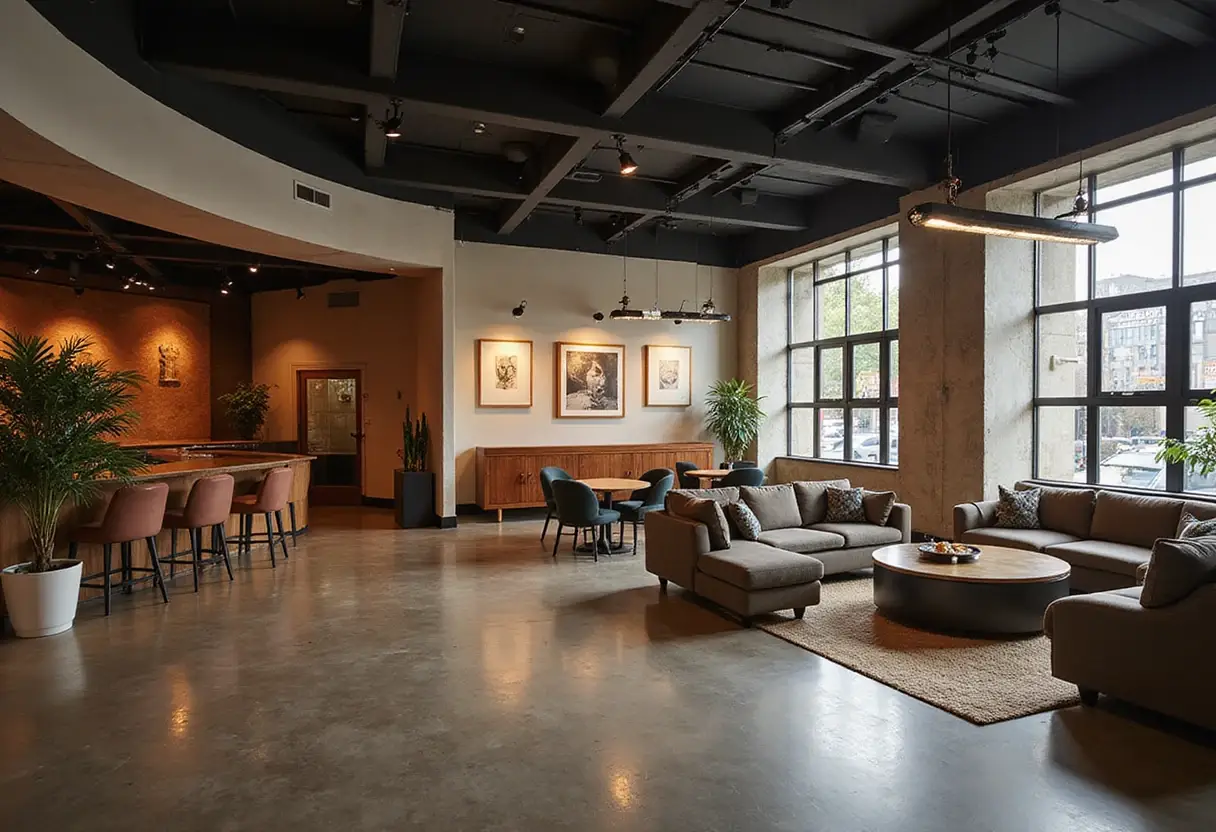
The project account describes modular, collapsible elements formed from rings and semicircles, held stable by a simple locking mechanism. Colour-coded acrylic hemispheres have flat upper surfaces that become seats, tables or counters. Openwork structures in stainless steel and acrylic spread through the room, their placement guided by a geometric floor design.
The units invite comparison with orreries or models of atoms. An aluminium-covered wall with circular service openings reinforces the science-lab atmosphere. Nile Koetting supplies multimedia elements, although the project description gives no detail on the works or their format.
Ito frames the social aim plainly: “I’m hoping [the bar] encourages people to have a happy time, eating and drinking with other visitors.” That is a modest test for a highly designed venue, and one the program leaves to the crowd rather than measures.
Two canapés, read in reverse
Ryuichi Yokomizo, 30, runs the culinary program. He spent nine years at the Michelin-starred Joël Robuchon restaurant in Tokyo’s Ebisu district. He was then asked to helm La & Le in Aoyama, which opened in March this year.
For Art Week Tokyo, Yokomizo presents two canapés:
- Gâteau of duck rillettes and pain d’épices: Yokomizo layers the rillettes over dark pain d’épices, then adds foie gras mousse, a paper-thin slice of apple, caramelised walnuts and delicate sprigs of micro amaranth.
- Tarte tatin-inspired sablé: Deeply caramelised apple sits over a sablé Breton base, topped with a quenelle of calvados-infused buttercream and artfully placed micro celery.
Both dishes carry an autumnal palette and reward attention before their identities become clear. The savoury rillettes appears sweet at first glance, while the sweet tarte appears savoury. Yokomizo organizes the menu around that inversion rather than presenting it as a technical gimmick.
He names the project “Entre” and centres it on the Japanese ideas of tsunagu, “to connect,” and aida, “the space between.” Yokomizo says surprise is his central concern in cuisine. His larger claim is about attention: “Like art, cuisine changes with one’s point of view. I hope to show how simply changing the angle of approach can transform eating into an entirely different experience. I believe that sharing good food and drink in this way can foster deeper communication.”
Three cocktails with authored identities
Three artist-devised cocktails extend the program:
- All That Shines — Mariko Mori: The drink uses luminous kuzumochi spheres, tapioca balls and rose caviar to evoke invisible ripples sent into the world as souls interact. The project account names those components but gives no preparation method.
- Part-Time Job — Yoshihiro Suda: Suda reaches back into his past as an illustrator for cider and whisky brands. His cocktail is as bittersweet as those memories, according to the project account.
- Caipirinha de Cinco Sabões (Caipirinha of Five Soaps) — Natsumi Aoyagi: The sudsy drink comes with a fable alluding to its historical rural Brazilian roots.
Taken together, the architecture, food and cocktails amount to an explicitly multisensory proposition. The project description calls the result unforgettable. No visitor testimony, attendance data or independent assessment appears in the announcement to support that adjective. The defensible achievement is more modest: Ito, Yokomizo, Mori, Suda and Aoyagi have each supplied a distinct frame for looking, tasting and drinking.
What does the design change for AWT Bar visitors?
For visitors, the change is concrete: a room assembled from movable seating, table and counter modules; an aluminium wall with service openings; multimedia work by Nile Koetting; two canapés; and three named cocktails.
The announcement gives no prices, daily hours, booking procedure, capacity, accessibility information or full ingredient and allergen lists. It also leaves the assembly sequence and locking system unexplained.
The practical answer is therefore modest: the design offers a more changeable environment and a tightly themed tasting experience, but the announcement is not enough to plan a visit. The real test is operational: staff must reconfigure and lock the modules quickly enough to preserve Ito’s promise of a happy, shared visit.
Source: theartnewspaper.com
More from Tom Whitfield
Show full bio
Market editor covering people, launches and day-to-day practice in arts in the broadest sense at Arts & Voices.
1,141 articles