Kandinsky's 'Betonte Ecken' Sets $85.8 M. Auction Record at Christie's
Wassily Kandinsky's 'Betonte Ecken' hammered at $74 million, reaching $85.8 million with fees at Christie's and nearly doubling the artist's previous auction record.

Programme
- Kandinsky's Betonte Ecken (1922–23) sold for $85.8 million with fees at Christie's on Tuesday, a new artist auction record.
- The previous Kandinsky record was $44.8 million, set at Sotheby's London in 2023.
- The Nahmad family bought the painting for a $1 million hammer at Sotheby's in 1986.
- Christie's global president Alex Rotter won the bidding at $74 million.
- The canvas carried a $60–$80 million estimate with a third-party guarantee.
A 1922 Wassily Kandinsky sold for $85.8 million with fees at Christie's 20th-century art sale on Tuesday night, setting a new auction record for the Russian-born pioneer of abstraction. The hammer price was $74 million.
The painting, Betonte Ecken (a German title translating as Accentuated Corners), carried a $60–$80 million estimate. Christie's guaranteed the sale, financed in full or in part by a third party, according to the sale catalogue, and the house confirmed to ARTnews ahead of the sale that it was bound to sell at a record-setting level. It tied for the highest-estimated lot in Christie's marquee November sales with a landscape by Gustav Klimt, also offered Tuesday.
The bidding war was short but competitive. Christie's global president Alex Rotter, post-war and contemporary art chairman for the Americas Sara Friedlander, and art advisor Ralph De Luca traded bids before Rotter won at $74 million — presumably on behalf of a client.
Who sold it, and what did they pay?
The seller was the Lebanese-American Nahmad family, the art-dealing dynasty whose holdings are reputed to include as many as 5,000 artworks worth upwards of $4 billion. ARTnews revealed the consignment in October.
The family bought the canvas at Sotheby's New York in 1986, where it hammered at $1 million, according to Sotheby's. That works out to an 86-fold increase in hammer price over 40 years. The painting had come to market once before, at the same house in 1964, hammering for $61,000.
What does this change for the Kandinsky market?
Plenty. The previous high was $44.8 million, paid for Murnau mit Kirche II (1910) at Sotheby's London in 2023. Tuesday's result nearly doubles it. Around 14 Kandinsky canvases have fetched more than $20 million since 1990, according to the Artnet auction price database, and all but one of those sales has come since 2012. His third-highest price, $41.8 million, was set just weeks ago in October, when Christie's London sold Das Bunte Leben (1907).
A century of ownership
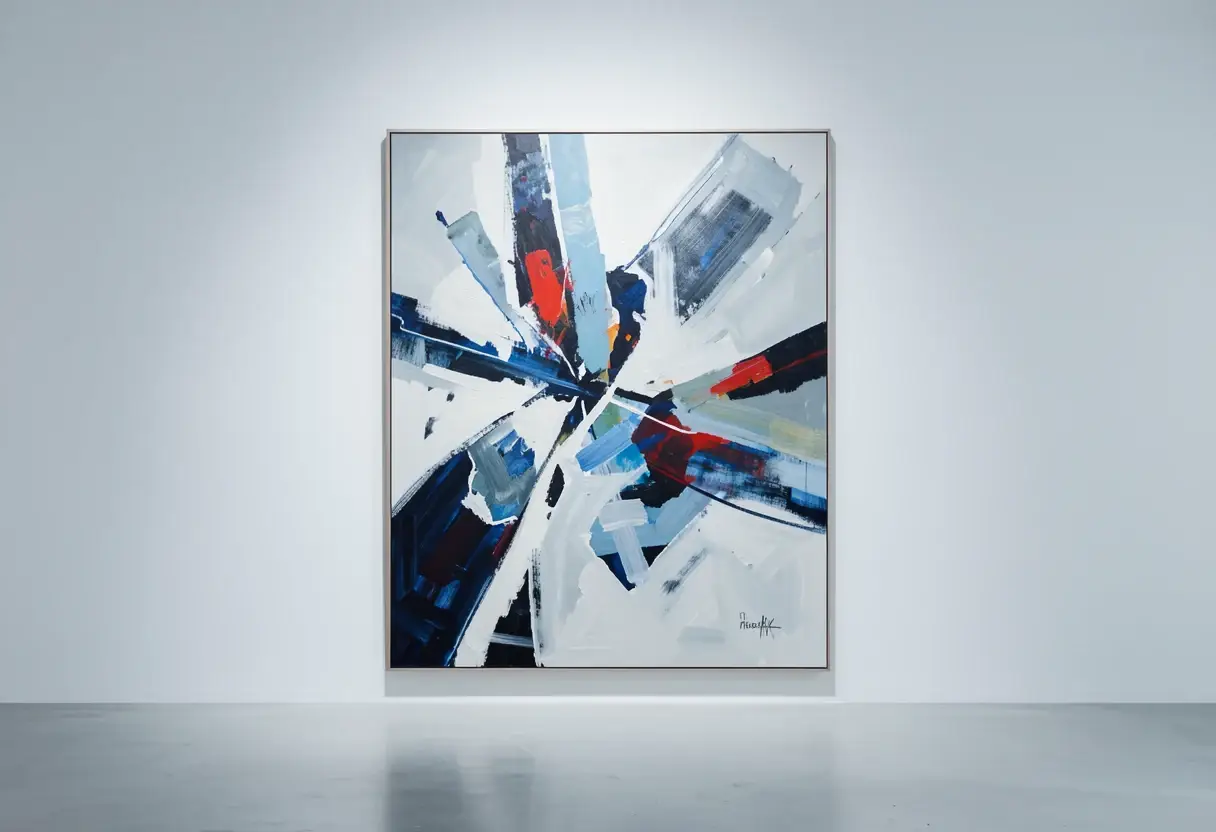
The painting measures just over four feet square and features dynamic abstract geometric shapes, with strong forms and lines pointing to each of its four corners.
Its provenance reads like a history of modern collecting. It first surfaced at auction at the Jacob Hecht Auction House in Berlin in 1926, from the Schwarz collection. Berlin's Galerie Nierendorf then sold it, probably in 1929, to Hilla Rebay, then the principal adviser to Solomon R. Guggenheim. Guggenheim acquired it from Rebay, and it stayed in the museum's collection until 1964, when the institution sold it at Sotheby's London to New York dealer Stephen Hahn. Hahn later sold it to Boston collectors Sandra and David Bakalar, who consigned it in 1986 — the sale that delivered it to the Nahmads.
The artist behind the record
Born in Moscow in 1866, Kandinsky published On the Spiritual in Art in 1911 and joined the influential Blaue Reiter group. After his first solo show at Der Sturm gallery in Berlin in 1912, his work appeared in the groundbreaking 1913 Armory Show in New York. He worked at the People's Commissariat of Education in Moscow from 1914 to 1921, then moved to Weimar in 1922 to teach at the Bauhaus.
He became a German citizen in 1928, relocated to France when the Nazis closed the Bauhaus in 1933, and took French citizenship in 1939. The Nazis seized dozens of his works in their campaign against "degenerate art." Kandinsky died in France in December 1944, three days short of his 78th birthday and six months before Germany's surrender.
With two of the artist's top three prices now set within a single month, the result confirms that museum-quality Kandinskys from his Bauhaus years have become the market's most contested trophy tier.
Original: artmajeur.com
More from Grace Kim
Show full bio
Correspondent covering technology and product news in arts in the broadest sense at Arts & Voices.
1,596 articles