Masha Sviatahor Breaks Soviet Archives Open in Promised Butterflies
Belarusian artist Masha Sviatahor fractures Soviet archival images of power in Promised Butterflies, her photomontage series on ideology and failed transformation.
Programme
- Masha Sviatahor has worked with Soviet photographic archives since 2018.
- Her first book, Everybody Dance!, was published by TAMAKA in 2025.
- She was named a BJP One to Watch in 2021.
- Much of her source material comes from Sovetskoe Foto, founded in Moscow in 1926.
- Her work has been exhibited at Yale University and Circulation(s) Festival.
Masha Sviatahor has worked with Soviet photographic archives since 2018. In her series Promised Butterflies, the Belarusian artist turns that material against itself. She inserts organic forms — a giant caterpillar on a party tribune, for one — into images of orchestrated political ritual until the scenes lose their stability.
Sviatahor works with photography, archival material, collage and photomontage. Her practice examines history, collective memory, and questions of power and ideology. Her first book, Everybody Dance!, appeared in 2025 from TAMAKA. Her work has been shown at Yale University and at Circulation(s) Festival, and in 2021 she was named a BJP One to Watch.
What drew her to the archive?
The visual language came first, she says. "I became fascinated by how carefully these photographs were constructed: the choreography of bodies, gestures and expressions, the recurring compositions, the precision with which every element seems to reinforce the others."
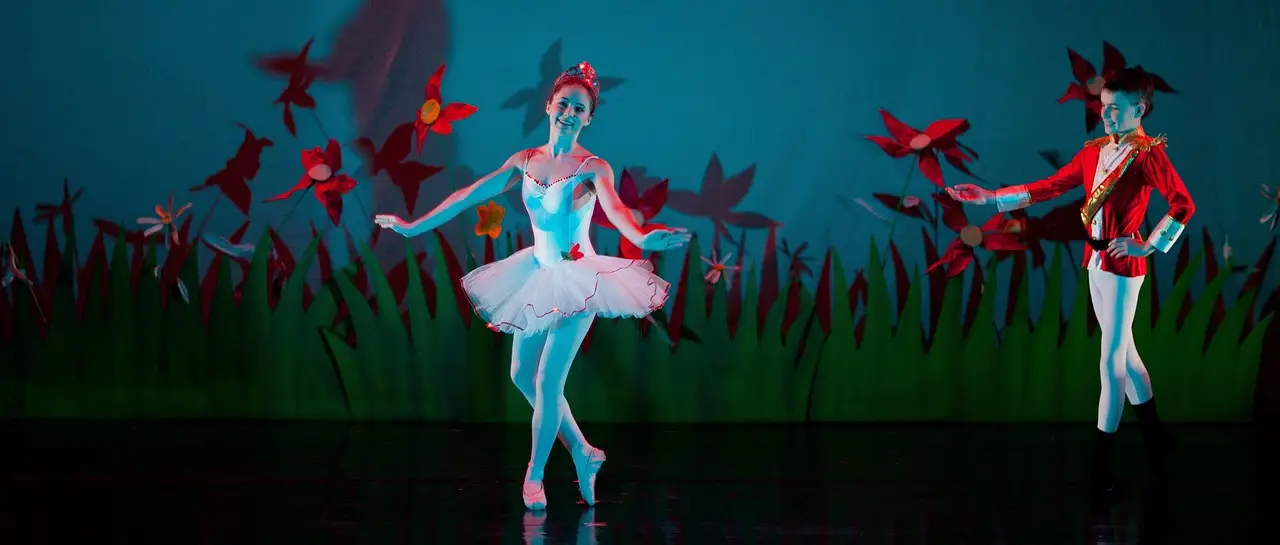
Her earlier works repeated, fragmented and reassembled familiar motifs — ballerinas, workers, soldiers, political leaders — to undermine their ideological meanings. Promised Butterflies narrows the focus to images of political power and collective unity.
The photographs she uses depict carefully staged collective rituals. What struck her was not only how widely they circulated but how strongly they resembled one another. "Particular visual ideas are repeated until they begin to feel natural or inevitable," she explains. Spectacle makes those ideas emotionally persuasive.
What does the intervention change?
Sviatahor treats the archival photographs as constructions built through repetition, omission and visual discipline. Her inserted elements interrupt their internal logic. "Something that initially appears coherent, unified and controlled starts to fracture," she says. "The image no longer functions as a stable whole."
The work stages a collision between two modes. Politics aspires to control, stability and permanence. The organic follows its own logic and can never be completely controlled. The forms she introduces make visible a resistance that, in her reading, already exists inside images of power.
The title points to a gap. "There was a constant promise of change, progress and a brighter future," she says of the Soviet context. Transformation happened, but never matched the utopia promised. It appeared instead as simulation, distortion or failure.
That tension, she argues, persists. Political systems still produce narratives of renewal while transformations are postponed, interrupted or distorted — waiting for wars to end, for authoritarian regimes to collapse, for violence to cease.
Who owns the image?
Working with photographs made by others raises questions of authorship. Sviatahor starts from the archive itself. "The images I work with are not neutral. They were created as instruments of ideology," she says. "They didn't simply document the world, they helped shape what people were encouraged to believe and how history itself was understood."
She refuses to erase the originals. "I want the tension between the original photograph and my intervention to remain visible because the work emerges through that encounter. I'm not adding truth." Instead, she creates a layer through which what was excluded or suppressed can return — not literally, but as something that was never supposed to appear.
Much of her material comes from the archives of Sovetskoe Foto, at one time the only photography magazine in the Soviet Union, founded in 1926 and published in Moscow. That material had already been selected, edited and arranged within ideological frameworks. Working with it, she says, the archive "stopped feeling like a fixed record of history and became something that could be reopened, questioned and read differently."
Her work is viewable at mashasviatahor.com.
Original: 1854.photo
More from Marcus Bennett
Show full bio
Staff writer covering people, launches and day-to-day practice in arts in the broadest sense at Arts & Voices.
799 articles