Norman Rockwell's $46m Saying Grace Leads Illustration Art Boom
Norman Rockwell's Saying Grace fetched $46m in 2013. Now the $1bn Lucas Museum of Narrative Art opens in Los Angeles as prices and institutional recognition for illustration art climb.

Programme
- Norman Rockwell's 1951 Saying Grace sold for $46m at Sotheby's in 2013
- The $1bn Lucas Museum of Narrative Art opened in Los Angeles
- Heritage Auctions sold Rockwell's So You Want to See the President! to the White House Historical Association for $7.2m in 2025
- The New Britain Museum of American Art holds almost 1,800 works in its Sanford B.D. Low Illustration Collection
- Crystal Bridges hung Rockwell's 1943 Rosie the Riveter beside Peale's George Washington
A 1951 Norman Rockwell painting made for a Saturday Evening Post cover, Saying Grace, sold for $46m at Sotheby's in 2013. That figure now anchors a market that has grown from near zero to millions of dollars per work, as the $1bn Lucas Museum of Narrative Art opens in Los Angeles to celebrate the field.
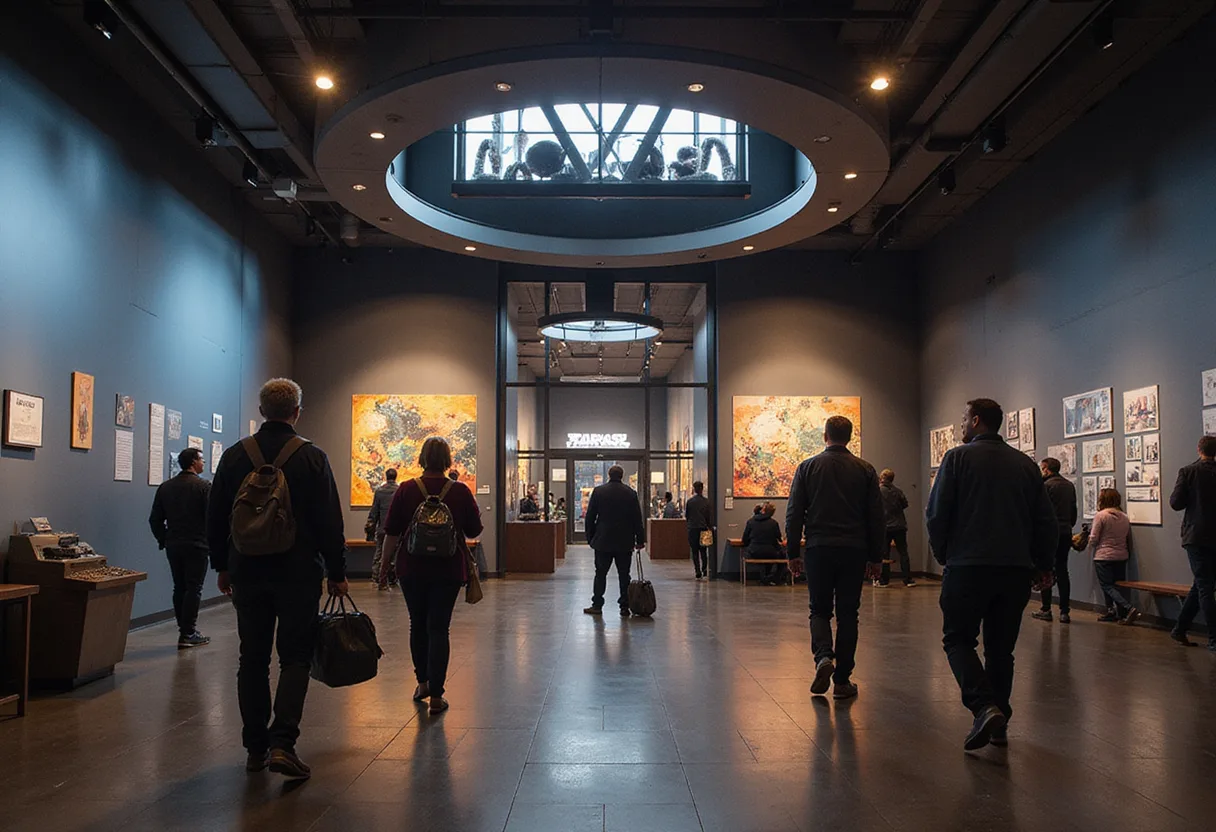
The museum, created by Star Wars and Indiana Jones filmmaker George Lucas, is devoted to children's book art, fantasy art, cartoon images, movie posters, film stills and magazine illustrations. Its holdings also include works distinguished as fine art by Paul Cadmus, Diego Rivera and Carrie Mae Weems. The opening marks what the trade calls the apotheosis of a market that began in the 1960s.
How did the illustration market start?
Manhattan-based independent art dealer Roger Reed traces the trade to the 1960s, when works used in children's storybooks, product advertising and magazine covers "were taken out of their context in publishing and sold just as paintings". Lucas and fellow filmmaker Steven Spielberg have ranked among the largest collectors of original illustrator art for decades. Many others have now caught up, and interest in works by Rockwell, N.C. Wyeth, J.C. Leyendecker, Howard Pyle, Maxfield Parrish, Jessie Willcox Smith, John Held Jr and Charles Dana Gibson has mushroomed over some six decades.
"A lot of the work of illustrators was pooh-poohed by the art world, because they were illustrators," says New York-based American art dealer Debra Force. "But you don't hear that so much anymore."
What prices do these works command?
The numbers now rival the top of the American art market. Rockwell (1894-1978) leads the field, with Saying Grace at $46m in 2013 and his 1957 oil The Rookie (Red Sox Locker Room) at $22.5m at Christie's in 2014. Four other benchmarks define the field's upper tier:
- Maxfield Parrish's 1922 Daydream-era painting Daybreak: $7.6m at Christie's in 2006
- N.C. Wyeth's 1943 tempera Portrait of a Farmer: $5.9m at Sotheby's in 2018
- J.C. Leyendecker's 1914 Football Hero, a Saturday Evening Post cover: $4.1m at Heritage Auctions in 2021
- Howard Pyle's 1907 Captain Keitt, frontispiece for his novel The Ruby of Kishmoor: $702,000 at Sotheby's in 2004
Works by Rockwell, Parrish, Wyeth and Leyendecker frequently bring the highest prices in American art sales at the major auction houses. "There's definitely a hierarchy," says Aviva Lehmann, deputy chair of fine art at Heritage Auctions, which sold Rockwell's 1943 So You Want to See the President! to the White House Historical Association for $7.2m in 2025.
Is Rockwell's dominance crowding out other illustrators?
Not according to the specialists. "Rockwell's success has not been at the expense of these other illustrators," says Skye Lacerte, an illustration art specialist at Swann Auction Galleries in New York. "Rather, it has helped establish a broader market in which collectors and museums are beginning to take the entire field seriously."
Lacerte notes that "immediately recognisable" images from magazine covers and illustrations from famous books like Alice in Wonderland, The Wind in the Willows and L. Frank Baum's Oz books are highly sought after. So is advertising art for "companies like Coca-Cola, TWA and Cadillac", she says, "because those images have become part of American cultural experience".
Which museums now collect illustration art?
The Lucas Museum joins an established infrastructure. The Brandywine River Museum of Art in Chadds Ford, Pennsylvania, the Norman Rockwell Museum in Stockbridge, Massachusetts, the Eric Carle Museum of Picture Book Art in Amherst, Massachusetts, and the National Museum of American Illustration in Newport, Rhode Island, all specialise in the field. The Rhode Island museum was founded in 1998 by Judy Goffman Cutler, owner of Manhattan's American Illustrators Gallery, who claims to have sold Lucas "hundreds" of original paintings by top book and magazine illustrators.
"I sold him his first Rockwell—it was called Going Out," Goffman Cutler says, referring to a 1933 painting used on a Saturday Evening Post cover. Citing "client confidentiality", she declines to say how many works she has sold to Lucas, noting only: "I built his collection."
The New Britain Museum of American Art in Connecticut holds almost 1,800 works in its Sanford B.D. Low Illustration Collection, named for the institution's first director, himself an illustrator who invited colleagues to donate. The collection spans Jessie Willcox Smith, Everett Raymond Kinstler, Stevan Dohanos, Walter Wick and William Steig. The Delaware Art Museum in Wilmington also collects in the field.
"Interest in illustration art doesn't begin and end with Rockwell, and the awareness of illustration art as art is definitely increasing," says Lisa Williams, head of curatorial affairs at the New Britain Museum. "I have no doubt that the collective appreciation for the category will continue to grow thanks to its elevation by these museums," says Quincie Dixon, head of sale in Christie's American art department. Dixon adds that "private collectors make up the bulk of this market, but perhaps that will change now that there are museums on both coasts dedicated to the category".
Can illustration art enter the fine-art canon?
Specialised museums may also be keeping the works segregated. Goffman Cutler states it is her "goal to have museums include American illustration art in their American art galleries". Only a few have done so.
A spokesperson for the Museum of Fine Arts, Boston, notes its "collection includes art from American artists of many backgrounds, including quite a few who have worked as illustrators, among them Winslow Homer, Childe Hassam, William Glackens, Joseph Leyendecker, Charles Sheeler". Their illustration work, however, is not necessarily what the museum shows, and the Leyendecker is not currently "on view". The Metropolitan Museum of Art and the MFA Boston both own Parrish paintings that sit outside their American art galleries.
Two institutions break the pattern. The Art Institute of Chicago has hung its Rockwell, The Dugout (1948), in an Arts of the Americas gallery. Crystal Bridges Museum of American Art in Bentonville, Arkansas, hung Rockwell's 1943 Rosie the Riveter—purchased from a private collector in 2009—next to Charles Willson Peale's George Washington (around 1780-82) and works by John Singleton Copley and James Peale Sr in its Visions of America galleries. "In the same section of the gallery as Rosie the Riveter," a museum spokesperson says, "are Susie J. Lee's Johnny [2013], Kerry James Marshall's Our Town [1995] and a new commission by artist Teri Greeves."
The greatest test for illustration art is no longer record prices, but whether it can enter the art historical canon and hold its own there.
Source: theartnewspaper.com
More from Elena Vasquez
Show full bio
Senior reporter covering technology and product news in arts in the broadest sense at Arts & Voices.
1,727 articles