Nwando Ebizie Turns Hildegard's 'Ordo Virtutum' Into 'Ecstasy of the Virtues'
Mahogany Opera premieres Nwando Ebizie's 'Ecstasy of the Virtues,' a mystery opera reworking Hildegard von Bingen's 'Ordo Virtutum' with BSL, dance and a Self-Loathing trickster.
Programme
- Mahogany Opera premieres Nwando Ebizie's mystery opera 'Ecstasy of the Virtues,' inspired by Hildegard von Bingen.
- The opera's final performance takes place at Barrow Town Hall on October 7.
- Ebizie's interest in Hildegard began in 2016, after she discovered she has Visual Snow Syndrome.
- Hildegard's Devil, the only male non-singing role in her original, is recast as the trickster spirit Self-Loathing.
- The production incorporates theatrical British Sign Language, dance and projections, following a yearlong BSL course by the composer.
By Grace Kim
Mahogany Opera premieres "Ecstasy of the Virtues," a new mystery opera by Nwando Ebizie built on Hildegard von Bingen's music — and the production gives its final performance at Barrow Town Hall on October 7. Hildegard, the 12th-century nun, mystic and polymath, remains one of the earliest composers whose work we can still trace. Nearly 1,000 years after her death, she has picked up an unlikely successor: a London artist working with neuroscientists, Deaf performers and Afrofabulist folklore (a strand of speculative art rooted in African myth).
Ebizie's route to Hildegard didn't start in a music library. It started in her own visual field.
Why did a contemporary artist turn to a 12th-century nun?
"My interest in Hildegard began in 2016 when I realized I had a neurological syndrome called Visual Snow Syndrome," Ebizie told OperaWire. The condition gives her a perceptual reality different from most people's: "a visual field full of translucent pointillist noise, swirling patterns, auras, light halos and photographic-like afterimages."
That diagnosis sent her toward the neuroscience of perception, which she explored with her collaborator, the neuroscientist Dr. Eva Bracey. It also sent her backward through history, looking for artists who recorded their own unusual ways of seeing. "Hildegard kept coming up in my mind as a woman who was not only a visionary polymath, but also, uniquely for the time, one whose visions and creativity were preserved and immortalized in her text and illuminations," Ebizie said.
She read Fiona Maddocks' biography "Hildegard of Bingen: The Woman of Her Age," along with Hildegard's own books "Scivias" and "Physica" and her letters. At university, Ebizie had studied medieval morality plays. Hildegard's philosophy clicked — particularly the casting of the soul as an everywoman rather than an everyman, written for her own nuns to perform.
Ebizie sees a gap the piece still fills. "It is interesting that still, in this day and age, it is rare to have an all-female cast, an all-women's story without a woman being a victim of male violence in an opera or a love interest," she said. "'Ordo Virtutum' is an uplifting piece, created for women to celebrate a philosophy that then as now is needed."
What does the new opera do with Hildegard's music?
Ebizie began by reading versions of Hildegard's scores in both modern and ancient notation. During an early residency at Snape Maltings, she and her collaborators improvised around the medieval material. That shaped her starting point — then she moved away from it.
"I deviated considerably," she said. Her contribution isn't another period recording. She treats the music as dramatic force, a strategy to carry a diverse, largely secular audience "through calmness towards ecstasy." She calls the result "my lens on what a secular ecstatic ritual could be."
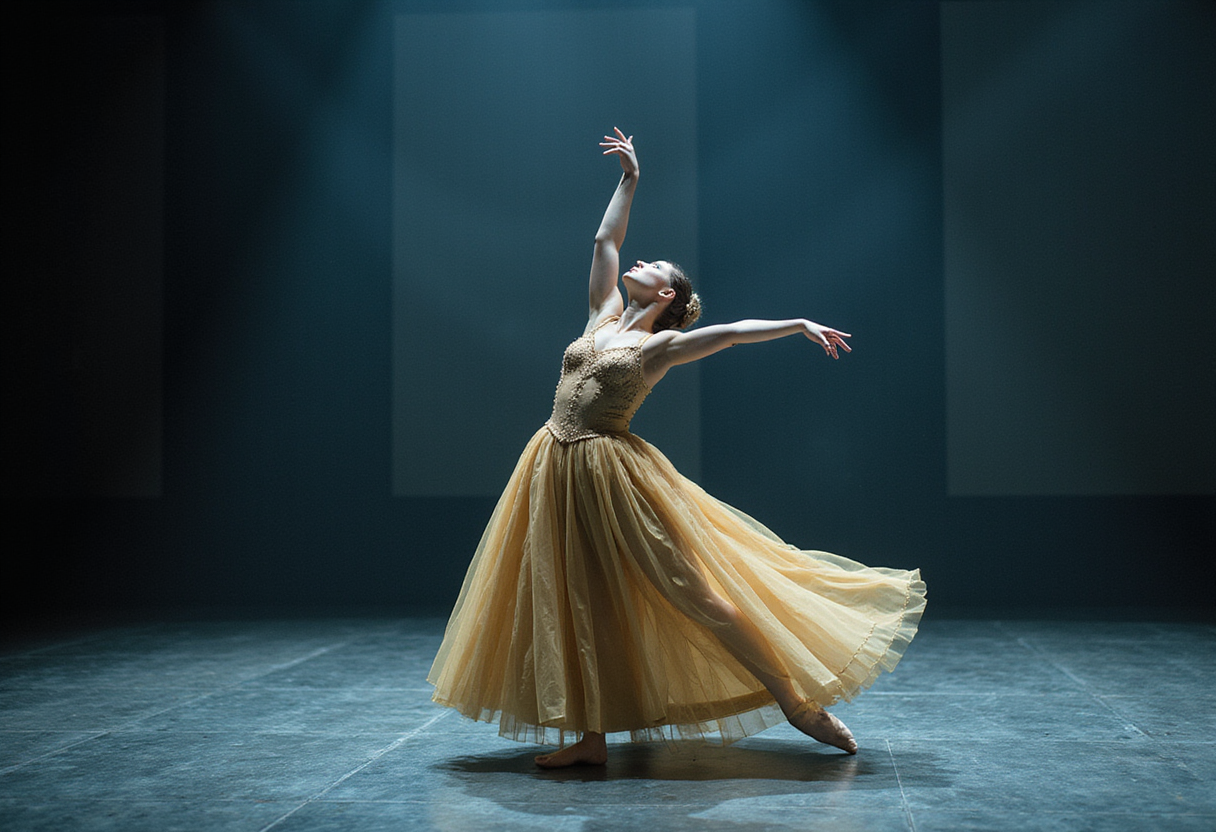
The staging layers dance, theatrical British Sign Language, and projections, with the design responding to each venue the production visits.
How does BSL reshape the piece?
The sign language isn't decoration, and it took years of groundwork. Ebizie completed a yearlong BSL course — "I'm still just a beginner!" — connected with Deaf culture, and worked with Deaf artists and interpreters to build the piece's language. The goal is a multisensory work with multiple routes into meaning.
The result is two parallel journeys through one opera. For Deaf sign-users, Ebizie said, the path through the piece is "perhaps clearer," because BSL works differently from English: "metaphor, simile and other poetic techniques don't work in the same way. But image and expressiveness are inherent to the language."
Why is Hildegard's Devil now 'Self-Loathing'?
The sharpest dramaturgical change sits in the villain. Hildegard's Devil — the only male, non-singing role in her original — becomes a trickster spirit called Self-Loathing. Ebizie frames it as "a more Jungian approach to the shadow figure," built on the idea "that what we push down into shadow, will rise up and control us."
The recasting also serves the audience. People arrive from religious, spiritual and non-religious backgrounds alike, and she wanted something "more neutral than the medieval catholic idea of the Devil."
Behind that choice sits a longer argument about colonial religion. Ebizie points to Christian missionaries who subsumed indigenous pantheons into Christian mythology — Eostre, the spring goddess, absorbed into Easter. In her own culture, she notes, a pantheon of nature spirits and a sky god coexists with each individual's "Chi," or personal god, and a horned trickster spirit called Ekwensu. "The missionaries declared that he was the devil," she said. "Turning a complex chaos bringer into a flat idea of evil. Enforcing a simple duality of good and bad."
Her libretto answers that flattening directly. The Virtues tell Self-Loathing:
You have no depth, no complexity, you are flat A flat idea of negative space… Created from a… colonial crisis of our old spirits Our tricksters, our nature spirits, our horned gods, our graveyard hags, our moon dancers…
What would Hildegard make of it?
Ebizie is careful not to claim intimacy with a figure edited by centuries of transcription. "I assume that I cannot really know her," she said. But the woman who emerges from the record — "so assured by her direct, clear visual and aural connection to God" — would hardly be startled by her reach. "She acted as a conduit for a beautiful vision of what humanity could be and I think that is why so many diverse groups of people are inspired by her today."
What does this change for opera audiences? It offers a template for reviving early music without museum glass: perceptual science, Deaf-led design and postcolonial myth worked into a score older than the form itself. The final chance to test it comes October 7 at Barrow Town Hall.
Original: mahoganyopera.co.uk
More from Grace Kim
Show full bio
Correspondent covering technology and product news in arts in the broadest sense at Arts & Voices.
458 articles