Pompeii's Erotic Frescoes and the Two-Century Fight to Keep Them Hidden
A king's heir locked away Pompeii's erotic art in 1819. A new book traces how pornography became a battleground for morality and power, from Naples to the internet.
Programme
- In 1819 Francis I ordered Pompeii's explicit artifacts hidden, creating the Gabinetto Segreto in Naples, largely closed until 2000.
- Webster's 1864 dictionary gave pornography its first English definition, citing Pompeii explicitly.
- Printmaker Marcantonio Raimondi was imprisoned by papal order for I Modi; no copies survive, but the plates did.
- Le coucher de la mariée (1896), directed by Albert Kirchner, is the first surviving erotic film.
- The material is adapted from Guilty Pleasure by Patricia Nilsson, published 2026 by Farrar, Straus and Giroux.
By Tom Whitfield
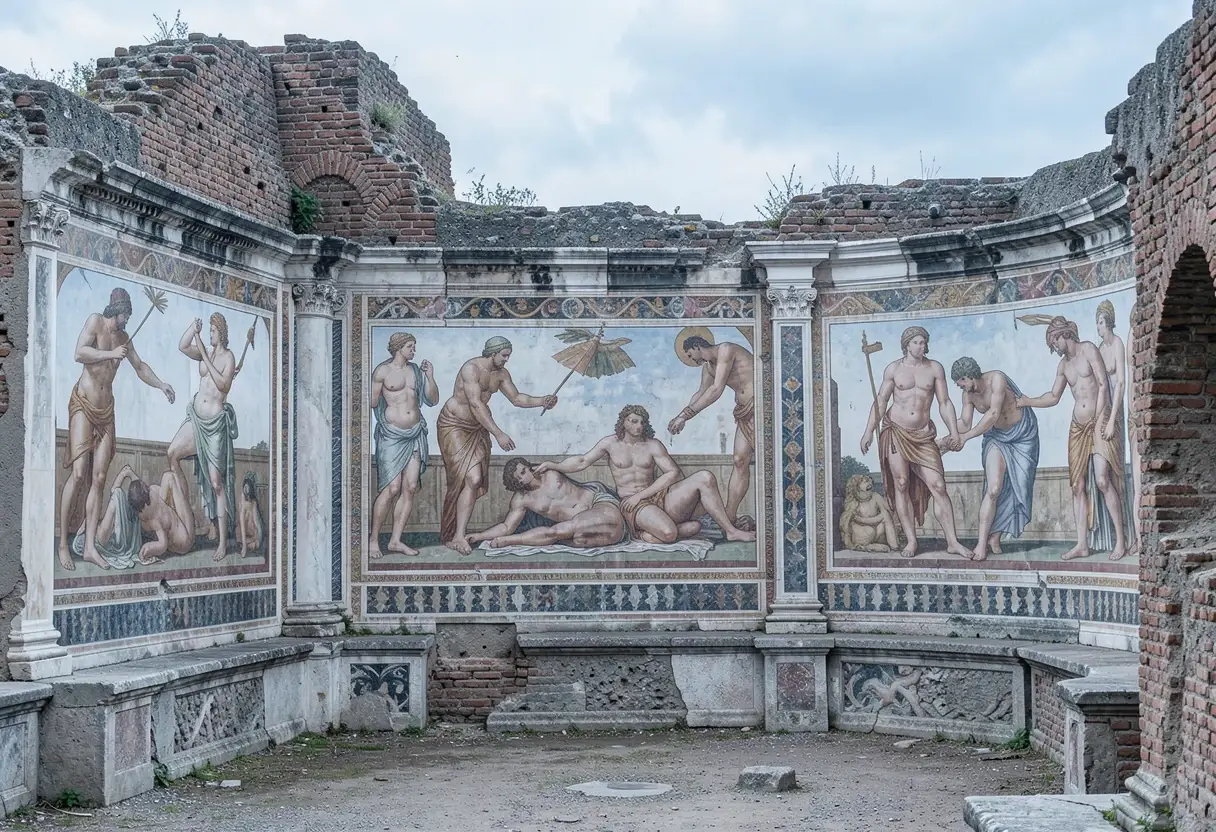
In 1819, the heir to the Kingdom of the Two Sicilies, Francis I, toured the newly unearthed Roman artifacts at what is now the National Archaeological Museum in Naples. He was so mortified by the explicit frescoes, paintings and sculptures that he ordered much of the collection hidden away again.
That royal embarrassment created the museum's Gabinetto Segreto — the "secret room" — which for nearly two centuries concealed works depicting "every conceivable act of lovemaking between women, men, gender-ambiguous figures and even gods (not to mention swans and goats)," in the words of an adapted excerpt from Patricia Nilsson's forthcoming book Guilty Pleasure: The Pornification of the Internet, the Economy, and Everything Else (Farrar, Straus and Giroux, 2026).
The material comes from Pompeii and Herculaneum, cities buried by the eruption of Mount Vesuvius in 79 CE and excavated from the mid-eighteenth century. Roman openness about sexual fantasy and pleasure clashed so sharply with Christian morality that authorities decided the public needed protection from it.
Who got in, and when?
For most of the next two hundred years, admission to the Gabinetto Segreto was restricted to learned men carrying permits attesting to their high moral standing — or bribes. At one point the entrance was bricked up entirely. The room stayed largely closed until 2000, apart from a brief opening during the sexual revolution.
When it reopened, the museum installed educational texts. Floriana Miele, the Gabinetto Segreto's scientific curator, told Nilsson these were meant to help visitors understand Roman attitudes toward fertility, life and pleasure, and to stop the works being read through "our own era's more crude perspective on the erotic."
Miele said antiquity suggests a "very different way of thinking about life and nature." Christianity shifted that. By the Middle Ages, an "attitude of prudish secrecy" had taken hold — a mindset she said feeds "prurient curiosity," and one the excerpt argues we remain stuck in today.
How Pompeii wrote the dictionary
The forbidden art shaped the very language of the debate. The word "pornography" combines the Greek pornē (prostitute) and graphien (writing). In 1864, Webster's defined it as "licentious painting [...] examples of which exist in Pompeii" — the first English-language dictionary definition, written amid frenzied media coverage of the Neapolitan excavations.
The pattern was global. Chinese chungonghua, rooted in Taoist ideas linking pleasure, health and spiritual harmony, showed lovers in elaborate settings. Japanese shunga woodblock erotica favored explicit close-ups. In India, instruction on kama produced the Kama Sutra and erotic temple reliefs. In every case, erotic expression was shaped — and constrained — by shifts in power.
Medieval Europe offers the sharpest example. Custom-ordered prayer books sometimes carried explicit scenes in their margins, and the papacy tolerated it while such works stayed a luxury of the elite. The printing press ended that tolerance.
What did the press change?
It made erotica mass-market — and made an example of its producers. The printmaker Marcantonio Raimondi, known for his collaboration with Raphael, was imprisoned by direct papal order for I Modi (The Ways, also called The Sixteen Pleasures), and every copy was ordered destroyed. No copies survive. But the printing plates did, and the engravings — later joined by sixteen explicit sonnets — live on.
Cinema repeated the cycle. Le coucher de la mariée (1896), the first surviving erotic film, was directed in Paris by Albert Kirchner, who a year later filmed the first cinematic life of Christ. El Satario (Argentina, 1907), Am Abend (Germany, 1910) and A Free Ride (believed shot in New Jersey, 1915) followed, largely underground.
What does this history change for us now? Nilsson's argument is blunt: with each technological leap — press, moving image, internet — pornography has revived the tension between our hunger for transgression and our fear of what it may unleash.
Original: bookshop.org
More from Tom Whitfield
Show full bio
Market editor covering people, launches and day-to-day practice in arts in the broadest sense at Arts & Voices.
1,546 articles