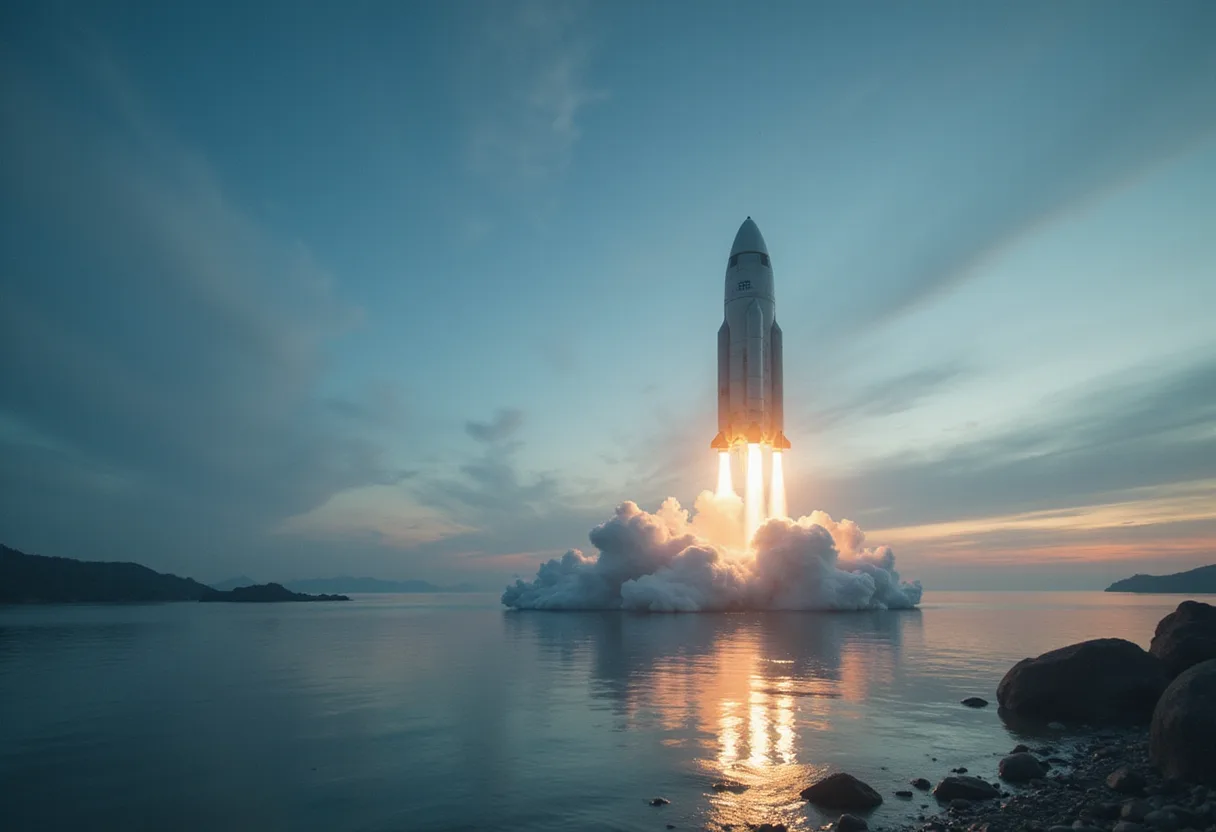
Project Hail Mary VFX Team Reveals How Zero-G Was Faked
Wire rigs, ESA Gaia star maps and a half-puppet alien: Paul Lambert and Mag Sarnowska broke down Project Hail Mary's zero-G effects at View Conference in Turin.

Programme
- Paul Lambert and Mag Sarnowska presented Project Hail Mary's VFX breakdown at View Conference in Turin on Friday.
- Half of Rocky's shots used practical puppetry; the other half were computer-generated by Framestore.
- Star positions were mapped with ESA Gaia data across 11.9 light-years, from Earth to Tau Ceti.
- Ryan Gosling performed zero-G scenes on wire rigs after the vomit-comet option was rejected as impractical.
- Digital footage was printed on Kodak stocks 5254 and 5203, with 10mm and 16mm used for Rocky's sonar-view shots.
By Elena Vasquez
Ryan Gosling floated through "Project Hail Mary" on wire rigs, including a rotating harness, after the production rejected the so-called vomit comet. Oscar-winning VFX supervisor Paul Lambert disclosed the method at View Conference in Turin on Friday.
"Zero-G was probably my personal biggest concern going into the movie," Lambert said. "We tried very hard to convince the production to use the vomit comet." The aircraft maneuvers briefly generate weightlessness, but the spacecraft sets were too elaborate to recreate onboard.
The numbers frame the scale. Half of the shots featuring Rocky, the alien companion, were puppet and the other half computer-generated. The team mapped stars across 11.9 light-years, from Earth to Tau Ceti, using data from the European Space Agency's Gaia mission. Two months of virtual-production tests preceded filming.
Takeaway: the film's most spectacular images rest on deliberately constrained, physics-led choices.
Why did the sky look familiar?
Lambert and co-supervisor Mag Sarnowska avoided colorful nebulae. They grounded the interstellar skies in astronomical reality for directors Phil Lord and Christopher Miller's adaptation of Andy Weir's novel.
"We had visions of all these beautiful nebulae, but in the end, the skies were pretty much as we see them today, from Earth," Lambert told the conference.
Exposure governed every decision. The team studied NASA footage and raw images from the International Space Station to learn how cameras behave in orbit. "If you were to take a movie camera up to space and try to shoot something, you wouldn't see the stars," Lambert explained.
The logic is strict. Near the brightly illuminated planet Adrian, background stars were largely absent. Farther from Tau Ceti, where the light was weaker, a hypothetical high-sensitivity camera could reveal them.
"Rather than simply choosing when to show stars with dramatic effects, we wanted their visibility to follow the actual lighting and exposure conditions," Lambert said.
Takeaway: realism, not spectacle, drove the film's cosmic backdrop.
How was zero gravity built shot by shot?
Removing the wires was only the beginning. When a suspended body still appeared to be hanging rather than floating, VFX artists adjusted the position of Gosling's legs, arms or torso and added drifting objects to reinforce the illusion.
Lambert said Gosling committed to performing his own stunt work, including demanding spacewalk material.
Cinematographer Greig Fraser ran hands-on experiments. He used an infrared-modified camera, programmable IR lights and water running in front of the lens to develop some of the film's stranger imagery.
"It was literally a mad science lab," Lambert recalled.
Burning fireballs, liquids, lasers and ferrofluid were also filmed to provide starting points for the microscopic effects. That is roughly one practical element per category of alien imagery in the film.
Fraser returned during postproduction to work with ILM's Helios virtual-camera system on the sequence near Adrian. Artists tracked Gosling's on-set performance and recreated it within digital environments, allowing Fraser to choose new camera positions without discarding the original acting.
Takeaway: digital tools served the performance, never replaced it.
What did the film-stock strategy achieve?
Fraser extended the exposure philosophy into the film's texture. Digitally captured footage was printed onto Kodak film and scanned back:
- 5254, with silver retention, for a relatively smooth, subdued Earth
- Grainier 5203 for space
- 10mm and 16mm prints for selected Rocky sonar-view shots
The smaller formats gave the alien's point-of-view images a more organic texture.
The pre-filming virtual-production sessions let Fraser and the directors test lighting, camera movements and the scale of spacecraft interiors. The resulting camera data guided the physical shoot and subsequent VFX work.
Takeaway: format choice, not filters, defined the film's two worlds.
How did Rocky stay half real?
Rocky, performed by James Ortiz and a team of puppeteers, posed the opposite problem: making a physically present character indistinguishable from his digital counterpart.
Sarnowska described three practical versions, including an animatronic and a smaller reference puppet. Framestore scanned the physical creation and studied hours of performance footage, reproducing the puppeteers' movement when the cramped spaceship sets made practical operation impossible.
"Our full CG Rocky got really good at mimicking the puppeteers," Sarnowska said. "In the end, half of the Rocky shots were puppet and the other half CG." She added that the team sometimes struggled to distinguish the versions during internal reviews.
The crew also rebuilt Rocky's transparent xenonite barriers digitally to remove reflections, hide operators and maintain the play of light through the set.
Across all techniques, the supervisors' ambition stayed consistent: make even the most elaborate effects obey a recognizable physical logic while ensuring Rocky felt as present beside Gosling as any human scene partner.
The approach paid off commercially. The moving tale of interstellar friendship proved one of this year's box office hits — and its methods are now a template for grounding large-scale science fiction in verifiable physics.
Source: Variety Film
More from Elena Vasquez
Show full bio
Senior reporter covering technology and product news in arts in the broadest sense at Arts & Voices.
623 articles