Roger Deakins Still Can't Define His Own Job
Roger Deakins, cinematographer of "Blade Runner 2049" and "1917," admits he still cannot define what a cinematographer is — and argues instinct beats any formula.

Programme
- Roger Deakins says he still cannot answer the question "what is a cinematographer?"
- He and James Ellis Deakins have collaborated on every project since meeting on Michael Apted's "Thunderheart."
- The flat-light murder scene in "The Assassination of Jesse James" was, he says, "a very conscious decision."
- The interview took place around Deakins' appearance at View Conference in Turin.
- Deakins chose "Moby-Dick" on a recent episode of "Desert Island Discs" and identifies with Captain Ahab.
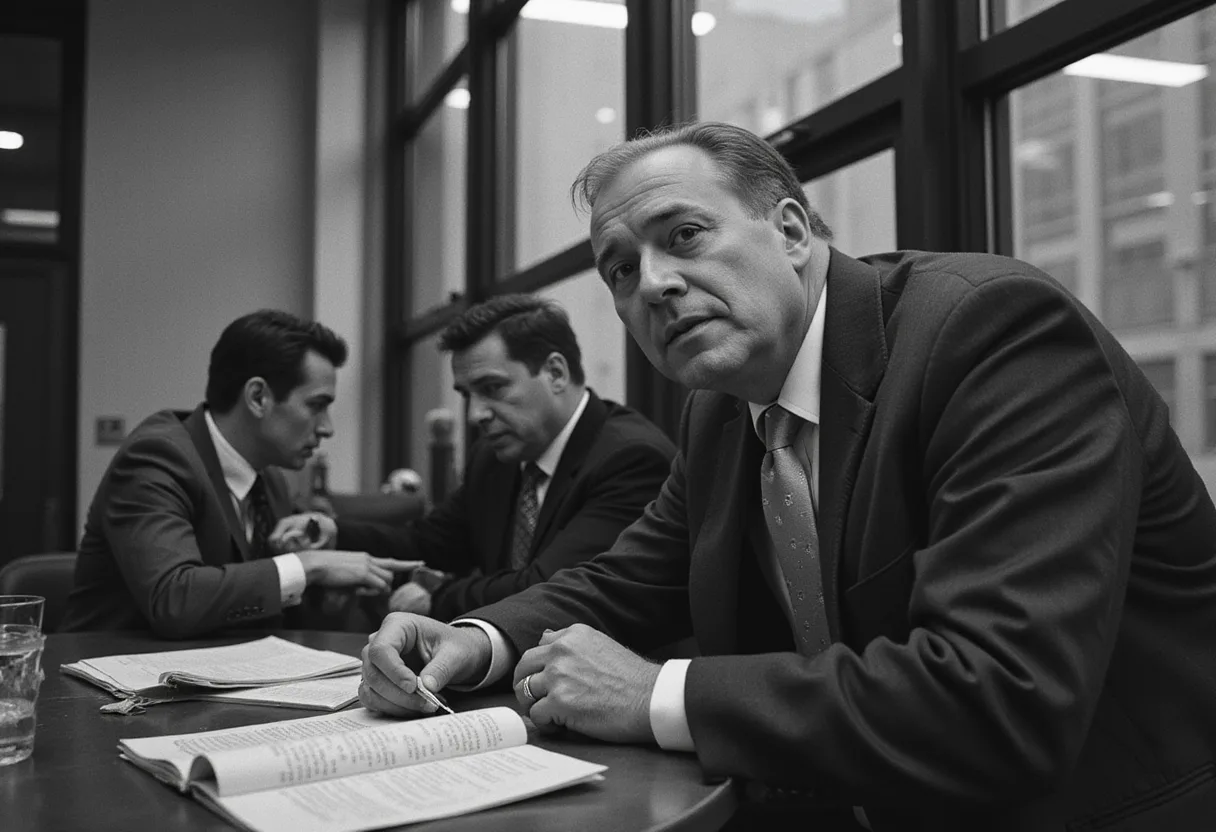
Roger Deakins, the cinematographer behind "No Country for Old Men," "Blade Runner 2049" and "1917," admits he cannot define his own profession. "Somebody asked the other day, what is a cinematographer? I mean, I still can't answer that," he said in an interview conducted around his appearance at View Conference in Turin.
The admission is unusual for a man whose images have shaped contemporary cinema. Deakins insists his work depends too much on the circumstances of each story, and the people telling it, to be reduced to a single method. "It's your emotional reaction to things that's important," he said. Technical choices can be discussed, but the decisions that shape an image come from something he cannot fully explain.
Where does his way of seeing come from?
Deakins was born in Torquay, a southern English resort town. As a young man, the camera gave him a confidence the world itself did not. "I was kind of hiding behind the camera to a certain degree," he recalled. "I had confidence because there was something between me and reality."
Only in retrospect, he says, has he understood the value of experiences whose importance escaped him at the time. "If you don't experience things, then what have you got to contribute?"
His wife and creative partner, James Ellis Deakins, shares the conviction. The two have collaborated on every project since meeting on Michael Apted's "Thunderheart." For her, experience supplies more than visual references. "If you're going to tell a story, having had many different experiences gives you many different points of view," she said. "You're able to actually add more to the story."
Deakins worries that cinema has grown too inward-looking, with filmmakers drawing inspiration mainly from other films. "I rarely, if ever, do that," he said of referencing earlier movies. "You bring all the things that you experienced in your life to something."
What was deliberate in "The Assassination of Jesse James"?
The gap between intention and instinct surfaces in Andrew Dominik's "The Assassination of Jesse James by the Coward Robert Ford." Most of the film contrasts light and dark. Yet the scene of Robert Ford's murder — set in a tent bar surrounded by snow, bathed in flat, even light — leaves Casey Affleck's Ford jarringly exposed.
Was the contrast deliberate? Deakins cannot entirely say. The look arose partly from the set itself: the tent, the snow, the whiteness around it. But there were choices. The crew could have introduced stronger shadows and let light fall on only part of the tent. Instead, they preserved the evenness.
"I think it was a very conscious decision to have almost a sort of documentary feel about it, as opposed to the rest of the film," Deakins said. He thinks the scene is stronger for it.
His still photography resists that kind of analysis even more. Asked about the relationship of shapes and forms in his images, he struggles. He sees the whole, not the parts. Ellis Deakins is more definite: "You may not be aware of it, but you are interconnecting shapes," she told him. "But I know it's instinctual."
How does the process change from director to director?
It varies sharply. With Sam Mendes on "Jarhead," Deakins worked largely handheld, responding to actors as they performed. With Joel and Ethan Coen, the process was often meticulously planned. He frames these as different routes to the same place. The common concern is what matters in a scene, and where the audience should stand as it unfolds.
Harrison Ford, discussing "Blade Runner 2049" alongside Ryan Gosling, once observed that Deakins' lighting proceeds from the story and leaves an actor feeling supported. Deakins calls that quality the product of collaboration. He particularly misses operating the camera with a director standing beside him rather than watching from a monitor. After a take, the director might turn and ask, "How was that for you?" "Then there was that sense of trust," he remembers. He misses that "intense collaboration and trust."
Does digital technology change the discipline?
The Deakinses distinguish digital tools from the habits those tools encourage. They have embraced whatever technology serves the story and have shot digitally for years. But Roger recalls the discipline of low-budget film productions, when stock and time were precious and rolling the camera carried weight. "You kind of had to figure out what was the essence of the scene and what was the shot that was going to give you that."
He admires Andrei Tarkovsky's long takes. "They would hold shots, and the shot would become something else. It would be saying something else." Ellis Deakins adds that restraint works too: holding back from an actor can leave an audience uneasy, wanting a closer view.
Off the Devon coast, days before the conversation, Deakins fished for mackerel from his boat — enough for supper. "You never know what might happen," he said, "and you've got to sort of change your approach constantly to adapt to the sort of tide and the weather and the way the fish are running." He acknowledges the parallel with filmmaking without pressing it. Both involve waiting, observation and a willingness to respond to the world rather than impose a plan.
At View Conference in Turin, both partners attended technical talks themselves — the man whose work is so often studied by others, still sitting in the audience, looking and listening. He recalled the photographer Raymond Depardon's remark: if he knew how to take a good photograph, every photograph he took would be good.
Asked whether he identified with Ishmael or Ahab — Deakins chose "Moby-Dick" as his book on a recent episode of "Desert Island Discs" — he answered without hesitation. "I'm definitely Ahab." "Searching for something he doesn't really understand, fighting something he doesn't really understand," he said. "I've always felt an affinity with Ahab for sure."
For aspiring cinematographers, the message is double-edged: no formula exists, and the Deakinses — through their Team Deakins podcast — argue the only path is experiment, examine your own footage, and ask why something works or doesn't.
Source: Variety Film
More from Elena Vasquez
Show full bio
Senior reporter covering technology and product news in arts in the broadest sense at Arts & Voices.
626 articles