Shanghai Jiao Tong Designers Propose Magpie-Friendly Melbourne Waterfront
Ten master's designers from Shanghai Jiao Tong University's School of Design have proposed a magpie-friendly Melbourne waterfront, a recycling game called Kingdom Midas, and a wearable scoliosis screener, among other projects published on Dezeen in October.
Programme
- Ten master's projects from Shanghai Jiao Tong University's School of Design were published on Dezeen in October as part of the publication's School Shows partnership series.
- The School of Design was consolidated in 2017 under a vision the institution calls 'Total Design,' with design education at the institution traced back to the early twentieth century.
- VeriSpine, by Lu Hanwen, Xu Zhiyu, Huang Keqiao, Peng Xinying and Mukaidaisi Abuduaini, uses nine detachable IMU sensors and three modular silicone carriers to screen for adolescent scoliosis during walking.
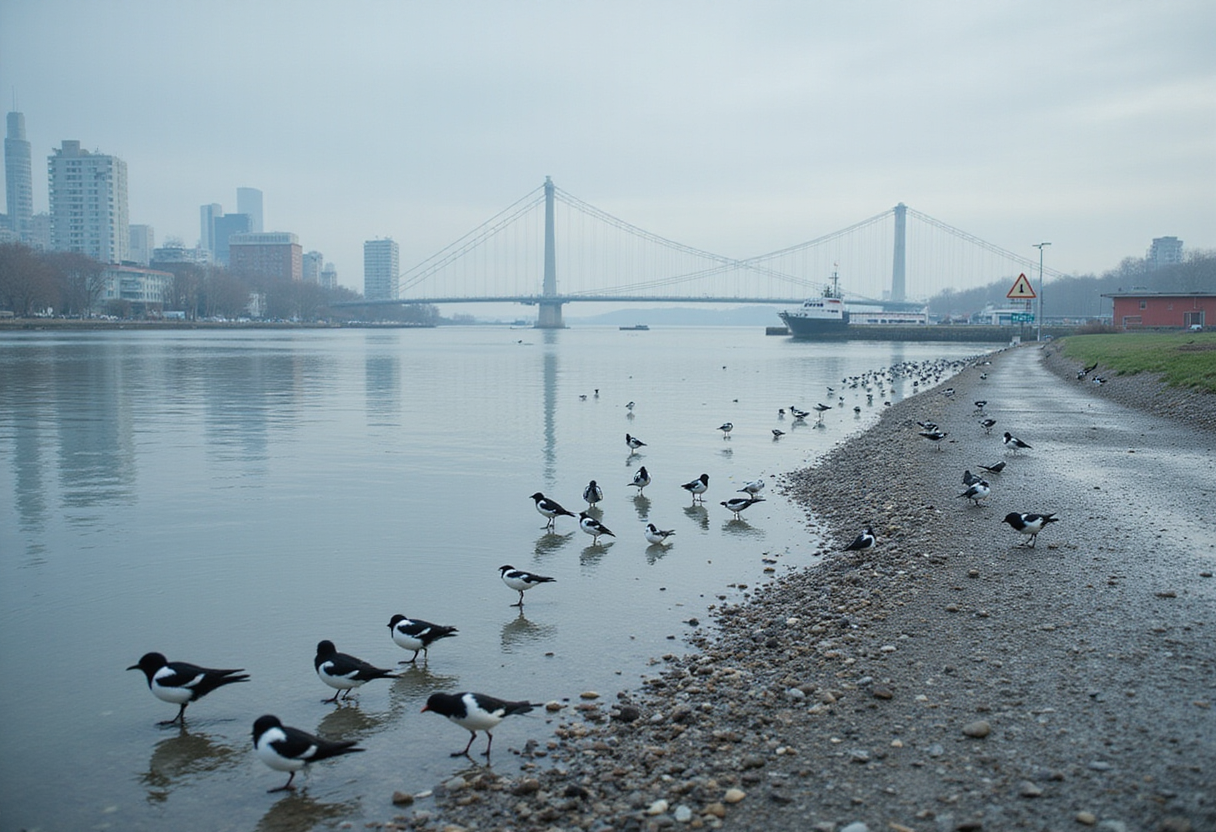
- 'Wings and Ways,' by Wu Jinghan, Li Shuyuan and Cao Yuheng, reimagines underused underpasses and waterfront spaces in Melbourne's Arden Precinct as shared landscape for humans and Australian magpies.
- The cohort worked through partnerships with POLIMI, RMIT, SAIC DESIGN, Unitree, and Apple's iCreate Club.
By Marcus Bennett
In Melbourne's Arden Precinct, three Shanghai Jiao Tong University master's students have proposed a waterfront redesign that treats Australian magpie breeding behaviours as the organising logic of the site. Wu Jinghan, Li Shuyuan and Cao Yuheng are among ten graduate designers from the university's School of Design whose work was published in October on Dezeen as part of its School Shows partnership series.
The magpie project, "Wings and Ways: Human-magpie Harmony Safe Space for Arden," reimagines underused underpasses and waterfront spaces in the precinct as a shared landscape for people and birds. The team responds to magpie breeding behaviours and the precinct's vegetation history, linking native shade planting, gentle landform changes, and restored plant communities into a single habitat strategy. The work emerged from an SJTU-RMIT joint virtual classroom.
What does the magpie waterfront actually propose?
The scheme treats the bird's nesting cycle as a constraint that shapes the built form. Native shade trees create visual buffers between paths and nests. Subtle changes in elevation steer foot traffic away from sensitive zones. The waterfront paths shift from commuter shortcuts into spaces for slow gathering. The students describe their ambition plainly: to transform spaces of conflict into opportunities for coexistence, where people can relax and magpies can forage, nest and breed. Tutors included Wang Ling, Zhu Liqing, Alice Lewis, Ethan Zhang and Lee Parks.
The School of Design brings together master's programmes in architecture, industrial design engineering, design and landscape architecture. It was consolidated in 2017 from earlier disciplines under a vision the institution calls "Total Design." Design education in the field of human habitat at Shanghai Jiao Tong University can be traced back to the early twentieth century, according to the school's published statement.
Why turn recycling science into a video game?
"Kingdom Midas," by He Liyouyu, Zhang Kai, Zhu Wenxin and Zhu Yeqi, is an educational adventure game that turns recycling science into story-driven missions. Players follow a boy named Maimai through a magical kingdom where discarded paper and metal come alive as resource spirits. The team embedded real industrial processes into the gameplay, including pulping, sorting, compression, magnetic separation and remanufacturing, transforming complex scientific processes into an engaging and imaginative experience for children. The studio ran through an Apple iCreate Club partnership. Tutors were Liu Bo and Liu Zhao.
The cohort's social-impact agenda extends into clinical hardware. VeriSpine, by Lu Hanwen, Xu Zhiyu, Huang Keqiao, Peng Xinying and Mukaidaisi Abuduaini, is a portable, wearable scoliosis screening system that captures spinal data through walking.
Can a wearable replace a clinical scoliosis exam?
Not yet, but the team designed VeriSpine for schools, communities and remote areas with limited screening access, a goal that matters because adolescent scoliosis often goes undetected without routine clinical attention. Nine detachable IMU sensors slot into three modular silicone carriers worn across the upper body and lower limbs, capturing motion data that a spatiotemporal deep learning network then converts into a screening result. The device folds into a compact carrying case for charging between uses. Tutor Tan Xinyang supervised the work.
Other projects push further across disciplines. "Life Pulse: Avenue," by Peng Di, Zhou Hengli, Zhuang Yaru and Zhu Xinyi, proposes transforming Shanghai's North Caoxi Road into the city's first sports and vitality business corridor, linking Xuhui Park, Xujiahui Center and Xuhui Sports Park through three spatial strategies: Sports, Culture, and Commerce Pulse.
"The Sunken Days of Towers," by Yan Jiahao, reimagines Bologna's Two Towers through six atmospheric narrative worlds drawn from archival research and ethnographic fieldwork. Tutors Huang Huaqing and Corinna Rossi supervised the project, part of an SJTU-POLIMI double master's programme.
"Soft-Tech Mobility," by Liu Yirui, Li Weiran, Wang Weichuan, Zhang Yin and Tao Kaiyan, applies colour, material, and finish thinking to vehicle interiors through an SAIC DESIGN and Unitree collaboration, addressing social uncertainty around rapid technological change. The team's three atmospheres (Serene Float, Meta-Interface, Crimson Rhythm) aim to rebuild a sense of security inside future vehicle cabins. "Parallel Orbits," by Alima Adalaiti, Yang Yuchen, Zhang Hewen, Wang Jiamin and Guo Yaya, combines a camera, projection and AI video synthesis to keep two distant lives visibly in step.
What does this output change for Shanghai's design pipeline?
The cohort shows how the School of Design channels graduate work through partnerships with POLIMI, RMIT, SAIC, Unitree and Apple's iCreate Club, with industry briefs embedded directly into studios. As these designers move into practice, the projects may set expectations for what Shanghai-trained graduates bring to a commission, including species-aware landscapes, clinical-grade wearables, AI-mediated intimacy, and urban corridors that double as commercial infrastructure.
Original: designschool.sjtu.edu.cn
More from Marcus Bennett
Show full bio
Staff writer covering people, launches and day-to-day practice in arts in the broadest sense at Arts & Voices.
482 articles