Torkwase Dyson's New Paintings Borrow Depth from Sculpture
Torkwase Dyson's latest paintings carry "a celestial depth that's often reserved for sculpture," testing the line between flat canvas and built volume.

Programme
- Torkwase Dyson has produced a new body of paintings.
- The source describes the work as having "a celestial depth that's often reserved for sculpture."
- The new paintings test the boundary between two-dimensional and three-dimensional art.
- No venue, dates, or titles are specified in the source.
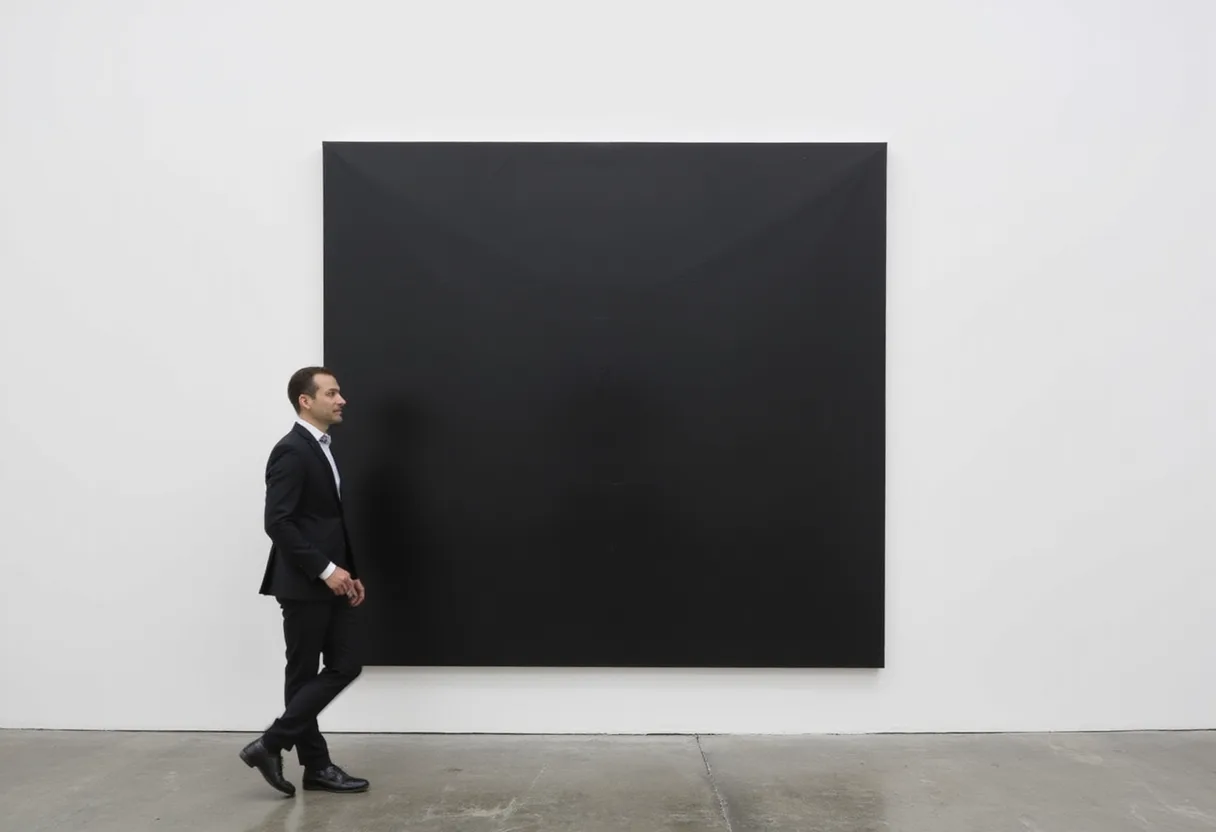
Torkwase Dyson's latest paintings carry what one critic has described as "a celestial depth that's often reserved for sculpture." The observation, brief as it is, names the central tension in the new work: flat canvas behaving like volume.
Dyson has built a career on that tension. The American artist works at the boundary between painting and architecture, treating the rectangle of the canvas as a constructed space rather than a surface. Her compositions favor black, deep blue, and precise geometric forms that suggest beams, voids, and load-bearing structures. The result reads less as image and more as environment.
The new paintings push this further, according to the source description. What does this change for the viewer? It changes the distance at which the work operates. Sculpture demands circumnavigation; the eye moves around it, measures it, tests its mass. Dyson's paintings, if they carry sculptural depth, ask for that same physical attention while offering only a frontal plane. The viewer supplies the missing dimensions.
This is not a new problem in painting, and Dyson knows it. The history of the medium is a long argument about illusion: perspective, impasto, the shaped canvas, the relief surface. Each generation of artists redraws the line between the represented and the built. Dyson's contribution has been to redraw it in terms of space itself — how bodies move through rooms, cities, and landscapes, and how a painting can compress that movement into a single encounter.
The word "celestial" in the source description deserves attention. It suggests not merely depth but distance — an impression that the farthest reaches of these paintings recede beyond their supports. Depth of that kind is usually the province of the sculptor, who can carve actual recession rather than imply it. A painter who achieves it works against the grain of the medium.
Dyson's geometric vocabulary makes this possible. Her forms are spare: straight lines, arcs, hard-edged planes in a restricted palette. Nothing in the toolkit announces illusionism. The depth, when it arrives, comes from the relationships between shapes — from spacing, weight, and the intervals of raw surface left open between them.
What the source does not specify is venue, dates, or titles for the new paintings, so viewers should watch announcements from the artist's gallery representation for exhibition details. Dyson's work has moved steadily through major institutions in recent years, and new paintings of this ambition will likely follow that path.
For now, the record stands at a single sentence, but a pointed one. When a painter's flat surface is described in the language reserved for sculpture, the line between two dimensions and three has been tested — and, on this evidence, blurred.
Source: NYT Arts
More from Marcus Bennett
Show full bio
Staff writer covering people, launches and day-to-day practice in arts in the broadest sense at Arts & Voices.
593 articles