Whitney Gives a Full Floor to 25 Years of Internet Art
The Whitney opens "artport: A History of Internet Art" on Saturday — a full floor for 25 years of net art commissioned by curator Christiane Paul since 2001.
Programme
- "artport: A History of Internet Art" opens at the Whitney Museum on Saturday, dedicating an entire floor to internet art.
- Curator Christiane Paul launched artport as an online gallery in 2001; the Whitney indexed it as part of its collection in 2015.
- artport produced 57 monthly splash pages between 2001 and 2006; the Whitney commissioned Auriea Harvey's work in 2023.
- Operator's "Human Unreadable" Act III, begun in 2022, performs the first 100 tokens' choreographic sequences and live-streams to 18 partner institutions.
The Whitney Museum opens "artport: A History of Internet Art" on Saturday, turning over an entire floor to digital art — a rarity in a New York museum's programming. The exhibition features works associated with artport, the online gallery that curator Christiane Paul launched in 2001 and that the Whitney officially indexed as part of its permanent collection in 2015.
Paul, adjunct curator of media art at the Whitney, has commissioned works across 25 years from artists ranging from the duo JODI to Mimi Ọnụọha. The most recent commission came from Jazsalyn, who earlier this year proposed what she called "Black Metatheories" as a means of forming something alternative to AI, prompting users with lines such as: "Consider blackness. How does life persist within the spectrum of impossible possibility?" Paul wrote the book on digital art in 2003 and is now writing a follow-up.
What changed when artport joined the collection?
Paul says the original thinking has stayed intact: "It's kind of weird to lock down net art in a collection. And that is why we decided to commission the works under non-exclusive licenses." The 2015 shift, she said, was about status: making artport its own umbrella collection gave all commissioned artists lifetime membership and treatment equal to collection artists.
It also fixed a database problem. When the Whitney added physical works by artport artists — for example, a sculpture by Auriea Harvey, commissioned in 2023 — a collection search would surface the sculpture but not her online work.
Who commissions the work?
The commissioner is always the Whitney Museum, Paul said, and artport never shows existing work; artists submit proposals. From 2009 to 2023, the "Sunrise Sunset" series marked sunrise and sunset with a 30-second intervention into whitney.org that played across all pages. "It's so net art to disrupt, particularly an institutional website," Paul said. But the format ran on New York time only, which prompted the shift to hourly interventions in the current "On the Hour" series — a format Paul also uses to give younger, more experimental artists a chance to work with the museum.
When artport launched in 2001, net art already had a history — the internet opened to the public in 1993, and artistic practice took off in the mid-'90s. Paul rapidly moved through the artists who created the field's language: Mark Napier, Tina La Porta, Martin Wattenberg, Marek Walczak and Amy Alexander.
How do you hang the web on a wall?
Since the '90s, Paul noted, critics have argued net art "should only be seen online." She calls that "such an ironic misunderstanding because online is not on your couch in your house. Online is everywhere!" The challenge, she said, is making the work accessible in a gallery while maintaining its net-ness.
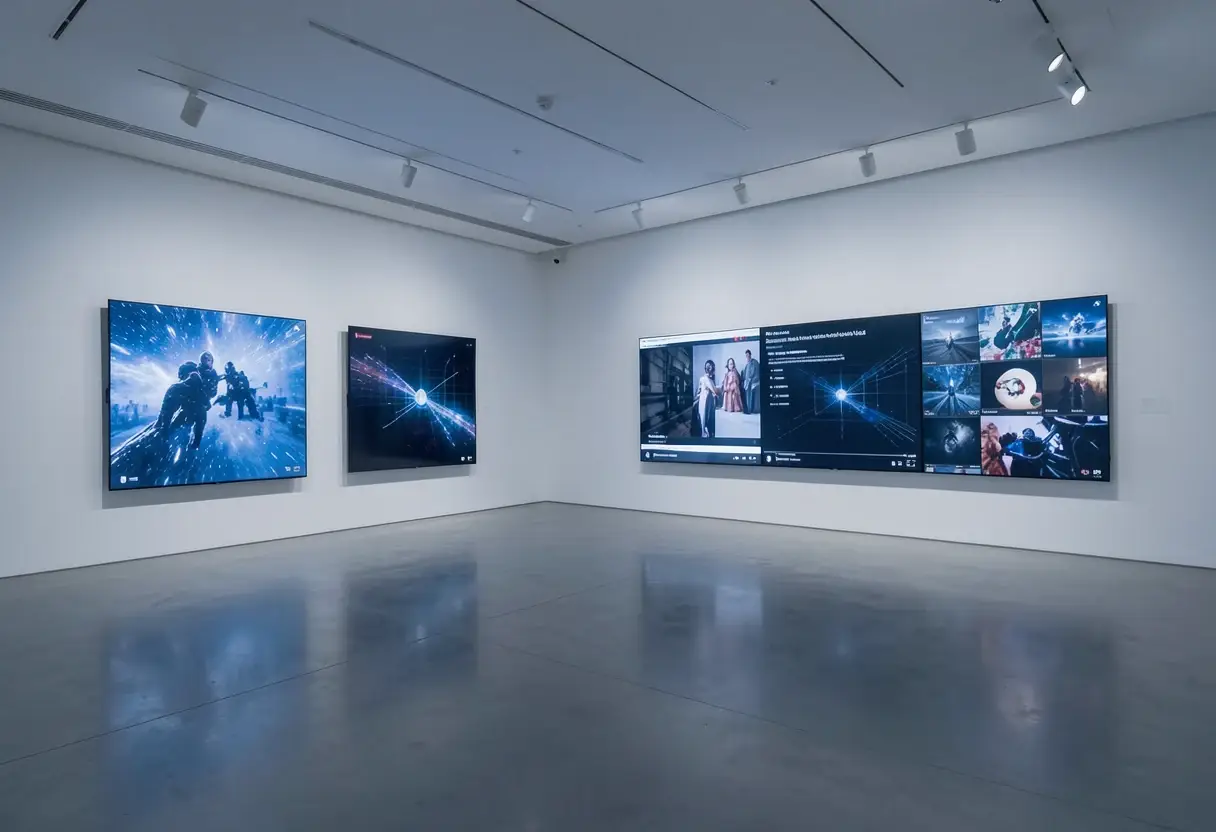
Her design conceit: an open floor arranged as a landscape of browser windows, with floating walls held up by poles suggesting open tabs rather than segregated rooms. Andy Deck's Screening Circle (2006), a collaborative pixel-drawing tool, becomes an installation projected onto a platform with four tablets so four people can use it simultaneously alongside the live online work. Michael Mandiberg's endurance performance Life Study (2018) — four years of filming himself painting his assistants — appears with its archive and some of the paintings themselves.
The title says "a history," not "the history." Julia Kaganskiy, Paul said, puts it nicely in her catalog essay: there are timestamps demarcating the concerns, social norms and media environments that shaped collective life. A different roster of artists would mark the same shifts but tell the story differently.
What does the show include?
The exhibition includes a new performance by the artist duo Operator: Act III of "Human Unreadable," their generative blockchain choreography begun in 2022. Act I translated choreographic sequences into large-scale black-and-white images sold as NFTs; Act II let collectors reveal the movement sequences behind their images. Act III brings bodies on stage, without screens, performing the first 100 tokens' choreographic sequences in a multimedia theater piece with spoken word. Its two matinees are live-streamed through 18 partner institutions — a stream Paul describes as an artwork in itself, "almost a little bit more like Nam June Paik's Good Morning, Mr. Orwell minus the technological difficulties."
Of the 57 splash pages produced monthly for artport between 2001 and 2006, Paul is showing only those where artists created standalone projects; section texts explain what splash pages were. The point, she said, is the connections across the floor: Jillian McDonald's fan-culture work inserting herself into Buffalo '66 with Vincent Gallo — made 20 years before deepfakes — sits across from Tina La Porta's voyeur_web (2001), itself countered by Maya Man's A Realistic Day in My Life Living in New York City (2024–25), with its performed TikTok version of realism.
Paul's verdict on the field's early freedoms is blunt: the first generation used the web as material, scraping and reprocessing it, and "the access they had, you don't have that anymore with the corporate lockdown." In a 2015 Rhizome interview she said she was dubious net art still existed. She now revises that framing slightly: the pure net artist whose practice exists only online is harder to find, and younger figures like Maya Man and Chia Amisola work across material forms — but, she said, "there is still net art, and a lot of it."
Original: whitney.org
More from Tom Whitfield
Show full bio
Market editor covering people, launches and day-to-day practice in arts in the broadest sense at Arts & Voices.
1,496 articles