Why Book Collectors Have Sniffed Their Libraries for Centuries
From Richard de Bury's 'aromatic' Paris libraries to book thieves hooked on scent, Will Tullett's 'Sniff' traces the surprising history of smelling knowledge.
Programme
- In 1345 Richard de Bury described Paris's libraries and booksellers as 'more aromatic than stores of spicery.'
- The Mogao Caves library at Dunhuang was rediscovered on June 25, 1900, after being sealed since the eleventh century.
- In 1978 Bruno Pagono was fined for stealing £25,000 of books from Oxford's Bodleian Library, blaming their smell.
- In 1866 a Scottish trial found paper mills guilty of polluting the North Esk with caustic-soda waste from esparto grass.
- Modern paper, made since the late nineteenth century, is less chemically stable and smellier than earlier rag-based paper.
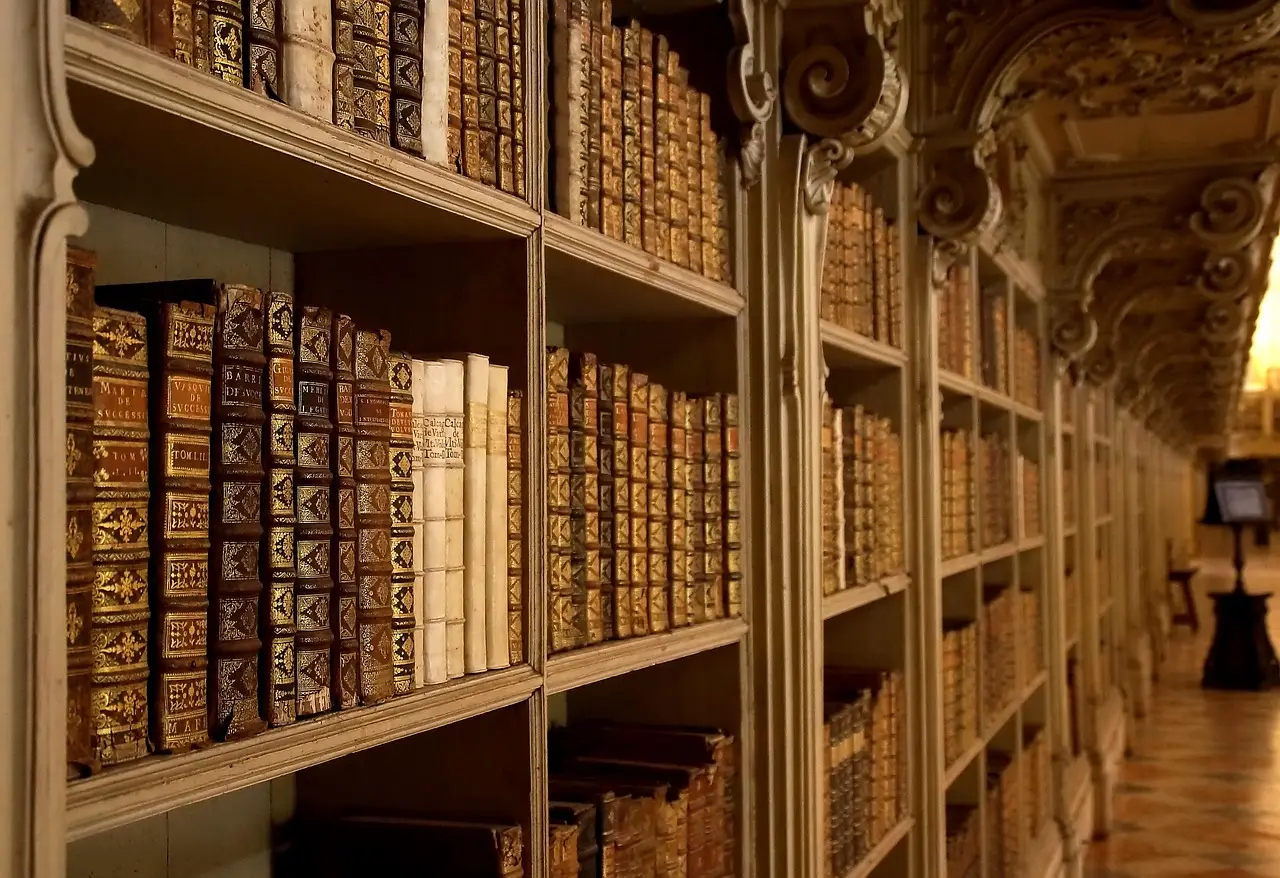
In 1345, the English book lover Richard de Bury described the libraries and booksellers of Paris as "more aromatic than stores of spicery." His Philobiblion framed reading as a sweetening of memory and collecting as gathering "sweet-smelling flowers" — knowledge itself shed perfume, like the panther that, according to medieval writers, "all other Beastes love and follow…for his sweete smell."
That's the opening move of historian Will Tullett's new book Sniff: A History of Smells, published by Yale University Press. The excerpt runs from medieval Paris to a polluted river in Maine, and its argument is simple: smell has carried cultural meaning that historians have largely ignored.
Why did philosophers distrust smell?
Tullett lays out the mechanism. From Aristotle to Hegel, thinkers judged the human nose unreliable and prone to prejudice. Immanuel Kant called smell ungrateful, dispensable, and more subjective than objective. Jean-Jacques Rousseau damned it with faint praise as the "sense of the imagination." In traditional hierarchies of the senses, smelling ranked in the middle at best — and at the bottom, associated with animality, childishness, femininity and racialized others. Seeing, not sniffing, was the source of knowledge.
Satirists weaponized that distrust. The seventeenth-century Frenchman Jean de La Bruyère mocked collectors, comparing the stink of an untouched Moroccan-leather library to a tannery. The Victorian dramatist Douglas William Jerrold skewered owners who believed they could "take a good sniff" and breathe in the "aroma of learning." In the early twentieth century, the Japanese critic Uchida Roan likened bibliophiles to book-eating insects delighting in the "sweet scent of old ink."
Where was smell taken seriously?
In China, quite literally. The word shuxiang means both "knowledge" and "the scent of books." In the seventeenth and eighteenth centuries, a fine collection "perfumes the family line with the scent of ink." Scent was also forensic: as early as the eleventh century, Chinese collectors sniffed out artificially aged forgeries. The Song-era painter-poet Mi Fu advised that volumes "aged by exposing them to smoke will retain an odor," while "genuine old paper or silk has a peculiar fragrance of its own." In 1781, a collector confirmed a volume as a Song-dynasty edition when an "ancient fragrance assailed the nose."
The excerpt's most elegant connection links de Bury to the Japanese philosopher Kuki Shūzō, who walked Paris's book-lined streets of St. Michel in the 1920s and inhaled the "fragrance of past wisdom." Kuki, who met weekly with Jean-Paul Sartre to discuss Heidegger, later wrote a treatise on iki arguing that "it is not that the fragrance triggers the memory," but that "we smell in the fragrance the memory of the past" — echoing Proust's belief that "the better part of our memory exists outside ourselves."
What does the smell of paper actually contain?
Sometimes, politics. On June 25, 1900, the Daoist monk Wang Yuanlu discovered a sealed library in the Mogao Caves at Dunhuang — thousands of manuscripts walled up since the eleventh century. When Aurel Stein and Paul Pelliot arrived in 1907 and 1908, they paid the monk a paltry sum and shipped the documents to Europe. Parisian archivists cracking the boxes registered a "pungent odor" of rancid butter, smoke and grime — which they read as proof of Tibetan culture's antiquity. Tullett notes those same noses never boiled their own culture down to such stereotyped components.
The smell could also incite theft. In January 1991, trainee book-binder Peter Lawson pleaded guilty at the Old Bailey to stealing three London volumes, claiming he could resist temptation "as long as I don't get a whiff." He got two years' probation and an order to stay away from bookselling premises. In October 1978, Italian lecturer Bruno Pagono was fined for stealing £25,000 of books from Oxford's Bodleian Library: "the smell of the books made me want to take them."
Is the smell of old books even old?
Not really. The vanilla-like odor comes from chemicals in decaying paper, and modern paper — produced since the late nineteenth century — is less chemically stable and smellier than earlier stock. Medieval European paper came from fermented rags; nineteenth-century mills reeked of bleach. When the American Civil War cut off cotton rags, Scottish mills switched to esparto grass boiled in caustic soda, turning the North Esk into water residents in an 1866 trial described as nauseous, loathsome and corrupt. Pollution travelled: by 1941, sulphite mills on Maine's Androscoggin river had locals vomiting as they crossed bridges, a poem in the Lewiston Evening Journal blaming failed crops on the "odor from the River."
The through-line holds: every era's books carry the smell of how they were made — and who paid for it.
Original: bookshop.org
More from Grace Kim
Show full bio
Correspondent covering technology and product news in arts in the broadest sense at Arts & Voices.
1,047 articles