Carrie Coon Wins Vancouver's Inaugural Luminary Award
Carrie Coon received Vancouver's inaugural Luminary Award and stars in Guy Nattiv's "The Liberation," a cult drama rooted in his grandmother's Yad Vashem testimony.

Programme
- Carrie Coon received the Vancouver International Film Festival's inaugural Luminary Award for acting this year.
- She stars in Guy Nattiv's "The Liberation," shot on Vancouver Island, opposite Lily James.
- The film is inspired by Nattiv's grandmother, whose archival testimony was recorded by Yad Vashem.
- Coon cites Steppenwolf's "Who's Afraid of Virginia Woolf?" transferring to Broadway as her career turning point.
- Four of the six female acting winners at this year's Emmys were over 50, Coon notes.
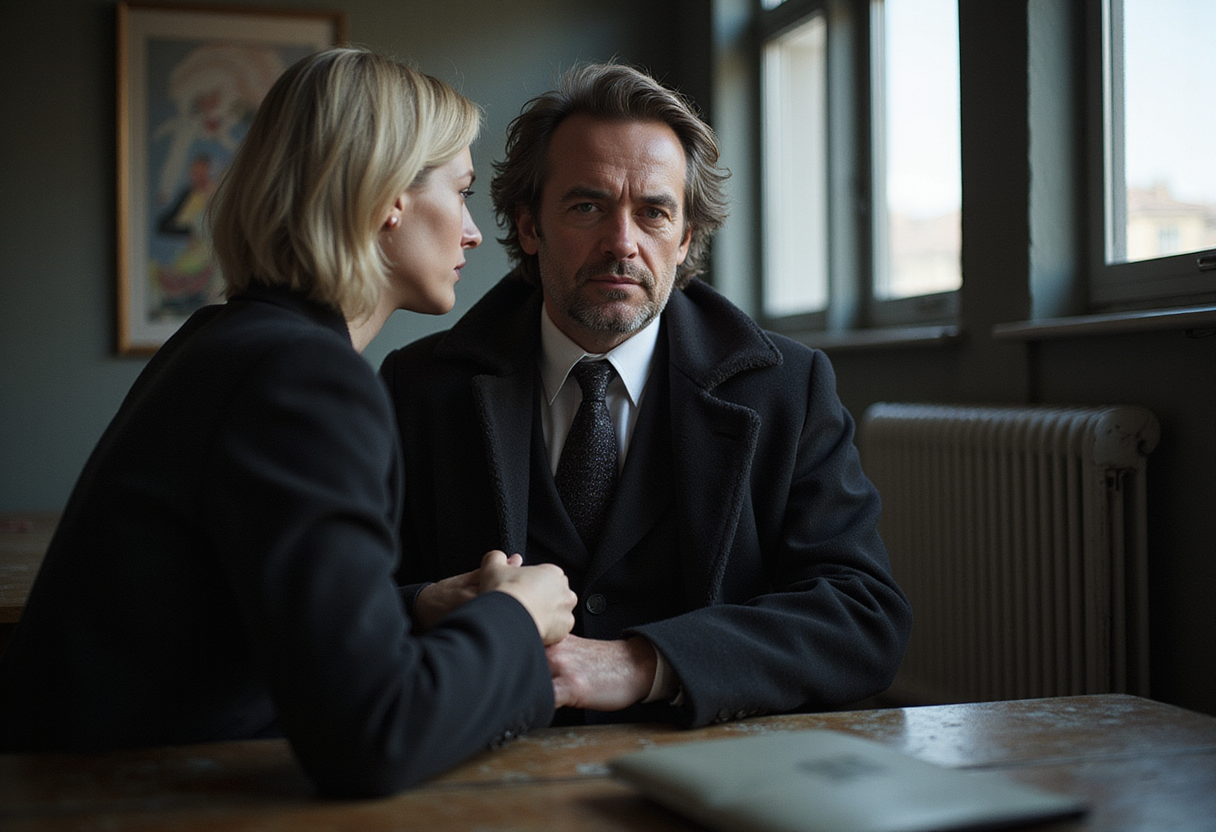
Carrie Coon received the Vancouver International Film Festival's inaugural Luminary Award for acting this year, while premiering there in Guy Nattiv's "The Liberation," a Vancouver Island-shot drama about a Holocaust survivor who leaves her family to join an all-female cult led by a charismatic figure played by Lily James.
"The Liberation" draws on Nattiv's own grandmother, whose archival testimony was recorded by Yad Vashem. Coon studied that testimony extensively before filming, and it anchored her whole understanding of the part.
"I was so fascinated by her. Just the vulnerability. How difficult it was. The fact that she could only do it when she was deep in the cult," Coon told Variety.
Why does Coon refuse to judge her characters?
Coon has built a career on parts that resist easy sympathy, from "The Leftovers" to "The White Lotus" and "The Gilded Age." Her position on likability is blunt.
"I think likability is an overrated quality," she said. "It's more interesting to play a character that is not just likable."
The film's central question, as Coon frames it, is why someone would willingly abandon a conventional life for an alternative community. Her answer pushes back on the common assumption that cult members are gullible.
"What we know is that the people who find themselves in that situation are often extremely intelligent," she said. "They're often, at heart, seekers — spiritual seekers."
"They're not stupid. I think so often, when we watch documentaries about cults, we stand outside it and we think, 'Well, that would never happen to me.'"
Inside the cult, Rita finds what her own life lacked: female friendship, self-exploration, the processing of trauma, even singing and dancing. Robbed of her childhood, she returns, in some ways, to a childlike state.
"She was really being controlled," Coon said. "And she was, frankly, also in love with this person. For better or for worse. And who are we to say what somebody needs to process the kind of trauma that she survived? Who are we to determine for a person what she needs in order to, frankly, not kill herself?"
That refusal to judge extends to her craft. Every character, even one capable of terrible things, must be understood from the inside.
"Human beings have a tremendous capacity — including, in its most extreme form, to murder somebody," she said. "Acknowledging the human capacity is fundamentally an act of compassion, which is why you can't judge a part that you play."
What was the turning point in her career?
Coon names one pivotal moment: Steppenwolf Theatre's production of "Who's Afraid of Virginia Woolf?" transferring to Broadway. After that, she says, "It has felt slow and steady ever since."
Without that transfer, she believes she would likely still be working in regional theater — a world she says has been "decimated" by a lack of funding. She calls it "a good training ground" and is saddened by young actors who have never done it.
"You know when you're losing them. You know when you've gotten them back," she said of reading a live audience. "That muscle is really important, because it's teaching you what good storytelling feels like."
In film and television, she notes, someone else makes that call.
Television, in her view, is where the richer roles now sit. "That's where the more interesting, meaty parts for women are happening," she said, citing a greater appetite for risk-taking there. "Film has been slow to catch up."
She points to this year's Emmys, where four of the six female acting winners were over 50.
"I think what the business is finally starting to acknowledge is that women are also economic drivers in their households. So it is actually good economic policy to make art that women want to consume," she said. "And maybe, as women are taking over in executive roles, we'll start to see more of those projects being greenlit in the film space as well."
Does Coon read her own reviews?
All of them, she admits — good reviews, bad reviews and "mean tweets."
"I think it is an inoculation," she said. "If you're willing to take in the praise — if you're hungry for the praise and the validation — you have to be willing to take in the criticism too."
She claims no anxiety about how audiences receive her less sympathetic characters: "I don't care what other people think. I'm not afraid of it."
"I'm in pursuit of what's most interesting to me, and I don't get to control how it lands in the world," she said. "I have no control over whether a project is successful, who likes it, who hates it, what they write about it."
What does "The Liberation" say about community?
The film, Coon argues, also exposes the erosion of community in modern life — the vanishing of "third space," remote work, social media and isolation. Cults fill that vacuum.
"Fundamentally, human beings are seeking belonging," she said. "That is a biological imperative, because it helps us survive."
Without community, she warns, something darker steps in: "White supremacy. QAnon. A strong political affiliation. Something will fill the void."
Her answer is not to condemn the communities people find, but to build better ones.
"We've forgotten how to build community, at a really fundamental level," she said. "And I think it's the source of a lot of the problems we're seeing, particularly in our country right now."
Looking ahead to what she calls the "crone years" — the last third of her life — Coon wants a community of her own: women she admires and can turn to for advice.
"I really just want to lean into my crones," she said. "I want to be surrounded by witches."
Source: Variety Film
More from Daniel Okafor
Show full bio
News editor covering consumer brands and retail at Arts & Voices.
276 articles