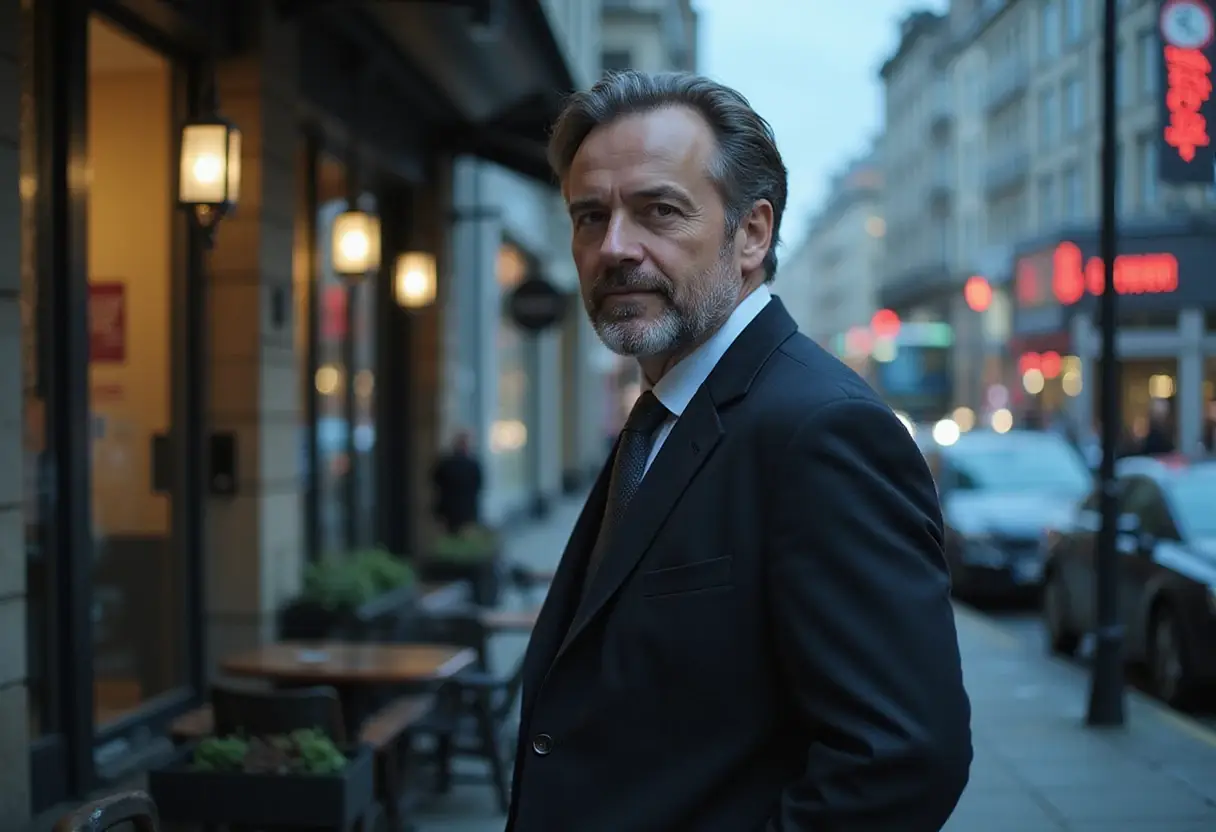
Elsinore brings Ian Charleson’s final Hamlet to the screen
Elsinore stars Andrew Scott as Ian Charleson, whose 24-performance Hamlet run at London's National Theatre ended weeks before his death on January 6, 1990.
Programme
- Ian Charleson died on January 6, 1990, aged 40.
- His 1989 National Theatre Hamlet run comprised 24 performances.
- Andrew Scott stars as Charleson in Elsinore.
- Daniel Day-Lewis withdrew from the National Theatre production in September 1989.
- The Royal Free Hospital later named an HIV treatment center in Charleson's memory.
Ian Charleson died of AIDS on January 6, 1990, aged 40, less than two months after his final bow in a 24-performance run as Hamlet at London's National Theatre. Elsinore, the new film starring Andrew Scott as the Scottish actor, examines his final months and makes his 1989 stage work central to the story.
His 1989 run ended weeks before his death, the first celebrity death in the UK openly attributed to AIDS. Ian McKellan, who saw Charleson in the production, gave the performance a one-word verdict: “Perfect.”
Elsinore draws on Sean Mathias, Charleson's close friend and the film's writer-director, and Ethan Silverman, his friend and executive producer whose idea initiated the project. Matthew Beard plays Mathias, and Johnny Flynn portrays Richard Eyre.
Charleson could act, dance and sing at the highest levels, and his stage range ran from Ariel in The Tempest with the Royal Shakespeare Company to Sky Masterson in Guys and Dolls at the National Theatre. He had studied at the University of Edinburgh before training as an actor in London.
On screen, his portrayal of Eric Liddell in Chariots of Fire included bare-chested sprints along frigid Scottish beaches and rousing speeches in pouring rain. Chariots of Fire won the Academy Award for Best Picture in 1982. His prominent supporting role as a clergyman in 1983 Best Picture winner Gandhi then made him look set for a major Hollywood career.
Mathias complicates that account. “He had charisma,” he said. “He was sexy. He had physical prowess.” The wider career was floundering, though Charleson kept landing parts in the 1987 horror movie Opera and the 1986 comedy Car Trouble. Mathias said the actor did not fit the Hollywood leading man mold and added: “It's fair to say he was cynical.”
Mathias also said Charleson was gay. “No one came out in Britain,” he said. “Nobody knew except your inner circle. And that normally did not include your family. They'd be the last to know.” Charleson learned he was HIV-positive in 1986 and kept the news largely private. “Very few people knew at that point that he was sick,” Mathias said.
Charleson lived in an era when HIV was effectively a death sentence. Silverman's memories offer a counterweight: the actor continued to move through public life. “He was a people person,” Silverman said. “He was always singing, joking, dancing.”
On a warm May night in 1987, Silverman and Charleson strolled through Rome and reached the Tiber at the Bridge of Angels.
“We arrived on the Tiber at the Bridge of Angels, which was perfectly lit, like a theater set,” Silverman said. “And all of a sudden he plants himself in the center of the bridge, and spins around, and sings ‘Everything's Coming Up Roses’ from Gypsy as Ethel Merman. It was perfect.”
Silverman also recalled that, as Charleson's health deteriorated, he talked about returning to the stage as Hamlet. “He talked endlessly about Hamlet,” Silverman said. “He talked about the fact that he had only had the opportunity to do it when he was very young.” Charleson had played Hamlet in 1974 with the Cambridge Theatre Company.
He told Silverman he thought he could improve on that earlier performance. His chance came after Daniel Day-Lewis suddenly dropped out of the National Theatre production in September 1989. Director Richard Eyre cast him without knowing he was sick.
Eyre said Charleson delivered a string of magnetic performances while showing up for treatment every day at London's Royal Free Hospital. The hospital later named a treatment center for HIV patients in the actor's memory.
“It was something more than stoicism,” Eyre said. “He defied his illness with a spirit that was dazzling — quite without self-pity, self-traumatization, and, at least openly, without despair.”
Charleson earned rave reviews. Drama critic John Peter of The Sunday Times was so taken with his characterization of the Danish prince that he persuaded his publication to fund the Ian Charleson Awards, which honor young actors each year for outstanding classical theater performances.
Eyre said: “In his last performance as Hamlet, he acted as if he knew that it was the last time he'd be on stage. He wasn't playing the part. He became it.”
What does Elsinore change for audiences?
For audiences, the practical change is that Charleson's final major stage role becomes the organizing frame for his screen and stage career. Elsinore sets the 1989 Hamlet work beside his concealed HIV-positive status and death, using Mathias, Silverman and Eyre as eyewitnesses. Their testimony is specific, but it remains personal rather than a complete production history.
The current information gives no release date, distribution plan, production scale or early critical response. The film's artistic achievement and reach therefore remain unresolved. When Elsinore reaches viewers, its test will be whether it can convey that final performance's clarity without reducing Charleson to his illness.
Original: catalogue.nationaltheatre.org.uk
More from Tom Whitfield
Show full bio
Market editor covering people, launches and day-to-day practice in arts in the broadest sense at Arts & Voices.
1,741 articles