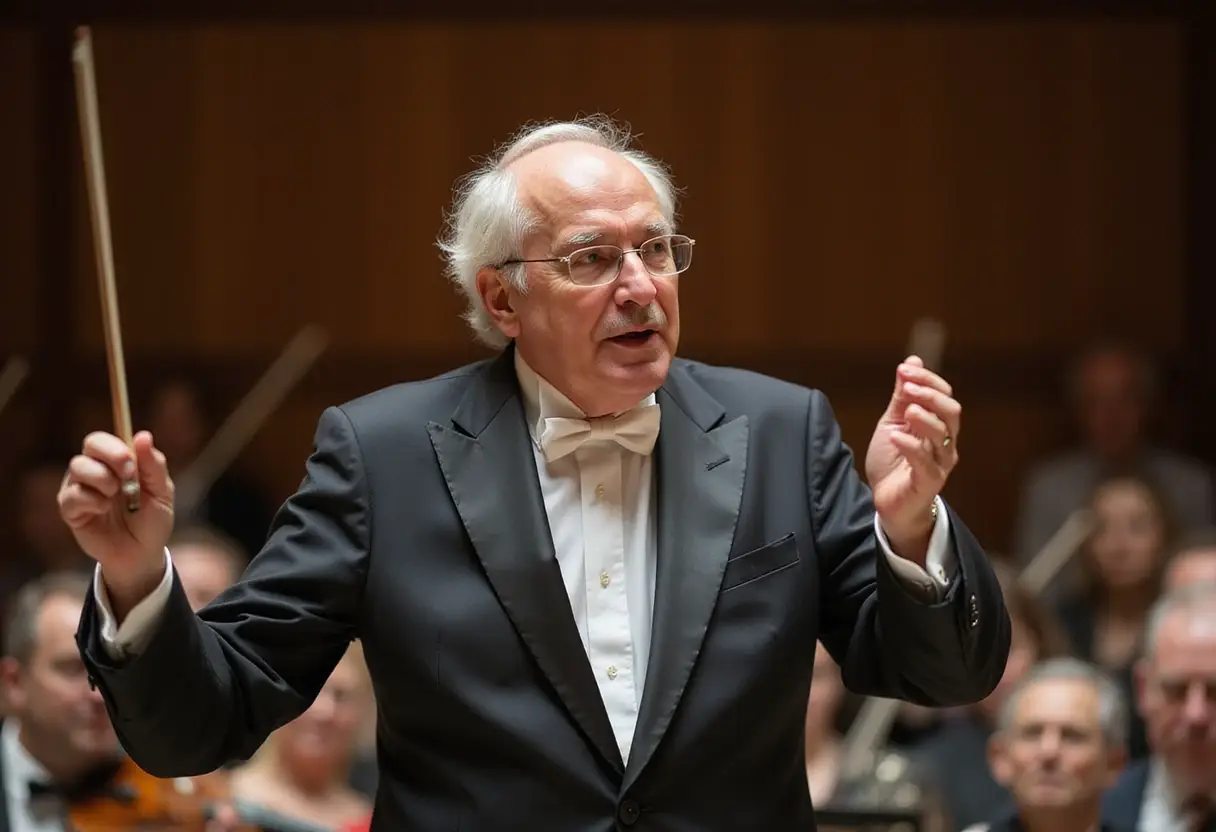
Jean Rondeau plays harpsichord in Ellicott City on November 21, 2026
Jean Rondeau plays Louis Couperin, Jean-Philippe Rameau, Francois Couperin and Pancrace Royer at First Lutheran Church in Ellicott City on November 21, 2026.

Programme
- Concert date and time: November 21, 2026, at 7:30 pm
- Venue: First Lutheran Church, 3604 Chatham Road, Ellicott City, MD 21042
- Program: Louis Couperin, Jean-Philippe Rameau, Francois Couperin and Pancrace Royer
- Competition: First Prize at the International Harpsichord Competition in Bruges in 2012, aged 21
- Training: Blandine Verlet in Paris, followed by the Guildhall School of Music and Drama in London
Marcus Bennett
Chamber Music of Maryland will present Jean Rondeau in a harpsichord concert at First Lutheran Church in Ellicott City on Saturday, November 21, 2026, at 7:30 pm. The event, titled “A Quick 5,” includes music by Louis Couperin, Jean-Philippe Rameau, Francois Couperin and Pancrace Royer.
At 21, Rondeau became one of the youngest performers ever to take First Prize at the International Harpsichord Competition in Bruges (MAfestival 2012), according to Chamber Music of Maryland’s profile. The profile traces his harpsichord study with Blandine Verlet at the Conservatoire National Supérieur de Musique in Paris.
He then trained in continuo, organ, piano, jazz, improvisation and conducting. He completed his musical education at the Guildhall School of Music and Drama in London.
The Washington Post called him “a master of his instrument and the sort of communicative gifts encountered in musicians twice his age.” In 2023, Gramophone wrote that Rondeau teaches us “what a flexible and expressive medium the harpsichord can be—perhaps more than any of us had realized before.”
Chamber Music of Maryland calls him a global ambassador for the instrument. Its profile says he combines “a profound respect for the past” with “boundary-pushing programming” and places him at the forefront of efforts to bring the harpsichord into the twenty-first century.
What will Maryland audiences hear?
A life divided between music and silence.
Rondeau described his working rhythm:
I was born in Paris, and for the past seven years I’ve been living in Brittany. I moved to New York last month, where I’ll be staying for the next six months.
My life is divided into two parts: periods devoted to music while I’m on tour, and periods entirely without music, when I neither play nor practice, in order to maintain a certain balance.
A first encounter.
Rondeau said:
I discovered the harpsichord at the age of five when I heard it on the radio. My first encounter was directly with the sound itself since the instrument wasn’t physically in front of me.
Without knowing what it looked like, who was playing, or even what music was being performed, I felt an immediate and profound connection with that sound.
Then, growing up in Paris, I had the privilege of taking harpsichord lessons from a very young age. A few years later, I began studying piano, organ, and composition, among other musical disciplines.
Since then, there has never really been a break in that journey, and the question of “becoming” a harpsichordist never really arose as such. Or rather, it has been a continuous question, but never in a hierarchical way.
A wider keyboard world.
Rondeau described a broad keyboard practice and called harpsichords his first focus. He explained his deliberate use of the plural:
I deliberately use the plural, because the variety of models and the long period over which the instrument evolved, spanning nearly three centuries from the 16th to the 18th century, require us as harpsichordists to develop the flexibility to move between instruments that can be remarkably different from one another.
He also said:
But I’ve also explored historical pianos and the modern piano, as well as organs, the clavichord, and even synthesizers.
A broad repertory.
Rondeau described the scope of the instrument’s writing:
What I love about the harpsichord repertoire is its extraordinary breadth, encompassing so many different styles and musical languages across those three centuries I mentioned earlier.
He noted that many composers wrote for the instrument, producing extensive bodies of work. Rondeau added:
So, I don’t think I have a particular preference, strictly speaking. Although I must admit that I feel a very special connection with the music of Louis Couperin.
Why audiences matter.
Rondeau made his case for hearing the harpsichord in person:
I think the harpsichord is an instrument that can speak to the intimacy of our emotions—to that hidden, almost clandestine space within us—through its delicacy.
It is also an unusual and sometimes intriguing instrument. Because it whispers rather than projects, it can invite a particular kind of listening, perhaps allowing us to enter a meditative state.
Chamber Music of Maryland lists the venue as First Lutheran Church, 3604 Chatham Road, Ellicott City, MD 21042, and directs attendees online for tickets and information. Maryland audiences will hear the four-composer program and Rondeau’s account of what the instrument can do. On November 21, his case will be concrete: a flexible and expressive medium that can speak to intimate emotion, whisper rather than project and invite meditative listening.
Source: mdtheatreguide.com
More from Marcus Bennett
Show full bio
Staff writer covering people, launches and day-to-day practice in arts in the broadest sense at Arts & Voices.
1,135 articles