Le Large Opens on Île Seguin, Paris, in a Former Renault Factory
Le Large, a new contemporary art center by RCR Arquitectes, opens on Île Seguin with Cecilia Alemani's 'Moteur Imaginaire' — 100+ works on the island's Renault past.
Programme
- Le Large opened on Île Seguin, Boulogne-Billancourt, as part of the €450 million ($504.5 million) Pointe des Arts development.
- The building, by Pritzker Prize–winning RCR Arquitectes, offers 26,910 square feet of exhibition space; about 40 percent of public areas are free.
- Inaugural show 'Moteur Imaginaire,' curated by Cecilia Alemani (2022 Venice Biennale), presents 100+ works by 55 artists from 23 countries.
- The exhibition includes 50 pieces from the Renault collection and 17 new commissions.
- Annual operating budget is estimated at €5 million ($5.6 million); the center is backed by collector Laurent Dumas's Emerige Endowment Fund.
By Daniel Okafor
A new contemporary art center has opened on Île Seguin, the former Renault factory island in Boulogne-Billancourt, west of Paris. Le Large anchors Pointe des Arts, a €450 million ($504.5 million) cultural development that also includes a cinema and a hotel.
The journey is part of the proposition. Visitors take Métro Line 9 to Pont de Sèvres, then walk 15 minutes or ride a five-minute bus. The reward is a site ringed by water, with views toward the Seine and the hills of Meudon. For much of the 20th century, Renault's factory stood here, employing thousands and shipping cars out by road and river.
The building itself makes a statement. Pritzker Prize–winning RCR Arquitectes designed a structure whose footprint widens from 5,382 square feet at the base to 16,146 square feet on the fifth floor. Its copper-colored anodized-aluminum façade (a metal finish that resists corrosion) is clad in diamond-shaped elements arranged like overlapping scales. The name is the point: in French, prendre le large means to head out to sea.
"The expression resonates with the island setting and its relationship to the water. It conveys the possibility of escape, departure, and discovery," director Paula Aisemberg told ARTnews in an on-site interview ahead of the opening.
What will Le Large actually show?
No permanent collection. No vanity museum for a collector's holdings. Le Large will run a changing program of temporary exhibitions across its 26,910 square feet of gallery space, on an annual operating budget estimated at €5 million ($5.6 million). Sometimes one show will take the whole building. Other times, several will run at once.
"Several shows running simultaneously, one on the fifth floor, another across the sixth and seventh floors. That will be the case for our second season," Aisemberg said.
The center wants crowds, not just connoisseurs. Around 40 percent of its public-facing spaces are free to enter. The sun-drenched first-floor lobby offers ample seating for extended conversations. A bookshop and concept store sit beside a staircase that doubles as amphitheater-style seating. On the fifth floor, before any gallery, visitors find two spaces by designer Constance Guisset: Extra Large, an 80-seat coffee shop with panoramic views, and Le Petit Atelier, free workshops for children aged six to ten.
Who pays for it?
Le Large runs on a hybrid model: a nonprofit association with an endowment fund, plus a commercial entity handling venue rentals and private events. Collector Laurent Dumas chairs the association, which manages all of Pointe des Arts with a mission to promote French artistic creation. The main patron is the Emerige Endowment Fund, the philanthropic arm of Dumas's company, Emerige — a patron whose earlier projects include a grant for emerging artists and the commissioning program 1 immeuble, 1 oeuvre (1 Building, 1 Artwork).
Comparisons will come, inevitably, with Paris's other collector-founded museums: Bernard Arnault's Fondation Louis Vuitton and François Pinault's Bourse de Commerce. Architecturally, Le Large shares the Fondation's purpose-built DNA, while the Bourse de Commerce retrofits a historic building with interventions by Tadao Ando. Curatorially, Le Large is the wild card. Its long-term direction remains to be established.
What is 'Moteur Imaginaire'?
The inaugural show, "Moteur Imaginaire" (Imaginary Engine), pulls out all the stops. Cecilia Alemani — director and chief curator of High Line Art in New York, curator of the 2022 Venice Biennale — has assembled more than 100 works by 55 artists from 23 countries, dating from the 1930s to the present.
"[The display] follows the car on an imaginary journey, from the factory floor to the assembly line, out into the world as an object of desire, and finally into the algorithm," Alemani told ARTnews. "That metamorphosis, from mechanism to living organism, is what drives the whole exhibition."
The exhibition draws on Renault's industrial past. The car maker's Art, Research and Industry program once invited artists into its factories; Jean Dubuffet, Arman, Jean Tinguely and Victor Vasarely participated. Fifty pieces from the Renault collection appear alongside historical photographs and archival material documenting the factory and its workers. "We felt it was essential to acknowledge that history," Aisemberg said.
French designer Pascal Rodriguez conceived the layout: four successive spaces, separated by partition walls pierced by large circular openings aligned on a single axis — a perspective that mimics assembly-line logic. "You feel as though you're inside a machine, a car park, a tunnel, or perhaps inside an engine cylinder," Aisemberg explained.
Added Alemani: "For almost a century, the Île Seguin was home to the Renault factory, a fortress of production that turned out some 30 million cars: a machine for making machines. I wanted the exhibition to work the same way, as an assembly line for machines and for ideas."
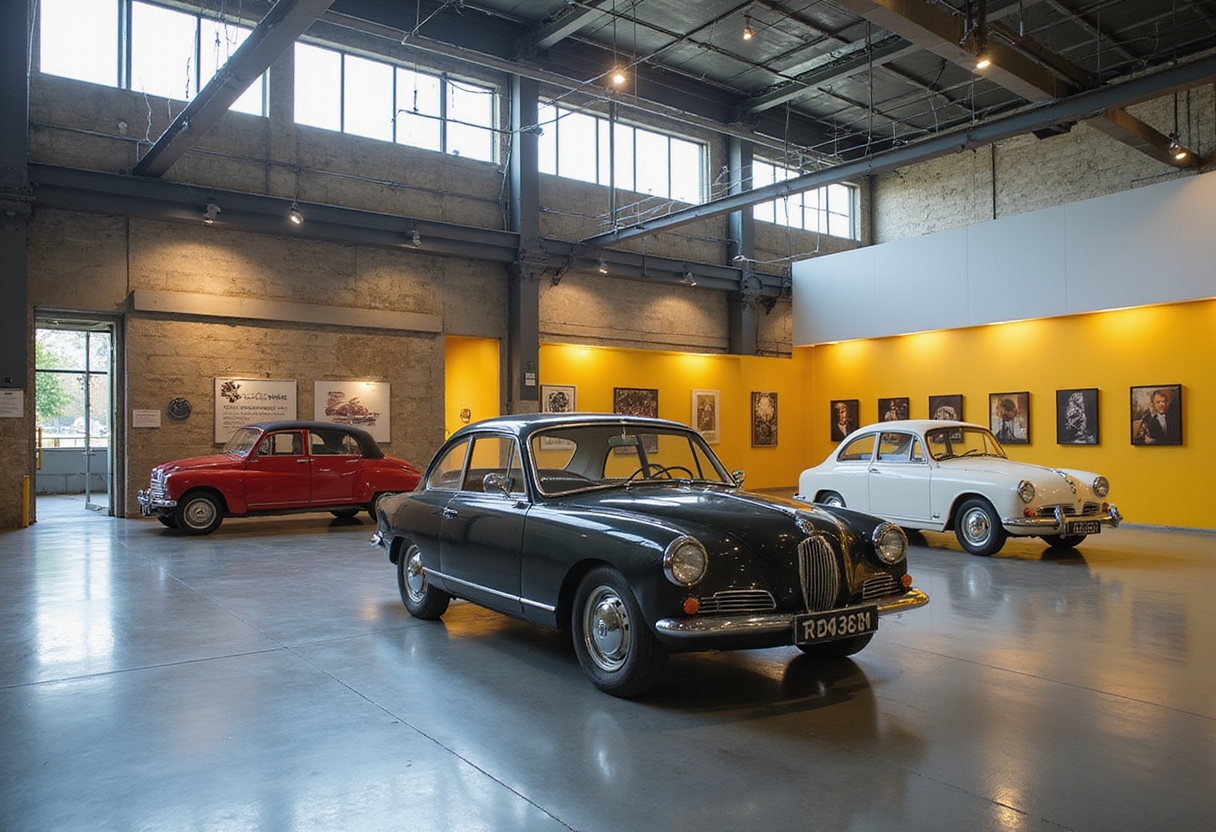
At each circular opening sits a car. The first is an 1898 Renault automobile transformed by Ghanaian artist Paa Joe Junior into a painted wooden palanquin, from Dumas's collection. Next comes Arman's intervention on a life-size wooden model of a Renault 10, which the artist cut into fragments and arranged in Plexiglas boxes.
Mohamed El Khatib's Renault 12, loaded with suitcases, documents and cassette tapes, recalls immigrant families driving from France to the Maghreb for summer holidays from the 1970s to the '90s. Bertrand Lavier contributed a Formula One Renault repainted in his signature thick brushstrokes.
Nearly half the included artists live in France. "Curating it was a wonderful opportunity to get to know the French art scene more closely," Alemani said, citing Sara Sadik, Randa Maroufi, Mohamed Bourouissa, Valentin Ranger, Romuald Jandolo and Bertille Bak. Some artists found personal ties: "Johanna Benaïnous learned that her grandfather had worked on the island," Alemani said. "I met a generation that treats history as living matter. They went into the archives, sat with former workers, and came back with pieces that are urgent, tender, and very much their own."
The show includes 17 new commissions. Clément Cogitore's film Untitled (2026) revisits the 1947 Renault factory strike through a nearly motionless scene of a woman knitting beside a stationary assembly line. Zhenya Machneva's tapestry depicts the engine of her grandfather's Renault Kangoo. "Woven on a manual loom, the work brings personal memory into dialogue with industrial history," Aisemberg said. "Its painstaking technique offers a deliberate contrast to the speed and efficiency of mechanized production."
"Opening a new institution is always rare, and doing it on an island so charged with memory is a real privilege," Alemani said. "The Renault factory was dismantled long ago, and today a brand-new building rises in its place, open to everyone. Le Large gives this extraordinary site back to the public, and 'Moteur Imaginaire' brings its stories back to life."
Source: ARTnews
More from Daniel Okafor
Show full bio
News editor covering companies, deals and strategy in arts in the broadest sense at Arts & Voices.
488 articles