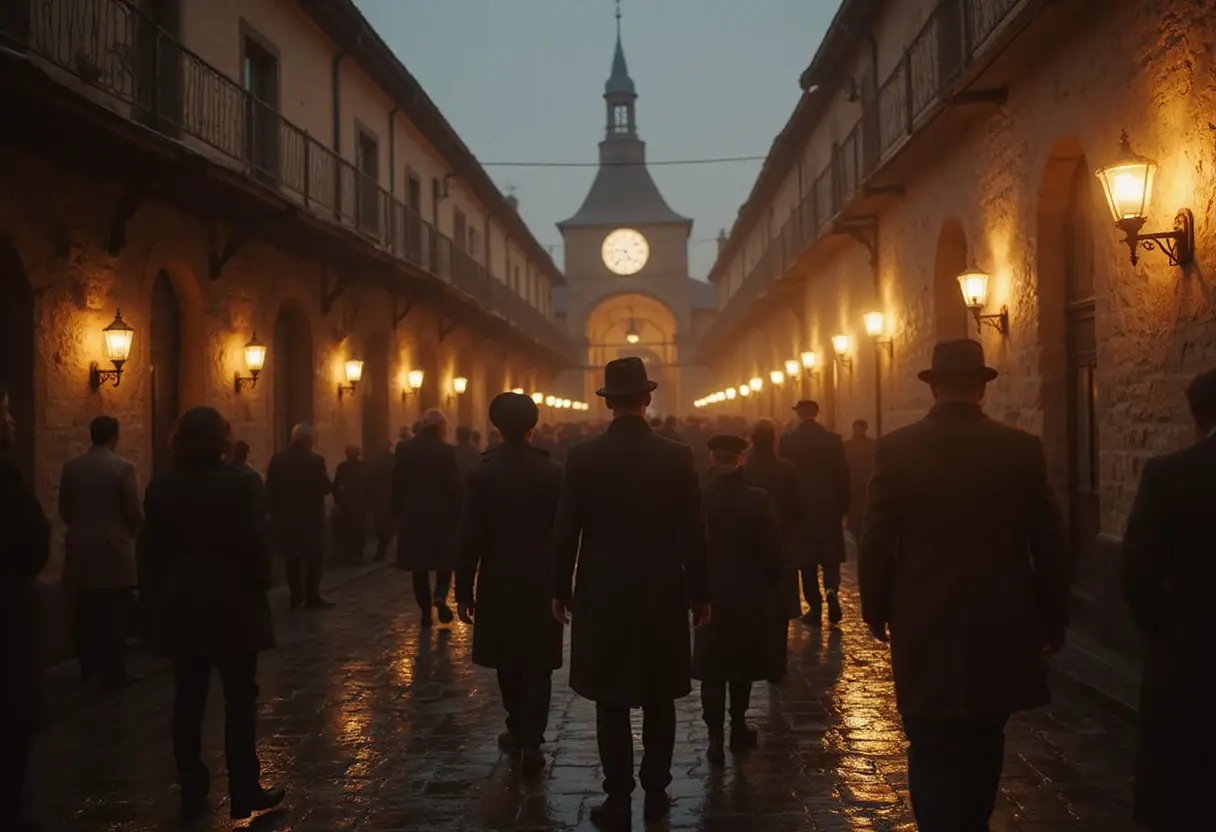
Milo Rau Buries Wagner's Dutchman Under Politics at Deutsche Oper Berlin
Milo Rau's 'Der fliegende Holländer' at Deutsche Oper Berlin turns Wagner into a multimedia lecture on German guilt, Israel and 1972 Munich. The opera barely survives.

Programme
- Milo Rau's production of 'Der fliegende Holländer' premiered at Deutsche Oper Berlin in the 2026-27 season.
- Act two restages the 1972 Munich Olympics massacre; act three depicts the 2005 inauguration of Berlin's Holocaust Memorial.
- Tomasz Konieczny, indisposed, stopped singing mid-duet; Derek Welton took over the Dutchman's vocal part from the side of the stage.
- Giedrė Šlekytė made her Wagner debut conducting the Deutsche Oper Berlin orchestra.
- Four police minivans and bag searches were deployed outside the premiere.
By Elena Vasquez
Swiss director Milo Rau's new production of Wagner's "Der fliegende Holländer" at the Deutsche Oper Berlin has staged the Dutchman's curse as a trajectory of German history, running from the Holocaust through the 1972 Munich Olympics to the contemporary Israeli-Palestinian conflict. The premiere ended in a predictable mixture of boos and applause. The opera itself, critics of the staging will note, all but disappeared.
Rau's framework is concrete. The Dutchman embodies Germany's unredeemed guilt for the Holocaust. Senta represents Israel, whose forgiveness might release Germany from its burden. Erik figures a Palestinian outsider, and Daland acquires the attributes of Israel's founding generation.
What does the production actually show?
The first act sets the Dutchman's arrival during the period of German-Israeli diplomatic rapprochement. He wears a black leather coat and military-style cap. His treasure arrives in crates bearing the names of German industrial companies, including BASF and Degussa.
The second act relocates the spinning room to the 1972 Munich Olympics massacre, with women in Israeli Olympic uniforms, a flag-waving Mary and projected hostage-taking testimony. The third act shifts to the 2005 inauguration of Berlin's Holocaust Memorial, where Anton Lukas's set finally materializes as monumental stone blocks recalling the Memorial to the Murdered Jews of Europe. Moritz von Dungern's projections mix images of persecution and death with banal footage of modern airport terminals and shopping areas.
Rau supplements this with documentary material filmed during a roadtrip through Israel, where he and collaborators brought Wagner's music into public spaces. Two Israeli performers, Sarah von Schwarze and Shlomi Moto Wagner, appear as narrators recounting purported personal histories. These film testimonies, the review notes, prove more interesting than the allegorical figures on stage.
The review's central charge: "Rau appears to confuse the recognition of a symbol with the development of an argument." Singers receive scarcely any direction, left to gesture downstage while captions supply their motivations. One moment genuinely converges — the Dutchman singing of being denied a grave amid the memorial's stone blocks — when, briefly, "Wagner illuminates an idea rather than merely accompanies it."
Rau's premise has intellectual grounding. Wagner himself associated the Dutchman with Ahasuerus, the Wandering Jew of Christian antisemitic legend. Given the composer's own antisemitism and the Nazi appropriation of his music, the review concedes an investigation of historical responsibility "might even yield genuine insights." But the production forecloses its own drama: in the conclusion, Mary shoots Erik, Senta takes her own life, and the Dutchman remains condemned. Redemption is denied before the story begins.
How did the musical forces fare?
Giedrė Šlekytė, making her Wagner debut, drew passages of beauty from the excellent Deutsche Oper Berlin orchestra, but the reading lacked sustained tension; climaxes became accumulated volume, and the orchestra often seemed reduced to a soundtrack.
The vocal evening turned extraordinary mid-performance. Tomasz Konieczny, audibly indisposed as the Dutchman, was unable to continue singing during the main duet with Senta. Derek Welton took over the vocal part from the side of the stage while Konieczny continued acting. Welton's vocal authority earned an enthusiastic reception.
Aušrinė Stundytė, in her role debut as Senta, struggled with a pressured upper register and unstable intonation; her Ballad, the opera's dramatic center, never acquired the hypnotic intensity the character demands. Kai Rüütel-Pajula asserted herself at the head of the Israeli Olympic delegation. Tareq Nazmi brought imposing authority to Daland despite signs of strain. Attilio Glaser offered a secure, engaged Erik; Omar Mancini's lightweight Steuermann vanished beneath the visuals.
The chorus, prepared by Marco Medved, delivered the outstanding musical contribution, restoring theatrical electricity in the sailors' music.
What lies behind the security?
Outside the hall, the management had posted four police minivans and conducted handbag searches — precaution against unrest, or, as the review asks, "was this all just a marketing ploy?"
The production's real failure, the review concludes, is not politicization but reduction: history and music both become components of a predetermined thesis, "delivered with the raised finger of indignation and guilt." How remembrance might become responsibility without instrumentalizing others' suffering receives little exploration — the question that might have made this staging matter.
Source: Opera Wire
More from Elena Vasquez
Show full bio
Senior reporter covering technology and product news in arts in the broadest sense at Arts & Voices.
823 articles