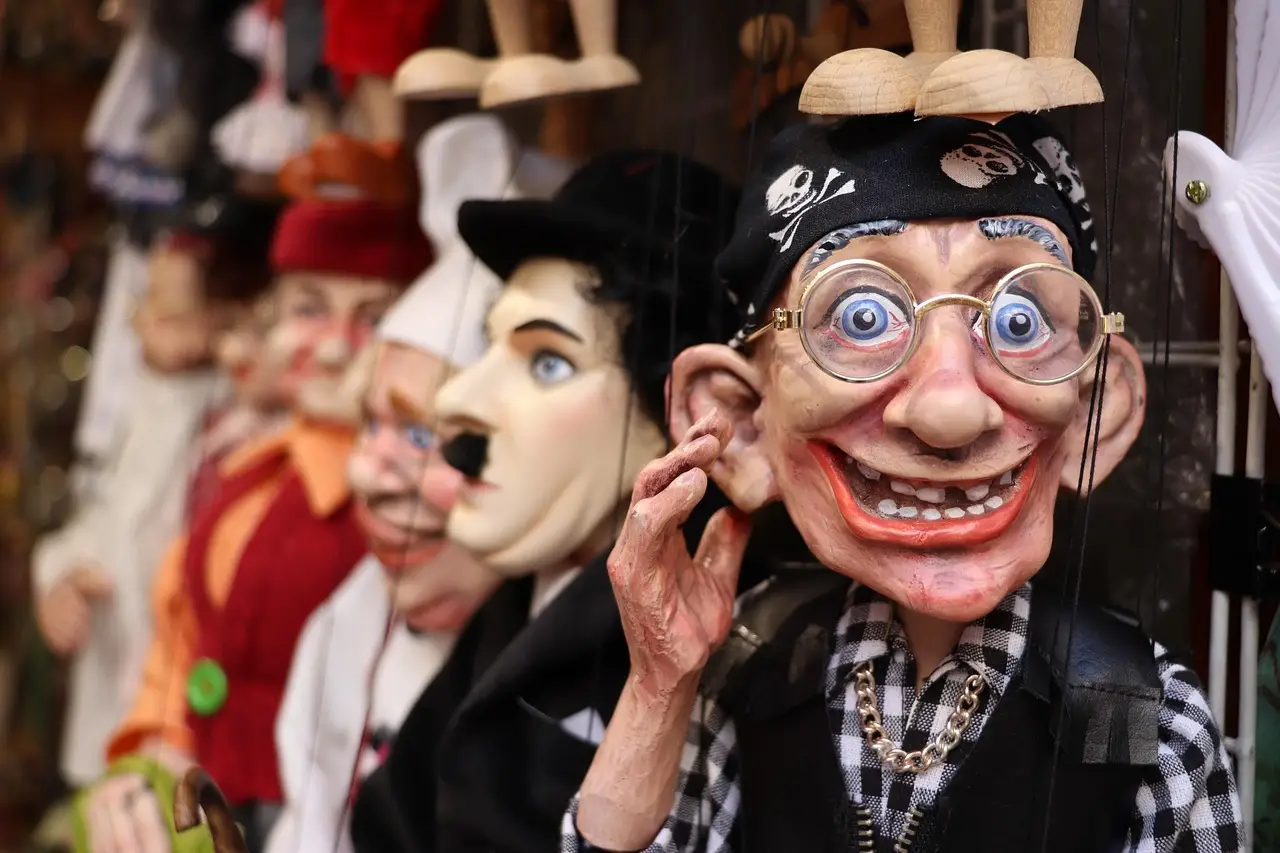
Peter Fluck, Spitting Image co-creator, dies aged 85
Peter Fluck, who died aged 85, shaped the satirical puppets of Spitting Image with Roger Law, turning photographic sketches and clay models into wire-operated foam-latex heads.
Programme
- Peter Fluck died aged 85; he and Roger Law formed Fluck & Law.
- Spitting Image ran on ITV from 1984 to 1996.
- The puppet show won International Emmy awards in 1985 and 1986.
- Its audience fell from 15 million to 6 million by 1996.
- Fluck & Law formalised their partnership in 1976.
By Daniel Okafor
Peter Fluck, who co-created Spitting Image, died aged 85. With Roger Law, he formed Fluck & Law, the partnership that revived television satire with ITV’s Spitting Image. The pair lampooned celebrities, politicians and the royal family with unusually disciplined spite.
Spitting Image ran from 1984 to 1996. It arrived two decades after the BBC’s That Was the Week That Was spoofed the British establishment and, in particular, Harold Macmillan’s final days as Conservative prime minister during the John Profumo affair. The new show found another stretch of Tory rule rich in distinctive characters.
How did Fluck and Law build their puppets?
Each likeness began with Fluck’s drawing from photographs, continued through a clay head sculpted by the pair, and ended as a puppet in foam latex (a moulded casting material), based on a recognisable caricature. The pair worked like a two-stage portrait studio: Fluck supplied the likeness on paper, while Law translated it into clay.
The heads were cast in foam latex. Their bodies were mostly foam too. Wires, rods and cables devised by Fluck operated the facial features before the camera.
Fluck said:
“I’m quicker when it comes to putting a likeness down on paper, but Roger Law is faster at breaking down a likeness in clay than I am.”
He added:
“We kept turning the clay mould around on the board, switching it between us until we suddenly decided it was finished.”
They met as students at the end of the 1950s at Cambridge School of Art, now Anglia Ruskin University. Their part-time tutor was Paul Hogarth, an “artist-reporter” (an artist who reported events through pictures). His paintings and illustrations recorded the Spanish civil war, apartheid South Africa and other countries on his travels. Hogarth inspired their interest in political caricature.
First came grotesque plasticine (modelling clay) models of public figures, photographed for the Economist, Sunday Times Magazine and others. In 1981, graphic designer and branding expert Martin Lambie-Nairn approached them to bring the characters to television. Fluck and Law decided puppets would do the job.
John Lloyd, after producing the BBC’s live-action satirical sketch show Not the Nine O’Clock News, helped pitch the project, originally titled Spit N Image. LWT, Thames Television, the BBC and Channel 4 all declined it. ITV company Central Independent Television then took it on.
With Lloyd as producer, Spitting Image launched. The start was shaky, but the show found its audience. It won International Emmy awards in 1985 and 1986, two years running. The Emmy statistics were neat. The audience statistics were not.
Production was expensive. By 1996, the audience had fallen from 15 million to 6 million. ITV axed the show.
What did the puppets make possible?
The targets arrived with their own wardrobes and defects, while the production treated caricature as a form of editorial criticism rather than mere celebrity decoration.
- Margaret Thatcher was domineering, aggressive and, as time went on, increasingly tyrannical, verging on madness.
- Norman Tebbit became a tough thug in a leather jacket. Geoffrey Howe was dull. Nigel Lawson was incompetent and a panicker.
- Cecil Parkinson was a playboy. Douglas Hurd received a “Mr Whippy hairstyle”.
- John Major, who succeeded Thatcher as prime minister, was colourless and dull. He ate peas, and the puppet was physically painted grey all over.
- Opposition leaders Neil Kinnock and David Steel were treated just as cruelly. Ronald Reagan looked genial, elderly and dangerous. The celebrity roster was all-embracing, from Mick Jagger and Ian Botham to Rupert Murdoch and Laurence Olivier.
- The royal family caused early controversy. The Queen Mother was gin-soaked. Queen Elizabeth II always wore a tiara, even under her headscarf.
What came after the hit?
Fluck was born in Cambridge to Ada (née Hughes) and Herbert Fluck, a gardener at Magdalene College. He grew up birdwatching and drawing stuffed birds at the university’s Museum of Zoology.
At 16, he left Cambridgeshire high school for boys with “four rather miserable O-levels” (secondary-school qualifications). He began at Cambridge School of Art. Hogarth guided Fluck and Law “into the politicised 1960s”. They marched with the Campaign for Nuclear Disarmament (CND), designing pamphlets and making woodcuts for its promotional material.
They moved to London and became freelance illustrators. Fluck supplemented his income by teaching at Hornsey, now part of Middlesex University, and Colchester schools of art.
They then made two-dimensional and three-dimensional plasticine models. Private Eye, the New Statesman, glossy magazines and newspaper colour supplements photographed them. Their work also appeared in Stern and Der Spiegel in Germany, and Time and the New York Times in the US.
In 1976, they formalised their partnership as Fluck & Law. Working from a defunct temperance mission hall in Cambridge, they produced a Radio Times front cover of an “all-American family”, including a dog, engrossed watching television. The image promoted programmes marking the American bicentennial.
After Spitting Image, Fluck returned to full-time art and sculpture. He moved to Cornwall, living in a cliff-top house in a fishing village. He worked and exhibited as an artist, making mobiles (hanging, moving sculptures), ceramics, interactive installations and sculptural pieces.
He showed no interest in joining a Spitting Image revival for BritBox, the joint ITV-BBC subscription channel, in 2020. Law returned to lead the creative team.
Fluck married Anne-Cécile de Bruyne in 1963. She and their son and daughter survive him.
Law’s return as creative lead for BritBox in 2020 left a measurable challenge: reversing the old slide from 15 million viewers to 6 million.
Source: theguardian.com
More from Daniel Okafor
Show full bio
News editor covering companies, deals and strategy in arts in the broadest sense at Arts & Voices.
1,668 articles